The convergence of global retirement savings and the financing of artificial intelligence infrastructure constitutes a systemic risk arising from long-term capital commitments financing technology assets with shorter economic lifespans, through opaque off-balance-sheet vehicles, private credit, and securitizations.
As of October 26, 2026, BlackRock manages $15.488 trillion in assets, compared with $11.6 trillion a year earlier, representing year-over-year growth of 15.5% and record net inflows of +$205.46 billion in the third quarter. Vanguard manages approximately $12 trillion, including $4.39 trillion in US ETFs. According to the European Central Bank, a severe AI-related private credit shock would result in losses equivalent to 5–6% of euro area pension funds’ assets and approximately 4% for insurers. UniSuper, with AUD 166 billion in assets, remains overweight in US technology stocks and plans to buy following a 10% correction. In Australia, 5.5% of household financial wealth is exposed to AI-related equities, primarily through pension funds, and nearly 90% of this exposure is overseas.
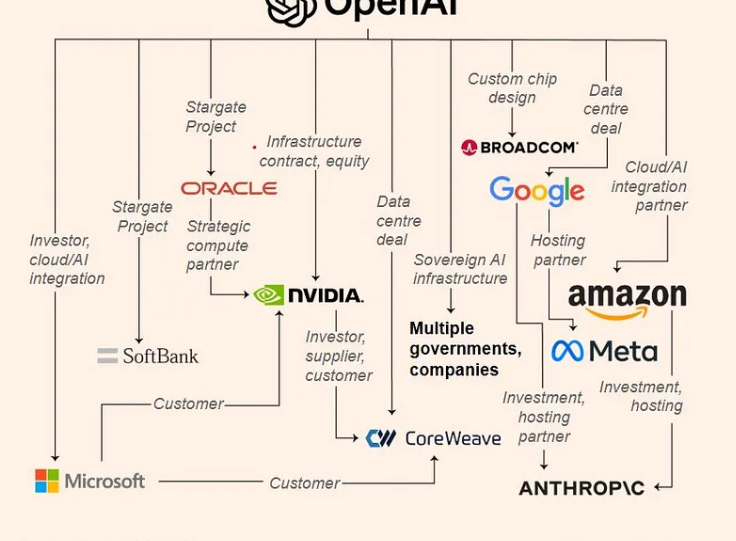
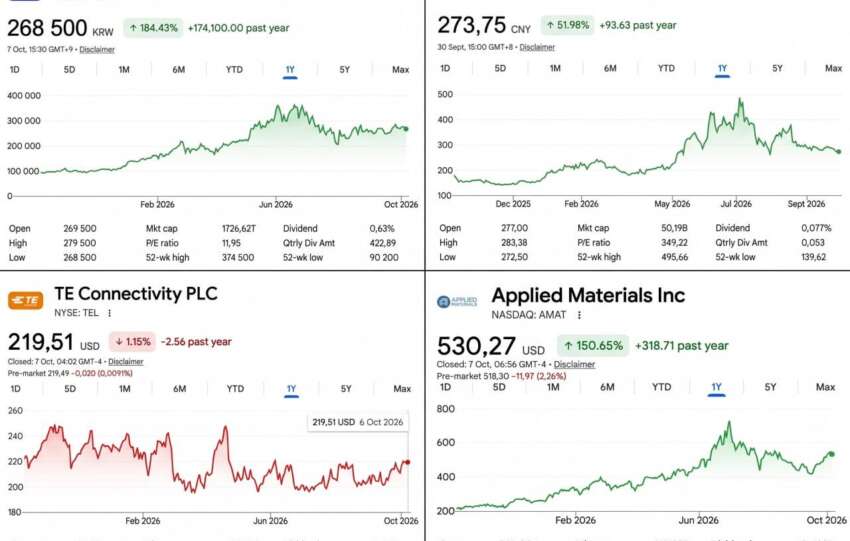
Pension funds’ index allocations mechanically finance hyperscalers and semiconductor suppliers, while insiders are massively selling their shares at market peaks. This dependence on a handful of counterparties, particularly OpenAI, can turn an isolated shock into a systemic crisis. The risk peaks between the current construction phase and the realization of returns on investment, within an estimated window of 2–4 quarters before refinancing constraints become dominant, barring another liquidity shock.
I. SYSTEM MAPPING: FROM RETIREMENT SAVINGS TO AI INFRASTRUCTURE
1. The index channel: default allocation as a vector of concentration
Index diversification, long considered a safeguard against idiosyncratic risk, is being called into question by the current concentration of the S&P 500 in large US companies associated with AI. Replicating this index therefore amounts to concentrating exposure on hyperscalers’ ability to monetize AI.
According to Morgan Stanley and Goldman Sachs, companies linked to AI infrastructure account for approximately 40% of the S&P 500’s total market capitalization. AI-related issuances account for nearly half of Investment Grade issuance volume, while 87% of venture capital flows go to AI-related companies. Index funds mechanically inherit this concentration.
In Australia, UniSuper for Advisers acknowledges that its AI exposure stems from its index-based strategies. According to MFS Investment Management, Australian pension funds thus represent a major global bet on AI, driven more by indices than by conviction. The Your Future Your Super test limits deviations from benchmark indices and locks in this exposure.
The Reserve Bank of Australia estimates that approximately 5.5% of household financial wealth is invested in AI-related stocks, primarily through superannuation, and that almost 90% of this exposure concerns foreign companies. A 20% correction in these stocks would reduce Australian household spending by approximately 2.5%.
2. The Private Credit Channel: Pension Funds’ Hidden Exposure
Private credit is a channel through which pension funds gain exposure to AI financing, beyond equities. In May 2026, the ECB ( Banque centrale européenne ) warned that the rapid growth of these exposures and disappointing expected cash flows could heighten credit risks and financial stress in the euro area. In a severe shock scenario, losses would reach 5 to 6% of pension funds’ total assets, compared with around 4% for insurers and 1.3% of banks’ equity capital.
At the end of 2024, the US private credit market stood at approximately $1,400 billion, compared with $1,500 billion for subprime loans in 2008. Despite lower leverage and predominantly long-term financing, the risk of mass withdrawals persists: Blue Owl and BCRED ( Blackstone ) have already had to activate gates in response to redemption requests worth several billion dollars.
3. The Securitization of AI Cash Flows and Financial Risks
The securitization of AI cash flows transfers risks opaquely to retirement savings. Issuances of asset-backed securities (ABS) backed by data centers rose from $2.4 billion in 2020 to $15.5 billion in 2025, with a new record expected in 2026. CharlesRiver Advisors, LLC forecasts more than $14 billion in annual issuances in 2026, while Morgan Stanley projects $120–150 billion over 2026–2027.
In October 2026, the first ABS backed by GPU loans emerged. Stonebriar Commercial Finance launched an issuance of approximately $869 million, with 15% of the collateral consisting of loans linked to AI chips. This securitization transforms GPUs, whose resale value falls by 30–70% within two years, into securities held, among others, by pension funds.
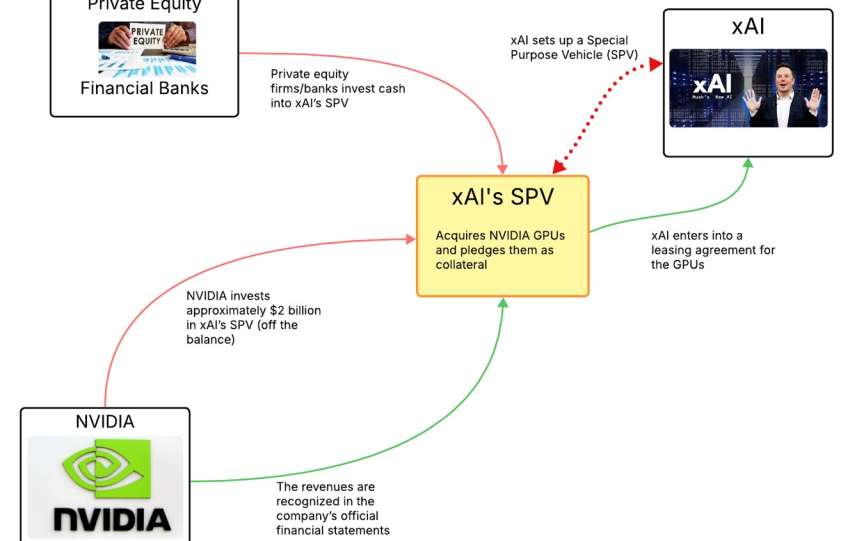
A special purpose vehicle (SPV) acquires the GPUs, leases them to a neocloud provider, and repays its debt using rental income. Nvidia may guarantee a residual value or purchase capacity, altering credit risk without this put option being valued or recognized in its public financial statements. This “missing premium” supports liquidity but makes the system more fragile in the event of a downturn.