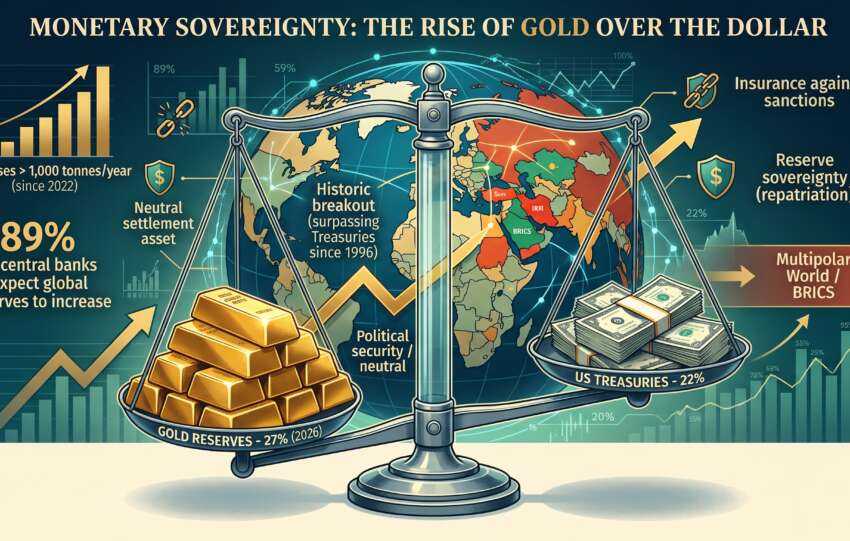
Gold was indeed a high-Sharpe asset during certain windows from 2025 to early 2026, and long-term bonds did under perform. However, as of September 7, 2026, gold does not "beat tech stocks" over 12 months. NVDA and the S&P have higher TTM returns than those shown in the table.
The illustrative recalibration (TTM window,…
Oil prices surged sharply after the US announced new strikes on southern Iran. Brent crude exceeded $92 per barrel, while WTI approached $90. Yields on 30-year Japanese government bonds (JGBs) surpassed 4.18%, and Nvidia exited the corporate bond market. How does this affect gold? Several explosions were reported near Bandar Abbas, Qeshm, and the Strait…
The Financial Times reports a marked shift among wealthy investors toward direct ownership of physical gold and secure, individually allocated storage. In 2026, purchases by this group have surged to record levels, signaling a retreat from electronic exposure in favor of tangible assets.
Industry observers highlight capacity constraints across premier vault facilities. London dealer Sharps…
The defining shift in digital assets this decade is not a price level. It is a change in structure: from instruments whose value rests on uncertain future appreciation to instruments whose value is delivered through continuous, automated cash flows, rent, interest, coupons, distributed by code. The RWA market has quietly completed this migration in 2026,…
The dominant factor in September is not an endogenous crypto narrative but a regime of real rates and geopolitical energy premiums.
US 10-year yields hit ~4.76-4.78%, the highest since January 2025, while the #DXY traded around 99.45-99.50.
Oil prices (WTI ~$86.5) reacted to US-Iran tensions and the Strait of Hormuz.
The Fed funds target is…
The market has exited the capitulation phase of June 2026, where BTC fell below $60k, driven by ETF creations and short squeezes pushing prices to ~$81.3k, though this does not confirm a sustained bullish cycle. Three simultaneous frictions are identified: a BTC supply wall between $81k-$86k, a potential 25bp hike at the September FOMC meeting…
Bitcoin surged to $76,800-$77,600, gaining 6-8% in 24 hours and 20% for the week. The market saw over $4 billion in 24-hour liquidations, marking the most violent short squeeze of 2026. Combined BTC/ETH ETF inflows exceeded $800 million, indicating massive institutional entries. The funding rate shifted from negative to positive, signaling a return of long…
Price is the last indicator to move
The stablecoin market has reached a new milestone: over $315 billion in total market capitalization, serving as the backbone of on-chain settlements, with adoption now extending far beyond the crypto ecosystem alone cross-border payments, corporate treasuries, and collateral for tokenized finance. Yet a massive, under-discussed anomaly persists:…
The stablecoin market has crossed a symbolic threshold: a market capitalization of over $315 billion. What was, five years ago, a niche tool for crypto traders has become a cash management infrastructure, for funds, fintechs, corporations, and soon, under the effect of the MiCA regulation, for regulated European institutions. Yet the fundamental question remains unchanged:…
The numbers, first. Tokenized real-world assets crossed $30 billion in early 2026, a 300% year-on-year increase : US Treasury debt ($10.7bn), commodities ($5.1bn), private credit ($2.9bn), institutional alternative funds ($2.2bn) leading the mix. Measured against what is coming, $30bn is a rounding error. The 2030 forecasts, by institution:
Source2030+ forecastScope noteMcKinsey~$2tnExcludes crypto, stablecoins, deposits,…
Analyse de marché
ESG Data Services