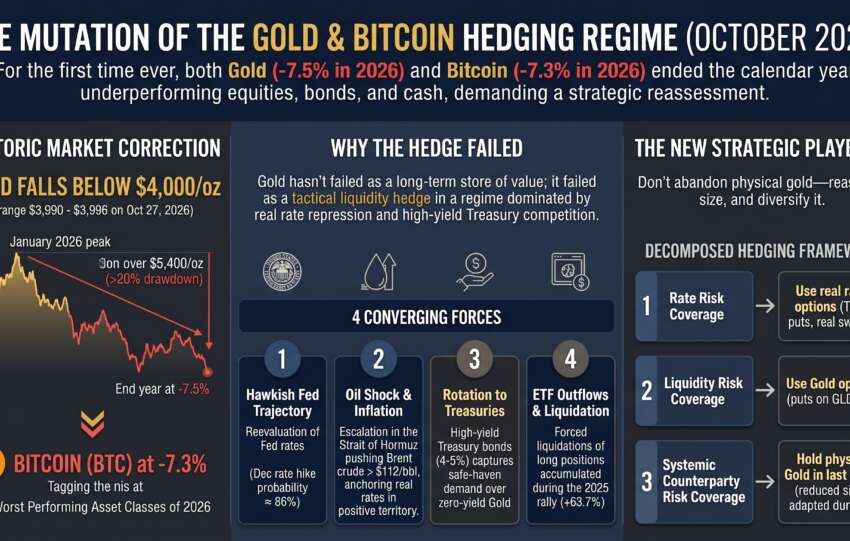
Gold fell below USD 4,000/oz (USD 3,990–3,996 on October 27), declining by more than 20% from its January 2026 all-time high (above USD 5,400) and ending 2026 down 7.5%, alongside Bitcoin (-7.3%), with both assets ranking last among major asset classes.
This configuration is historically unprecedented: it is the first time a calendar year has…
The convergence of global retirement savings and the financing of artificial intelligence infrastructure constitutes a systemic risk arising from long-term capital commitments financing technology assets with shorter economic lifespans, through opaque off-balance-sheet vehicles, private credit, and securitizations.
As of October 26, 2026, BlackRock manages $15.488 trillion in assets, compared with $11.6 trillion a year earlier,…
Thesis. The 2024/2026 cycle has transformed compliance from a cost center into a competitive moat. In Europe, the crypto market has become license only (the end of MiCA grandfathering on July 1, 2026); in the United States, the securities/commodities boundary is being established by the CLARITY Act (§10505, Senate vote on September 15, 2026). For…
The week of August 19 25, 2026 will be remembered as the moment tokenized equities stopped being a roadmap slide and became a product. Coinbase listed tokenized Apple, Nvidia, Meta and Alphabet shares on Base using its purpose-built B20 standard, backed 1:1 by shares in ADGM regulated custody, with Chainlink providing pricing and roughly fifty…
The 2024–2026 AI cycle is the largest fixed-capital investment cycle in modern economic history. The market question is no longer “Will AI transform the economy?” but “Who bears the capex risk, and at what rate of return?” Humanoid robotics and converging technologies (MANBRIC: Metaverse-AI-Nano-Bio-Robotics-Info-Cognition, the extended NBIC family) are derivatives of this cycle: real bets…
Europe carried out the largest ESG regulatory simplification since the adoption of the CSRD in 2025-2026: the scope of mandatory reporting contracted (~50,000 → ~5,000 companies), but the requirement for granular data did not disappear, it shifted toward voluntary disclosure, the value chain, and sustainable finance. Strategic paradox: fewer obligations = greater value for credible…
The 2024-2026 cycle has transformed compliance from a cost center into a competitive moat. In Europe, the crypto market has become license-only (the end of MiCA grandfathering on July 1, 2026); in the United States, the securities/commodities boundary is being defined by the CLARITY Act (§10505, Senate vote on September 15, 2026). For DAOs, the…
2025–2026 is the point at which programmable money moved from experimentation to regulated infrastructure. Three layers are converging: private stablecoins (GENIUS Act/MiCA), wholesale CBDCs (Agora, mBridge), and a common data grammar (ISO 20022 as the exclusive standard since November 2025). The dollar is being “privatized and programmed” abroad while Europe is building regulatory monetary sovereignty:…
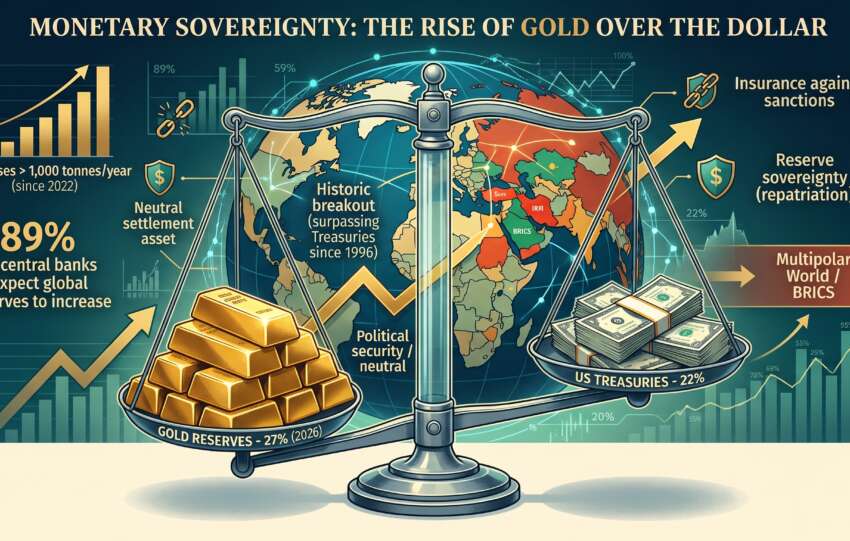
Central banks’ accumulation of gold reflects a structural shift in the monetary system: gold is becoming a strategic reserve and settlement asset, beyond its traditional hedging function. According to the World Gold Council, 89% of central banks expect global gold reserves to increase over the next 12 months, and 45% plan to increase their own…
Technological revolutions are not equal as investment themes; they are equal as cost curves. Three curves are collapsing simultaneously in 2026-2030, the cost of AI inference, the cost of physical action (humanoid robotics and logistics), and the cost of biological reading/writing (sequencing, synthesis), and their intersection is creating the markets of the decade: instrumented smart…
Analyse de marché