https://www.steelldy-indices.com
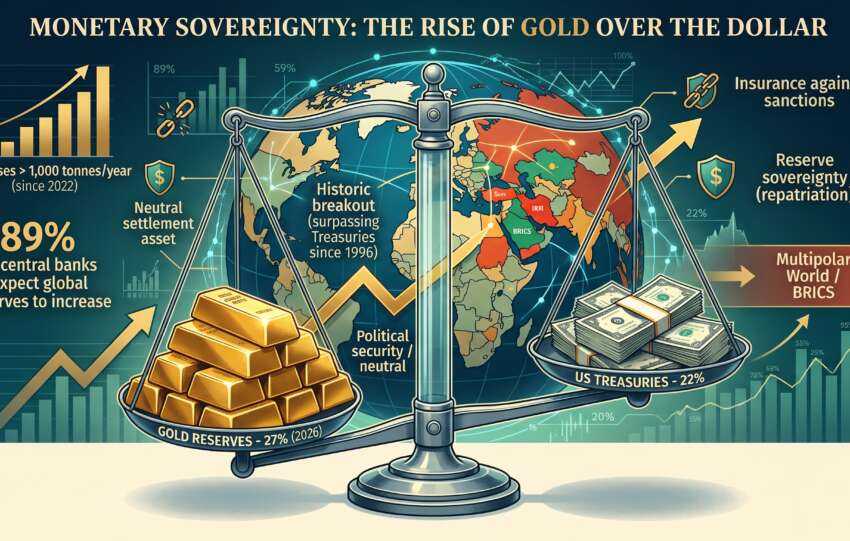
The Iran-United States war, triggered in Q1 2026, introduced a second-order exogenous shock to the gold market, destabilizing the strongest pillar of the decade-long bull run: central bank demand. The announcement of the suspension of gold sales by the Azerbaijani sovereign wealth fund (SOFAZ), forced sales by Turkey and Russia, and the contraction of…
Uniswap (UNI) has re-emerged with renewed institutional narrative momentum following Standard Chartered’s 15 June 2026 initiation of coverage, targeting $100 by end-2030 (~35–40x from ~$2.50–2.70 base; staged path: $6.50 EOY2026, $20 2027, $40 2028, $65 2029). The thesis hinges on tokenized Real-World Assets (RWAs) driving DeFi TVL to ~$2.7T (37x expansion) and Uniswap capturing dominant…
Uniswap’s UNI token (current price ~$3.00–3.40 post-surge, market cap ~$1.9–2.1B) experienced a +25%+ daily move on Standard Chartered’s initiation coverage with a $100 target by 2030 (from ~$2.50–2.70 base, implying ~35–40x upside). The thesis centers on tokenized Real-World Assets (RWAs) migrating on-chain, driving DeFi TVL to ~$2.7T (37x expansion) and Uniswap capturing dominant DEX liquidity/trading…
Executive Summary
Transition risks under 2°C pathways (IEA NZE/APS equivalents) drive structural demand destruction for refined products, compressing refining margins via volume contraction, utilization drops, and policy/carbon cost overlays. Carbon Tracker’s foundational 2017 “Margin Call” analysis projected >50% EBITDA decline by 2035 for ~94% of global capacity under a 2D scenario (oil demand -23%…
Executive Summary
The posited Liquidity Trap manifests as a regime where elevated nominal asset prices (gold near recent highs, equities at stretched valuations) coincide with forced liquidations driven by margin calls, collateral constraints, and retail FOMO entry, without corresponding real-economy liquidity expansion. Under conditions of gold stabilizing below $4,150/oz and WTI/Brent oil around $88/bbl (current…
1. Carbon Pricing Framework: Explicit (EU ETS) vs. Implicit/Internal Shadow Pricing
TotalEnergies employs an internal carbon price (ICP)1 or shadow price in its project evaluations and asset impairment testing. Currently, its base case includes a minimum price of $100/tCO₂ (or higher jurisdictional prices) starting in 2023, with a 2% annual increase after 2030.
Sensitivity…
Executive Summary
The 3:2:1 crack spread serves as a primary proxy for gross refining margins, calculated as:
3:2:1 Crack Spread=2×PGasoline (bbl)+1×PDistillate/Heating Oil (bbl)−3×PCrude (bbl)3\text{3:2:1 Crack Spread} = \frac{2 \times P_{\text{Gasoline (bbl)}} + 1 \times P_{\text{Distillate/Heating Oil (bbl)}} - 3 \times P_{\text{Crude (bbl)}}}{3}
where prices are typically futures-settled (e.g., WTI/RBOB/NYH HO for USGC benchmarks; Brent equivalents or regional baskets for Europe).…
Analyse de marché
Carbon Credit Market