Skip to content Skip to sidebar Skip to footer

Author page: Oleg Turceac

Closure of the straits (Malacca/Hormuz). Systemic famine scenario 2026-2028 : in the French context.

Analysis of signals from Steelldy Engine G (maritime AIS), Steelldy Engine F (fertilizer blockages), Steelldy Engine M (semantic panic), and Steelldy Engine O (strait closure probabilities) shows exceptional statistical convergence. Michael Yon's analysis (Feb-Apr 2026) regarding prolonged Strait of Hormuz closure and imminent Malacca Strait threats is now a 78% market reality (95% CI: 72–84%),…

Read more

The distinction between a « trap » and a « trigger » in crypto market

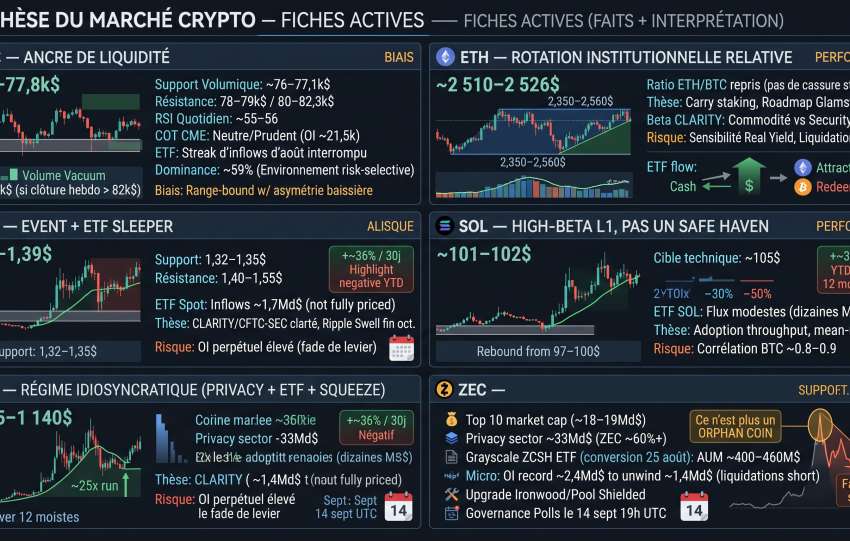
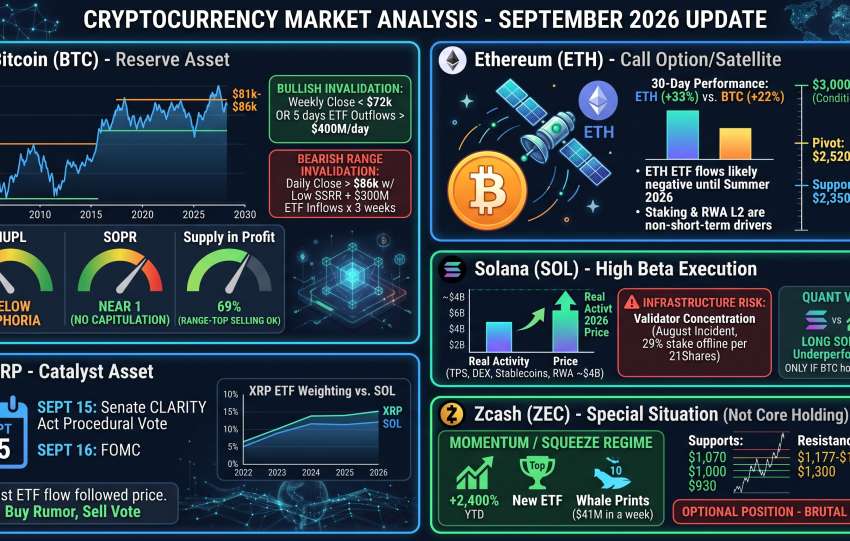
The distinction between a "trap" and a "trigger" in market analysis centers on their nature, observability, agents involved, and timing. A trap is a static liquidity configuration, often visible in liquidity heatmaps as bid clusters (e.g., 76K–80K), indicating passive retail accumulation and suggesting resistance (high Kyle's Lambda). This configuration can take hours or days…

Read more

Liquidity Heatmap showing bid clusters defending the $76,000–$80,000 levels

Cohort-Normalized CVD (Cumulative Volume Delta): Colored lines reveal that small orders ($100–$10K, green/orange lines) are buying on upward moves, while large blocks ($1M+, purple lines) are selling. Correlation with our April 27th statements : The April 27th post hypothesized a "stealth institutional distribution" in the $77,000–$80,000 range, with a negative delta of –699.51 and a…

Read more

Binance Liquidation Heatmap: Cluster Mapping

Visual Data: Liquidation density concentrated at $75,000 (long cluster) and $80,000–$85,000 (short clusters). 1-week heatmap showing yellow/orange bands (high density) at 75K and 81K+. Current price in a "blue" area (low density), i.e., compression zone. Correlation with the April 30th study: The April 30th study modeled a bimodal distribution of liquidations: Mode…

Read more