The original Triffin Dilemma (Bretton Woods I) pitted the issuance of international liquidity (USD) against the necessary convertibility into gold, creating a tension between domestic objectives (avoiding inflation) and international objectives (providing reserves). In the Bretton Woods 2.0 framework, the form of this dilemma is rewritten based on strict collateral rules imposed by the GENIUS…
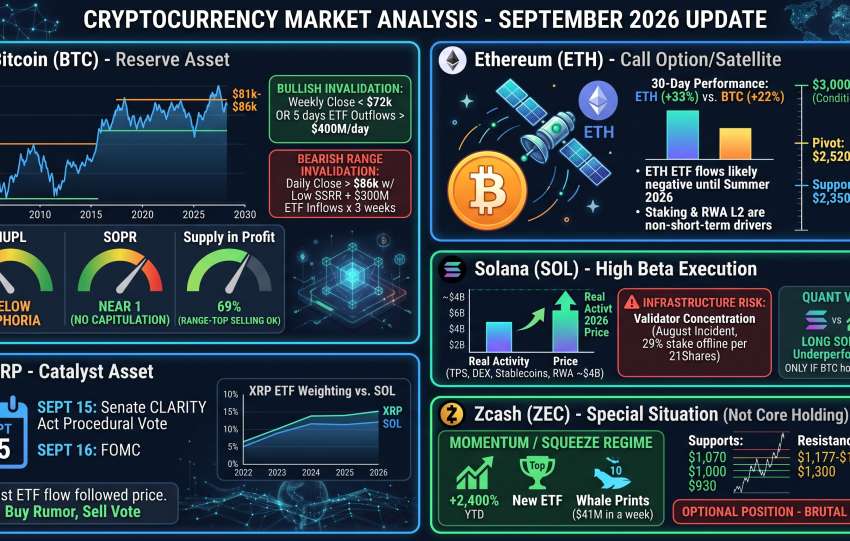
Central Thesis: The integration of Coinglass Liquidation Map data, the 3D rising wedge pattern, and BTC/Stablecoins dominance reveals that BTC has climbed towards 81,800 USD based on 17.68 billion in vulnerable long leveraged positions below current levels. This configuration, superimposed on the geometry of the 3D rising wedge (mechanical target 67,500-70,000 USD in case of…
The Brent oil market shows an extreme divergence between the paper price (futures contracts) at $109 and the physical price (spot) at $141, a $32 gap reflecting a strong "backwardation." Normally, future prices are higher than spot prices (contango) due to storage costs; this inversion signals an immediate scarcity of physical oil. The $141 price…
L’escalade militaire entre les États-Unis et l’Iran, initiée fin février 2026, a déclenché une reconfiguration structurelle du système financier mondial. L’Iran a monétisé le détroit d’Ormuz en imposant un péage de $2 millions par passage de pétrolier, payable exclusivement en yuans chinois ou en USDT sur le réseau Tron . Cette décision transforme un conflit régional en arme de destruction massive contre le système…
1. Cadre conceptuel. L’interopérabilité stablecoins-RWA comme condition sine qua non du scaling de la finance parallèle
L’interopérabilité entre stablecoins (USDT/USDC dominance >85 % du marché, MC ~300 Md$ au 27/03/2026) et RWA tokenisés (TVL distribuée ~26,63 Md$ ex-stablecoins, rwa.xyz) constitue le pont programmable entre liquidité fiat-native et actifs réels fractionnables. Elle transforme les stablecoins…
Bloomberg Terminal couvre bien le pricing spot XRP et certains stablecoins (via exchanges centralisés et partenaires), ainsi que les actualités RLUSD, mais n’expose pas directement les données on-chain XRPL comme book_offers, amm_info, depth pools AMM ou slippage en temps réel. Les desks institutionnels et risk teams réalisent cette capture via développement custom en combinant les…
Oui, l’architecture ouverte et publique de l’XRPL permet précisément cette intégration institutionnelle des flux de liquidité sur les EMTs réglementés comme EURØP (MiCA-compliant, émis par Schuman Financial) et RLUSD (Ripple USD). Les données temps réel du DEX (order book + AMM) sont accessibles via les API natives du ledger, ce qui facilite leur capture par…
XRPL (XRP Ledger) powers regulated Electronic Money Tokens (EMTs) under frameworks like the EU’s MiCA regulation through a native, efficient, and compliance-focused token architecture. Unlike programmable smart-contract platforms, XRPL embeds token issuance, transfers, liquidity, and regulatory controls directly into the protocol. This design delivers 3–5 second finality, sub-cent fees, and institutional-grade features without external layers.…
The integrated analysis of the Steelldy Risk Engine and Steelldy Gotham confirms that the USDC stablecoin has become the preferred vehicle for massive capital flight from the United Arab Emirates (UAE) due to three critical factors: the real estate collapse (a 31% drop), operational failures of local banks, and the regulatory superiority of USDC over…
La présente note a pour objet d'analyser les règles de valorisation applicables aux catégories spécifiques d'actifs numériques que sont les (a) NFT (Non-Fungible Tokens) et (b) les stablecoins dans le cadre du CARF. Elle vise à fournir un cadre méthodologique pour le calcul des plus-values, la déclaration des transactions et la gestion des risques fiscaux…
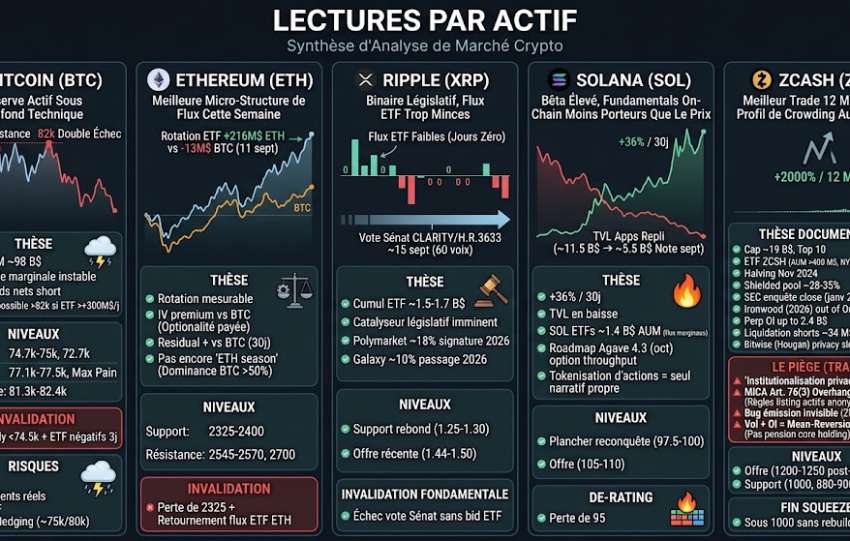
Analyse de marché