"The market is not content with betting on the end of the automobile; it is actively financing its replacement infrastructure."
The convergence of the following signals validates a macro-microstructure arbitrage thesis:
(a) Dark Pools (ATS): Since April 1, 2026, discreet accumulation of blocks >$10M in "Smart City" ETFs (GRN, CITIES), with an institutional buy/sell…
Russia is negotiating a grain distribution hub in Egypt, a BRICS member, using existing port infrastructure and Russian traders already present to enhance wheat exports.Russia currently supplies around 80% of Egypt's wheat imports, and the project aims to create alternative pricing and supply chains for the Global South independent of Western exchanges like the Chicago…
The information, factually confirmed by multi-source convergence (including the Financial Times of April 8, 2026), establishes that Iran now demands payments in cryptocurrencies (BTC, stablecoins) and in Yuan for oil transit through the Strait of Hormuz, completely bypassing SWIFT.
This mechanism, controlled by the IRGC, sets a rate of $1 per barrel, creating an…
The Brent oil market shows an extreme divergence between the paper price (futures contracts) at $109 and the physical price (spot) at $141, a $32 gap reflecting a strong "backwardation." Normally, future prices are higher than spot prices (contango) due to storage costs; this inversion signals an immediate scarcity of physical oil. The $141 price…
It forms part of the FSB’s broader work on non-bank financial intermediation (NBFI) resilience and assesses structural risks in the repo (repurchase agreement) markets backed by government bonds—the dominant segment of the global repo market.
Market Size and Composition (as of end-2024)
Government bond-backed repo outstanding totaled approximately $16 trillion, representing roughly 80% of…
The “return of Russian oil” refers to the U.S. Treasury’s series of short-term General Licenses (GL 133 issued March 5, followed by GL 134 on March 12 and updated GL 134A on March 19, 2026) that authorize the sale, delivery, and offloading of sanctioned Russian-origin crude oil and petroleum products already loaded on vessels. (ww.reuters.com)…
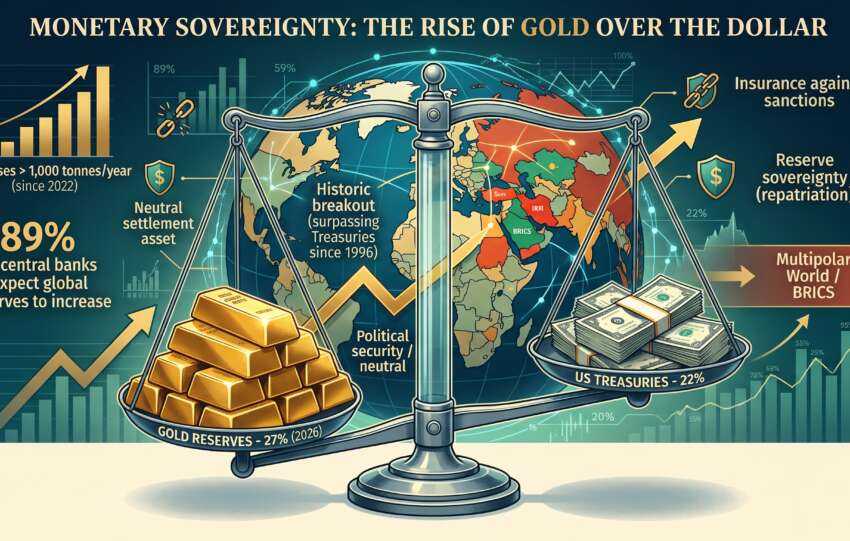
In a podcast discussion, Mike Maharrey of Money Metals interviewed Brian Lundin, President and CEO of Jefferson Financial, regarding factors influencing the gold and silver markets. Lundin argued that long-term monetary trends, rather than short-term geopolitical events, fundamentally drive metal prices.
While global conflicts like tensions involving Iran caused brief spikes in gold prices…
The US Treasury issued a temporary waiver on restrictions for certain stranded Russian oil shipments, announced around March 12-13, 2026, to address global supply disruptions amid escalating tensions with Iran.
This 30-day exemption allows countries to purchase and transport Russian crude and petroleum products that were loaded onto ships as of March 12, 2026, with…
Europe has hit a mathematical wall: the blockage of the Strait of Hormuz has removed 5 to 7 million barrels per day (b/d) from the market. Replacement by American Liquefied Natural Gas (LNG) cannot cover this deficit due to the physical limits of regasification capacities. Under these conditions, the return of Russian oil and gas…
The current outperformance of gold (XAU) and mining stocks over the rest of the market (especially technology) is not a temporary anomaly. It results from the "double commoditization" of AI and software, which is destroying the monetization model of intellectual capital. As intelligence becomes a cheap and widely available commodity, the physical resources needed to…
Analyse de marché