1. Demand Megatrends FTSE Russell identifies two megatrends: AI and the energy transition. We quantify them as follows:
A. AI Infrastructure: The five hyperscalers (Amazon, Microsoft, Google, Meta, Apple) invested $320 billion in H1 2026, in line with an annual projection of $650 billion. Each 100 MW data center requires approximately 30,000 tons of…
Carbon Credit Market
The Carbon Pricing Dashboard provides details about direct carbon pricing instruments and carbon markets around the world.
1.1 Formal Specification of the GloBE ETR
The determination of the Effective Tax Rate (ETR) under the GloBE regime follows a formal specification whose mathematical precision conditions the entire tax calculation chain. The ETR per jurisdiction, denoted ETR_j for jurisdiction j, is defined by the ratio: ETR_j = ACT_j / GI_j, where ACT_j represents the…
Genesis and Legal Foundations of Pillar Two in the OECD/G20
Framework Pillar Two, the product of the OECD/G20 work on base erosion and profit shifting (BEPS 2.0), constitutes the most ambitious reform of international taxation since the OECD and UN model conventions. Its stated objective is to establish a minimum effective tax rate of 15%…
Synthetic carbon credit tokens, as derivative instruments replicating reference indices (ICE EUA, voluntary composites) via futures, total return swaps (TRS), or oracle-based smart contracts, diverge fundamentally from physical credits in fiscal characterization. Physical credits are generally treated as intangible property (capital assets under IRC analogies or inventory), while synthetics lean toward Section 1256 contracts (mark-to-market,…
https://www.steelldy-indices.com
Executive Summary
Reduction in refined fuel demand (gasoline/diesel) is primarily driven by electrification (EV penetration ~25% global new sales 2025, displacing ~1.2 mb/d oil equivalent), efficiency gains (MPG improvements offsetting VMT growth), and behavioral shifts, not dominantly by 15-minute city models. The 15-minute city (proximity-based urbanism) and smart digitalized local economies contribute secondarily…
1. Carbon Pricing Framework: Explicit (EU ETS) vs. Implicit/Internal Shadow Pricing
TotalEnergies employs an internal carbon price (ICP)1 or shadow price in its project evaluations and asset impairment testing. Currently, its base case includes a minimum price of $100/tCO₂ (or higher jurisdictional prices) starting in 2023, with a 2% annual increase after 2030.
Sensitivity…
1.1 Proprietary Multidimensional Benchmark Evaluating the Integrity, Durability, and Liquidity of Carbon Credits
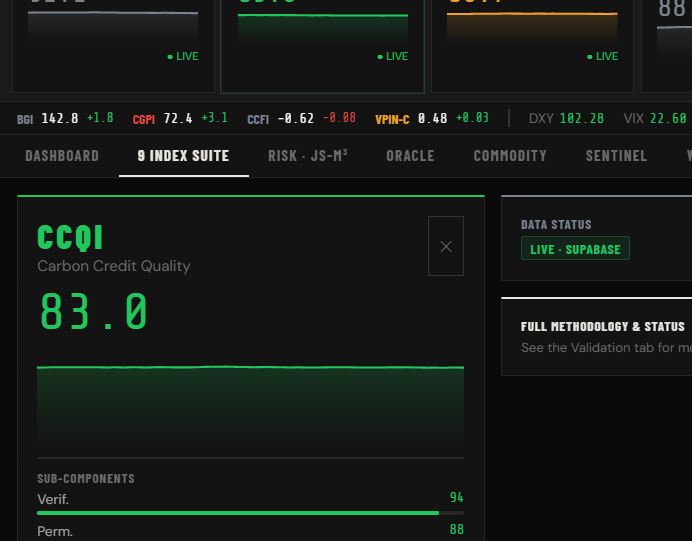
The Climate Credit Quality Index (CCQI) developed by STEELLDY is a next-generation proprietary benchmark specifically designed to address the transparency and standardization gaps characterizing the voluntary carbon credit market. Unlike traditional indices, which are limited to price aggregations or transaction volumes, the…
1.1 Replicating Carbon Price Exposure Without Physical Holding of Credits
Synthetic tokens offer exposure to carbon credit prices without requiring the physical holding of the underlying credits, by using derivative mechanisms such as futures contracts, total return swaps, or price oracles that replicate the performance of a carbon market benchmark index. This structure offers advantages…
1.1 Collective Structuring and Pooling of Heterogeneous Quality Carbon Credits
Pool tokens represent a stake in a collective portfolio of carbon credits with heterogeneous characteristics, structured as a mutual fund or a collective investment vehicle. This form of tokenization allows for the pooling of risks specific to each carbon credit and offers increased liquidity compared…
1.1 Direct Ownership Tokens
1.1.1 On-chain Representation of Carbon Credits Held in Custody by the Investor
Direct ownership tokens constitute the most fundamental form of carbon credit tokenization, representing a digital claim on a physical carbon credit held in custody by an accredited custodian. This structure ensures a one-to-one correspondence between the issued token and…
Climate