The convergence of global retirement savings and the financing of artificial intelligence infrastructure constitutes a systemic risk arising from long-term capital commitments financing technology assets with shorter economic lifespans, through opaque off-balance-sheet vehicles, private credit, and securitizations.
As of October 26, 2026, BlackRock manages $15.488 trillion in assets, compared with $11.6 trillion a year earlier,…

The restructuring of the global economy to finance the AI capital shortfall rests on recycling Asian savings, mobilizing new investors, and transforming cash flows into investable assets.
First, the AI boom generates liquidity in South Korea and Taiwan, part of which flows into dollar-denominated assets and indirectly supports investment by US hyperscalers. Taiwan’s current…
No more "speculative NFTs": tokenized assets are becoming income generating instruments , rents, interest, coupons distributed via smart contracts.
Analysis of a paradigm shift that brings RWA closer to private credit and fixed income. Tokenization was first framed as a story of appreciation: buy a token, wait for it to rise. The story of…
Thesis ESG enters its accounting phase: the European taxonomy, CSRD and carbon markets are transforming extra,financial data into quantifiable data , and therefore into allocation signals. Smart cities represent the physical application ground: sensor-driven buildings, mobility, energy and water, whose flows (and savings) become financeable assets.
Facts. Voluntary carbon market: ~$2 billion today, commonly…
L'analyse financière pour la structuration d'investissements en Smart Cities identifie trois instruments clés. |a| L'iShares Smart City Infrastructure UCITS ETF de BlackRock affiche une performance de 57,35 % sur 5 ans avec une volatilité de 14,48 % et un TER de 0,40 %. |b| Le Fonds infrastructure smart city de Vanguard et |c| Blackstone Infrastructure…
Facts and structure. The European ESG taxonomy (CSRD + Green Taxonomy) is transforming investment flows into constrained flows: a poorly scored asset loses its place in the investable universe. On the carbon side: the voluntary market is currently ~$2 billion, with a trajectory toward ~$100 billion by 2030 (market consensus referenced on your homepage); tokenization…
As of September 11, 2026, the crypto market presents a mixed macro regime. Bitcoin trades near $77,200–77,400, showing a -4.7% weekly decline as it digests levels below $80,000–82,000. ETF outflows have been observed for three days. Ethereum is around $2,470–2,480 with slight daily stability but a weekly -2%, while XRP at $1.35 drops -6.6% weekly…
The Financial Times reports a marked shift among wealthy investors toward direct ownership of physical gold and secure, individually allocated storage. In 2026, purchases by this group have surged to record levels, signaling a retreat from electronic exposure in favor of tangible assets.
Industry observers highlight capacity constraints across premier vault facilities. London dealer Sharps…
The defining shift in digital assets this decade is not a price level. It is a change in structure: from instruments whose value rests on uncertain future appreciation to instruments whose value is delivered through continuous, automated cash flows, rent, interest, coupons, distributed by code. The RWA market has quietly completed this migration in 2026,…
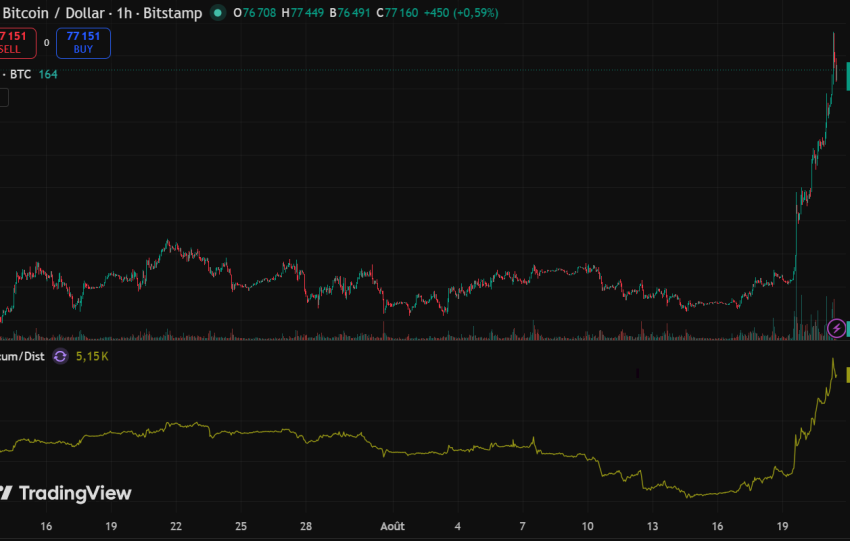
Bitcoin surged to $76,800-$77,600, gaining 6-8% in 24 hours and 20% for the week. The market saw over $4 billion in 24-hour liquidations, marking the most violent short squeeze of 2026. Combined BTC/ETH ETF inflows exceeded $800 million, indicating massive institutional entries. The funding rate shifted from negative to positive, signaling a return of long…
ESG Data Services
Analyse de marché