The stablecoin market has crossed a symbolic threshold: a market capitalization of over $315 billion. What was, five years ago, a niche tool for crypto traders has become a cash management infrastructure, for funds, fintechs, corporations, and soon, under the effect of the MiCA regulation, for regulated European institutions. Yet the fundamental question remains unchanged: what is the promise of parity worth?
The False Sense of Security
Most players content themselves with three reassuring rituals: reading the monthly attestation published by the issuer, checking that the price has not recently deviated, and telling themselves that “too big to fail” offers protection. Each of these rituals is insufficient, and for a measurable reason.
The attestation is a snapshot, not a film. It is monthly, sometimes quarterly, aggregated, and produced by a firm mandated by the issuer itself. Between two attestations, the composition of reserves can change significantly: Treasury bills swapped for commercial paper, bank deposits swapped for repo loans. Recent history has shown that a composition drift can precede a parity drift by several weeks. Price is a lagging indicator. Stable parity can coexist with growing distrust among insiders: silent withdrawals, concentration of redemptions, asymmetric flows on certain platforms. When the peg deviation appears on screens, the information is already public and the spread has already been paid by those who waited. “Too big to fail” is not a metric. It is a belief. But a belief can neither be audited, compared, nor integrated into a documented risk policy—the very one that your regulator, audit committee, or LPs will eventually demand from you.
What Is Measurable Must Be Rated
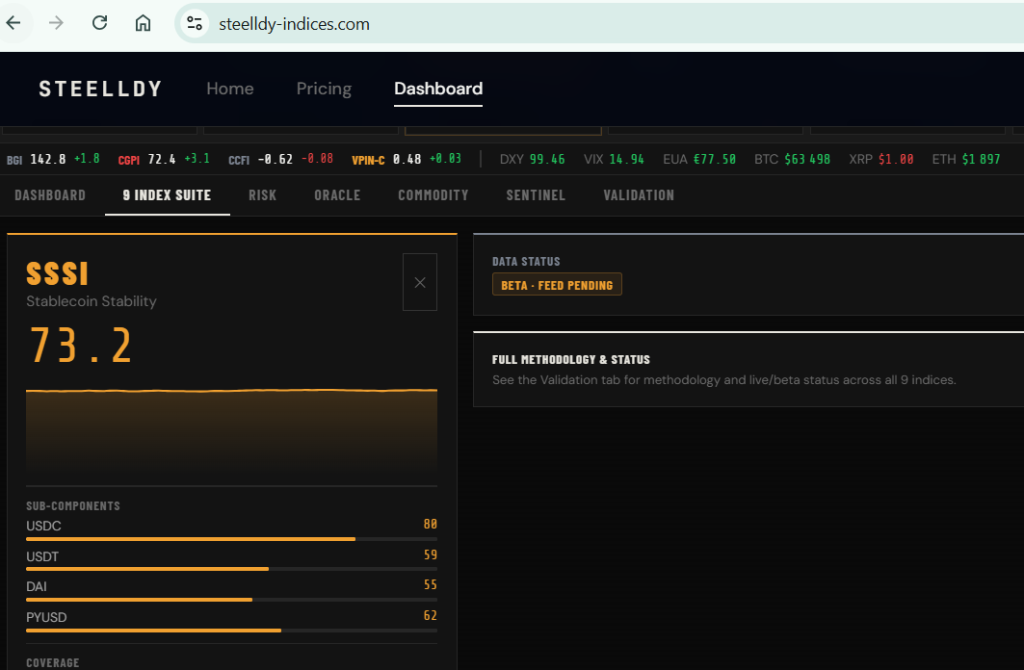
The good news: the data exists. Transparency and composition of reserves, historical parity deviation, exchange flow structure, all of this is quantifiable. The problem is not the absence of data, but the absence of continuous and independent rating. This is the logic behind the SSSI (Stablecoin Stability & Soundness Index) by STEELLDY, which rates the top ten stablecoins every six hours across three pillars:
– Reserve transparency—frequency, granularity, and quality of the issuer’s publications;
– Parity deviation—smoothed by an exponential weighted moving average (EWMA) that penalizes the persistence of deviations rather than their instantaneous amplitude, to distinguish market noise from a genuine drift;
– Informed flow detection—inspired by the VPIN (Volume-Synchronized Probability of Informed Trading), which identifies flow imbalances characteristic of actors who “know something” before others. None of these three pillars is spectacular on its own. It is their combination—and their frequency—that changes the game: a stablecoin can show perfect parity while its score deteriorates over three weeks due to a combined drop in transparency and abnormal informed flows. This is exactly the type of signal a treasurer or risk manager needs to receive before it hits the headlines.
The MiCA Era Changes the Scale of Requirements
With the full implementation of the MiCA regulation, stablecoins backed by the euro and those distributed in Europe fall under a regime of reserve, governance, and disclosure requirements. The framework is progressing, but it remains declarative and periodic. Between an issuer’s regulatory compliance at time T and the actual soundness of its parity at time T+30, there is a gap. This gap is a risk, and this risk must be measured continuously, not attested to in hindsight.
Conclusion: From Trust to Measurement
The traditional financial industry took decades to move from banking’s “trust me” to credit rating, and then to the continuous pricing of risk. Stablecoins do not have the luxury of this time: they operate 24/7, at the speed of on-chain settlement. Their soundness rating must live at the same frequency. “Trust me” was an acceptable reserve policy when stablecoins were worth $5 billion. At $315 billion |and heading toward a trillion| what is not measured is not managed.