The restructuring of the global economy to finance the AI capital shortfall rests on recycling Asian savings, mobilizing new investors, and transforming cash flows into investable assets.
First, the AI boom generates liquidity in South Korea and Taiwan, part of which flows into dollar-denominated assets and indirectly supports investment by US hyperscalers. Taiwan’s current account surplus increased by 111% year on year, reaching 62.5 billion dollars in the first quarter of 2026. This mechanism recalls the “savings glut” described by Bernanke, but it is more concentrated and vulnerable to a reversal in the AI cycle, foreign exchange tensions, and risks affecting institutional balance sheets. Second, according to Fed Chair Kevin Warsh, the world has shifted from an excess of savings to a wave of investment. Yields on 30-year US Treasury bonds have exceeded 5%, their highest level since 2007, as governments must refinance their debt, fund population ageing, and raise NATO defence spending to 5% of GDP by 2035. Decarbonization also requires the addition or renovation of more than 80 million kilometres of electricity grids by 2040, while AI represents another major claimant on capital.
Over five-to-ten-year horizons, the supply of investors willing to bear duration, inflation, and policy risks is not unlimited. The AI duration paradox compounds this challenge: power lines can last 50 years, data centre structures 30 years, and their financing 15 to 20 years, whereas accelerators can become obsolete within three years. Profitability therefore depends on the ability of AI-related output to offset this obsolescence and the rising cost of capital. Securitization offers a second response.
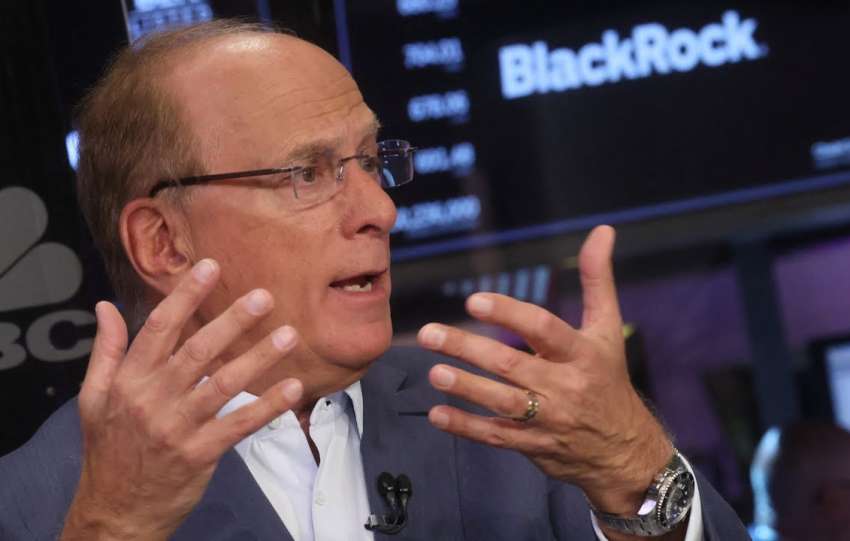
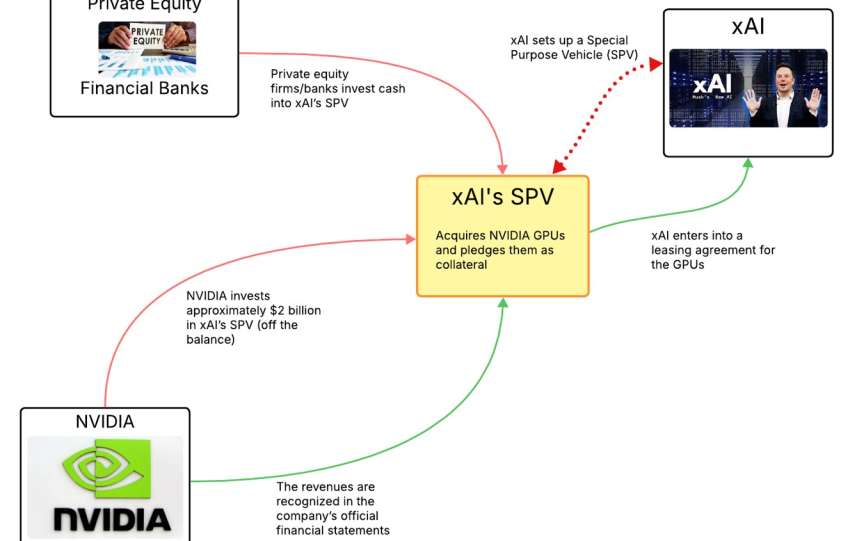
Larry Fink believes that the current financing of AI infrastructure, concentrated among a handful of companies and lenders, will not be sufficient to meet future needs. As mortgages and loans were before it, computing infrastructure could be transformed into securities accessible to a broader investor base. Issuance of asset-backed securities linked to data centres is expected to reach 50 billion dollars in 2026, up from 4 billion in 2020. GPU-backed securities are also expanding: Nvidia has enlisted six Wall Street firms to raise more than 500 billion dollars through similar structures. In a typical arrangement, a special purpose vehicle (SPV) purchases GPUs, leases them to a neocloud provider, and repays its debt using rental income; Broadcom guarantees the senior securities, while Google guarantees the site leases.
Anthropic can thus add approximately one gigawatt of computing capacity without recording additional debt on its balance sheet. However, a recent academic study considers the debt of these SPVs to be a structured obligation incorporating a derivative: an implicit put option granted by the GPU manufacturer. The manufacturer promises to lease the chips if the neocloud provider cannot find customers, thereby becoming the buyer of last resort. This guarantee, whose value depends in particular on the volatility of computing prices, is neither valued nor recorded in the manufacturer’s public financial statements. Its premium, despite potentially being substantial, is virtually zero or embedded in GPUs’ high margins, thereby supporting the system’s liquidity while concealing certain risks. Broadening the investor base could mobilize bank deposits, pension funds, tokenization, and the savings of US households.
Wealth inequality nevertheless limits the reach of this mobilization: 87% of households earning more than 100,000 dollars a year own stocks, compared with 28% of other households. The wealthiest 1% own 54% of stock market wealth, compared with 40% twenty years ago; the bottom 90% hold only 7%, and the bottom half just 1%. Fink compares tokenization to the Internet in 1996 and proposes a regulated digital wallet providing access to ETFs, bonds, stablecoins, and infrastructure stocks. BlackRock’s BUIDL tokenized fund, backed by US Treasury bills, exceeded one billion dollars in assets under management in March 2025 and reached nearly 2.9 billion by mid-year, accounting for more than 40% of the tokenized Treasury bill market.
Another channel is the bipartisan proposal put forward by Senators Cassidy and Kaine: to borrow 1,500 billion dollars over five years to establish an investment fund independent of the Social Security system, invested in equities, private equity, and other assets for 75 years. The fund would aim to supplement benefits through long-term returns. However, the Social Security Trust Fund, with approximately 2,800 billion dollars in assets, is expected to be depleted by 2033, reducing benefits to 83% of the amounts promised.
Finally, banking regulation could constrain this financing. The Basel III Endgame reforms would require banks to hold more capital against technology loans, making credit for AI more expensive. The BIS warns that transferring risks to private credit does not eliminate them and that regulators could tighten oversight of this entire ecosystem. As traditional banks are constrained by capital and liquidity requirements, non-bank funds, insurers, and pension funds are becoming substitute providers of financing. This shift nevertheless creates new systemic risks associated with vehicles’ refinancing needs, procyclical fluctuations in appetite for private credit, and the activation of guarantees.