ESG Data Services
The defining shift in digital assets this decade is not a price level. It is a change in structure: from instruments whose value rests on uncertain future appreciation to instruments whose value is delivered through continuous, automated cash flows, rent, interest, coupons, distributed by code. The RWA market has quietly completed this migration in 2026, and the numbers are now large enough to be a fiduciary topic.
The facts, mid-2026
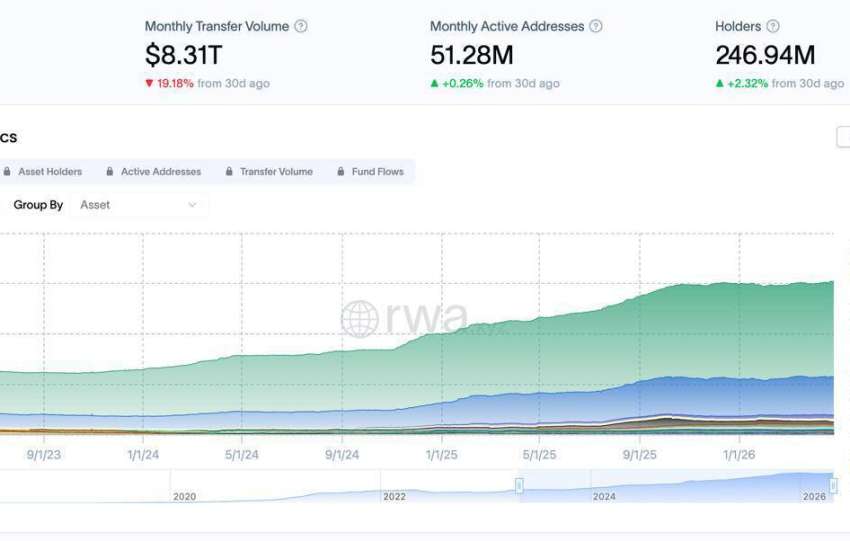
On-chain real-world assets excluding stablecoins stand at $33.5B (rwa.xyz, July 2026), roughly 4× their early-2025 level, with ~995,000 holders across 167 tokenization platforms . The composition tells the structural story:
• Tokenized US Treasuries & money-market funds: $13.4–15.2B led by BlackRock’s BUIDL ($2.6B, daily yield distributed by token mint, ~3.4% 7-day APY), Circle’s USYC, Ondo’s USDY, Franklin Templeton’s BENJI.
• Tokenized private credit: $8–18.9B depending on methodology, with $33.7B originated all-time (Maple, Centrifuge, Figure, Apollo’s ACRED).
• Commodities (mostly tokenized gold): $5.5B, with Q1 2026 spot volume of $90.7B already above all of 2025.
• Tokenized equities: ~$1–1.9B and the fastest-growing segment +114% in H1 2026, wallets up 188% to ~352,000 accelerated by Nasdaq’s March 2026 approval of same-CUSIP tokenized settlement.
Add the $290–322B stablecoin layer, the settlement medium, and the architecture is complete: yield-bearing instruments on one side, programmable cash on the other.
Why the revenue structure changes everything
Three properties distinguish a yield-structured RWA from the speculative token of 2021:
1. The asset is self-justifying. BUIDL pays ~3.4% from T-bills and repo, in daily distributions, whatever the crypto market does 9 . Valuation questions shift from “what will someone pay for this token?” to “what is the quality and durability of this cash flow?” a credit question, answerable with credit methods.
2. Distribution is automated and auditable. Yield accrues and pays out by smart contract — BUIDL mints yield tokens to whitelisted wallets each business day removing the operational leakage of legacy coupon processing.
3. The collateral becomes productive. BUIDL is now accepted as margin collateral at Deribit, Crypto.com and in Binance’s off-exchange program: the asset earns Treasury yield while securing trading positions a capital-efficiency property no idle traditional collateral matches.
This is why serious analysts now describe leading RWA products as programmable private credit and fixed-income instruments, not as NFTs with a story. S&P Global and Moody’s rate tokenized funds close to their traditional twins, pricing the incremental risk where it actually lives smart contract, custody and platform operations.
The honest caveats (what the dashboards don’t say)
Rigor requires the other side of the ledger. Liquidity remains the unbuilt half: most tokenized Treasuries and private credit still mint and redeem rather than trade, and by one analysis 56% of reported RWA value sits idle 8. Tokenized equities remain a “Layer 2.5” market, the products with the strongest legal foundations have the weakest liquidity, and the most-traded wrappers have the weakest ownership rights; no product yet combines standard ownership, wide wallet distribution, institutional liquidity and independent on-chain price discovery at scale 10. BUIDL itself counts ~106 holders, institutional adoption, emphatically not mass adoption.
The 2026–2035 trajectory
Scenario forecasts diverge honestly: BCG/ADDX’s widely-cited path to ~$16T of tokenized illiquid assets by 2030 sits well above McKinsey’s low-single-digit-trillion base case 15. The spread itself is information: the outcome depends on distribution infrastructure and regulation, not on technology, which is ready. With the SEC’s January 2026 statement settling tokenized securities’ status, MiCA’s transition complete (1 July 2026), Nasdaq/FINRA rails approved and the ERC-7943 neutral token standard adopted, the question has moved from “is this allowed?” to “is your institution ready?”.
Our conviction: the winners of 2026–2035 will be the actors who can measure cash-flow quality across this new asset class, reserve integrity, compliance alignment, risk-adjusted yield, settlement quality. Measurement is the layer that turns a programmable coupon into an allocatable asset. That is the layer STEELLDY was built to provide.
Sources
Stobox. https://www.stobox.io/reports/state-of-rwa-2026
rwa.xyz. https://app.rwa.xyz/assets/BUIDL
链捕手ChainCatcher. https://www.chaincatcher.com/en/article/2279810
altFINS. https://altfins.com/knowledge-base/track-and-scan-200-tokenized-equities-on-altfins/
orochi.network. https://orochi.network/blog/2026-stablecoin-regulatory-expectations-the-future-of-global-payments
tokenizedliving.com. https://tokenizedliving.com/blackrock-buidl-fund-tokenized-treasuries-across-multiple-blockchains/
Sources principales (avec dates)
- www.steelldy-indices.com , page d’accueil et positionnement produit (consulté le 26/08/2026) 1 ;
- www.scoregex.streamlit.app, application ScoreGEX (consultée le 26/08/2026) 2 ;
- www.steelldy.com, magazine (consulté le 26/08/2026) 3.
- Stobox, State of RWA Tokenization — 2026 Mid-Year Report, données au 10/07/2026 (rwa.xyz : 33,5 Mds$ ; segments ; ERC-7943 ; SEC jan. 2026) 8.
- RWA.xyz — BUIDL, données au 26/08/2026 (2,61 Mds$ ; APY 7j 3,43 % ; 106 détenteurs) 9 ; Yahoo Finance (13/07/2026) : tokenized Treasuries 380 M$ → 14,6 Mds$ ; Eco.com (17–21/08/2026) : BUIDL ~2,5 Mds$ mai 2026, marché RWA 22–25 Mds$ 23 ; TokenizedLiving (18/08/2026) : collatéral BUIDL, nouveaux produits BlackRock août 2026 13 ; DeFi-Intel (15/07/2026) : architecture BlackRock×Securitize×BNY 14.
- Orochi Network (14/07/2026) : stablecoins 322,6 Mds$ mai 2026 ; GENIUS Act (18/07/2025) ; MiCA (Circle autorisé, Tether délisté) ; Hong Kong (HSBC, Anchorpoint, avril 2026) ; MAS ; volumes T1 2026 ~4 500 Mds$ 12 ; StablecoinLaws (30/07/2026) 21 ; StablecoinInsider (25/08/2026) : fin transition MiCA 01/07/2026 16 ; DataAnalyticaSystem (20/06/2026) : RLUSD 8 Mds$ 22.
- ISO 20022 : J.P. Morgan (04/08/2026) 6 ; OasisPro (19/07/2026 : 65 % non conformes, 44 % banques en retard, deadline 14/11/2026) 4 ; Optimus (03/08/2026) 7 ; Ionova (20/06/2026 : timeline, coûts 25–75 $) 5.
- CBDC : Eco.com (17/08/2026 : e-CNY 16 700 Mds¥, mBridge, Agora) 28 ; CBDC Registry (02/07/2026 : pilote euro numérique S2 2027, émission possible 2029) 25 ; Central Bank of Ireland (14/05/2026) 26 ; FII Institute (17/06/2026 : vote Parlement fév. 2026, Pontes fin 2026) 27 ; Blockcritics (19/05/2026 : coûts 1,3 Md€/320 M€, limites 500–3 000 €, Pontes T3 2026, vote juin 2026) 24.
- Carbone : Market Research Future (23/07/2026 : 1,87 Mds$ 2025 → 7,18 Mds$ 2035 ; CORSIA 2027 ; removal +28,3 %) 20.
- CSRD/Taxonomie : KPMG (27/02/2026) 17 ; Clarity AI (10/08/2026 : ratios d’alignement non comparables, exemple 3,4 % vs 13,9 %) 29 ; CarbonTool (27/06/2026 : Omnibus I en vigueur 18/03/2026) 18 ; Obsidian (16/06/2026 : référenciel directive (UE) 2026/470) 19 ; AKD (24/02/2026) 30 ; Grant Thornton (29/01/2026) 31.
- Robotique : RoboticsCenter (12/07/2026) ; Optimusk (03/07/2026) 34 ; ValueAddVC (14/06/2026 : Unitree IPO août 2026 ~6,2 Mds
/2035, revenus sectoriels <500 M$) 35 36 ; TechStoriess (22/08/2026) 37 ; AlgorithMine (10/08/2026) 38.
- MANBRIC : Grinin, Grinin & Korotayev, The MANBRIC-Technologies in the Forthcoming Technological Revolution (Springer, 2017) 32 ; The Cybernetic Revolution… (2016) 33.
- Actions tokenisées : Chaincatcher/insights4vc (02/08/2026 : 951 M$ → 1,89 Mds$ ; ~36,8 Mds$ distributed ; Nasdaq same-CUSIP) 10 ; altFINS/CEX.IO (30/07/2026 : +114 % H1 2026, 352 000 wallets) 11 ; Pharos (12/07/2026 : S&P/Moody’s sur risque tokenisé ; BCG 16 T$ 2030 vs McKinsey) 15.