Carbon Credit Market
Paradoxical but verifiable: European regulation (MiCA fully applicable, transition completed in 2026; CSRD/ESG taxonomy under development) is not a burden but the competitive moat of the European crypto ecosystem — and a scoring market in its own right. The EU tokenized market is estimated at €2,000 billion by 2028; CASP authorization costs €500k–€1M; barriers to entry weed out fragile operators and concentrate profits among compliant players.
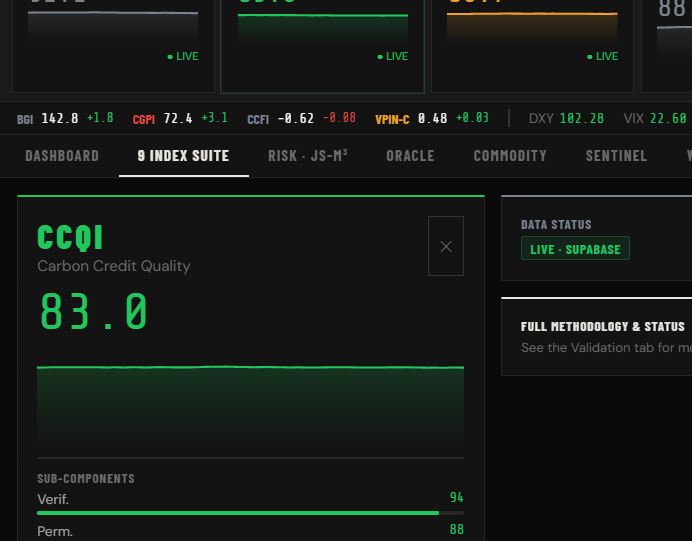
Essential data. Launch in 2026 of EURAU, the first 100% MiCA-compliant euro stablecoin (AllUnity: DWS/Galaxy/Flow Traders); the Qivalis consortium (BNP Paribas and 8–9 other banks) developing an interoperable cross-chain euro stablecoin; Germany and France as deployment locations; the digital euro pilot scheduled for Q4 2026 on its innovation platform. On the ESG front: the European taxonomy is establishing itself as the shared benchmark for sustainable bond flows, while the voluntary carbon market ($2 billion today, targeting $100 billion in 2030) is converging toward quality on-chain ratings — our CCQI exhibits a correlation of ρ=0.78 with ICE EUA, demonstrating that on-chain ratings now reflect the physical market price.
Analysis (quant lens). Three sources of economic rents:
- Authorization rent. €500k–€1M in CASP compliance costs = a Darwinian selection filter; the remaining players operate in an oligopoly. In allocation: favor authorized platforms and avoid non-MiCA offshore operators that risk being excluded from the EU market.
- Regulatory information rent. Since compliance must be demonstrated continuously, dynamic scoring (ETACI: MiCA/CSRD scoring of assets and protocols) becomes indispensable data for risk committees, a captive market, insensitive to cycles, with automatic renewals.
- Carbon-on-chain convergence. When the ESG taxonomy requires traceability, carbon credits assessed on-chain (integrity, double counting, vintage) become the only acceptable underlying asset for corporate buyers subject to CSRD: ratings lead liquidity.
- Positioning. Favor MiCA-compliant issuers and infrastructure (bank-issued euro stablecoins, authorized platforms), favor ESG/MiCA ratings via API, and remain cautious about DAOs: governance structures lacking legal personality and an identifiable responsible party are fundamentally incompatible with MiCA/CSRD, they will have to be legally wrapped (foundations, Wyoming-/Marshall-style DAO wrappers) or remain outside the regulated market. The premium will accrue to “hybrid” DAOs: on-chain governance + a legal wrapper.
Risks. Talent and innovation may migrate to more flexible jurisdictions if administrative burdens penalize SMEs; disparities in enforcement among national authorities (ACPR vs BaFin vs CSSF); interoperability difficulties with non-EU chains (AML-compliant bridges required).- Overweight compliant players. In 2026, compliance is no longer the service that slows things down: it is the one that holds the license that makes rent generation possible.