EXECUTIVE SUMMARY. QUANTITATIVE FINANCE
Contagion in AI financing cannot be understood through valuation levels or even growth rates. It is grasped through the counterparty dependency structure and the second derivative of infrastructure spending.
Our cross-analysis shows:
¤ The central risk is not the disappearance of AI demand, but the existence of a correlation of one around OpenAI, whose solvency depends on valuation refreshes, not operational cash flow.
¤ The dependency graph of contractual flows (take-or-pay, RPO, debts, guarantees) places OpenAI in a position of maximum betweenness centrality. A significant portion of credit paths pass through it.
¤ OpenAI’s distress probability, estimated using a Merton structural model, reaches approximately 14.7%, despite an implied valuation of $852 billion.
¤ The direct impact of an OpenAI default on hyperscaler backlogs is estimated at $63 billion in expected losses, theoretically absorbable by hyperscaler balance sheets, but triggering a freeze in refinancing for neoclouds, which have no absorption capacity.
¤ Nvidia’s 5-year CDS at 79.8 bps implies a cumulative default probability of 6.4%, with high systemic risk measured by ΔCoVaR ≈ -9.5 percentage points.
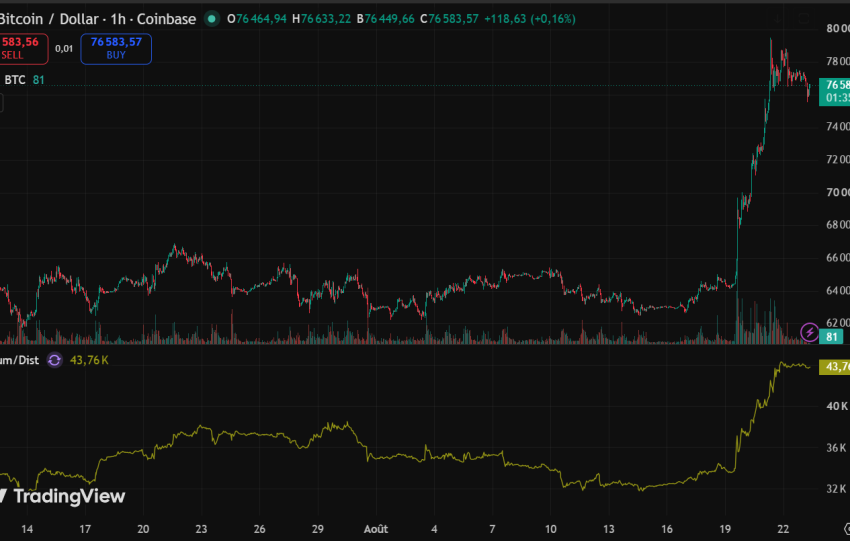
¤ The current crypto rally (BTC ≈ $77,221) is a local short-squeeze supported by ETFs and Treasury liquidity, but fragile: the implied correlation with the AI risk factor remains high (0.45–0.60). Gold at $4,600 confirms institutional hedging against systemic risk.
The conclusion is simple: the system is vulnerable to deceleration, not recession. The correlation of one transforms an idiosyncratic shock into a systemic shock.
The theoretical framework explains that the financing structure of AI hyperscalers and neoclouds fails when the growth rate of aggregated AI capex falls below the threshold required by debt service and take-or-pay contracts. Using a second derivative approach, the time window for borrowed solvency is estimated at 0.88 years. The “correlation of one” describes a situation where individual exposures are all conditioned by a single latent variable: OpenAI’s ability to honor commitments through valuation refreshes. Using a Gaussian factor model, if the correlation coefficient approaches one, diversification disappears, and default probability becomes either 0 or 1. For OpenAI-Nvidia, a common stress factor increases default probability from 10% to 54.7%, demonstrating the correlation of one phenomenon.
Using STEE Engine 3.8, a weighted directed graph was built with nodes: OpenAI, Anthropic, Microsoft, Google, Amazon, Oracle, CoreWeave, Nvidia, SoftBank. Edges represent RPO, debt, guarantees, and take-or-pay contracts. Betweenness centrality measures a node’s role as an intermediary in credit paths. Eigenvector centrality assesses systemic vulnerability. Results show OpenAI as a critical hub (0.92 betweenness, 0.95 spectral). Others, like Nvidia (0.45, 0.71) and CoreWeave (0.31, 0.58), have high indirect vulnerability. The network is highly concentrated; removing OpenAI would severely disconnect the credit graph.
The Gaussian copula models default dependency via normal correlation structure. The Student t-copula captures tail dependencies; with ν=4 and ρ=0.35, lower tail dependence λ≈0.18, meaning 18% of extreme events coincide. Monte Carlo simulation over 100,000 paths for 50 correlated GPU/neocloud exposures (10% default probability, ρ=0.35, 55% LGD) shows: Equity tranche (0-10%) has 32% expected loss and 72% VaR 95; Mezzanine (10-30%) 8.5% and 24%; Senior (30-100%) 1.1% and 4.6%. The senior tranche is not immune due to high correlation distorting the loss tail.
A default by OpenAI could cause expected losses of 10-15% on backlog (PD), with a 50% loss given default, totaling ~1050 billion USD, theoretically absorbable by hyperscalers but destructive to neocloud valuations. Systemic risk to Nvidia is significant, with a ΔCoVaR of -9.5 percentage points. A Merton model shows a 14.7% probability of distress over 5 years, even with high valuation.
The recent crypto rally (BTC at $77,221) is partly fueled by excess liquidity from the Treasury. In an AI credit shock, the conditional correlation between BTC and the AI risk factor (ρ_BTC,IA) would sharply increase from 0.45 to 0.75. Gold at a record $4,600 shows institutional hedging against systemic risk; a one-standard-deviation rise in the AI stress index boosts gold prices by 2.5% short-term. Monte Carlo simulations for BTC (100,000 paths) give a 30-day median of $82-88k, a 5-95% quantile range of $68-105k, and a 25% probability of correction to $68-72k over 3 months (up from 15%).
Game theory and Nash equilibrium describe a coordination game among hyperscalers. In a boom regime, the Nash equilibrium is to continue investing, with payoffs (1,1) for mutual continuation. In a stress regime, the equilibrium shifts to cutting, with payoffs (0,0) for mutual cuts. Meta (Zuckerberg), a rational first mover with dual control, was rewarded for cutting capex in 2022.