Analyse de marché

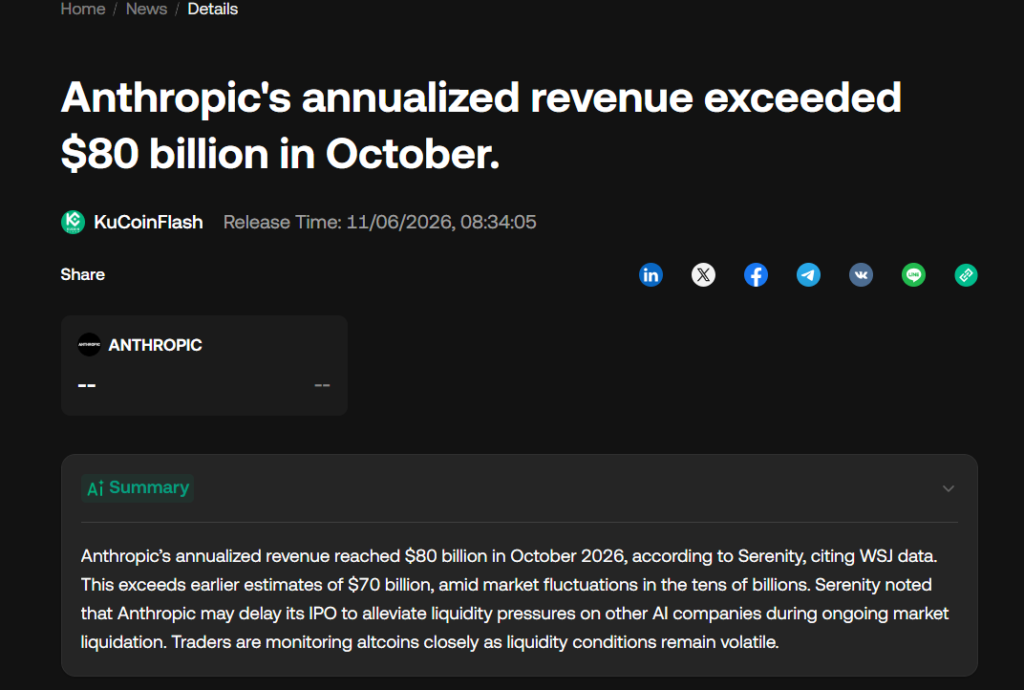
Anthropic’s $80 billion in october 2026
A three-tier monetization architecture, dominated by a consumption-based billing model, propelled the annualized run-rate revenue from 41 million dollars in 2023 to approximately 81 billion dollars in October 2026.
This growth is accompanied by massive compute costs and predominantly non-cash accounting losses, which explain the apparent paradox between an operational “cash machine” and a deeply negative net income.
The viral thesis that “every token in Claude prints money” is fundamentally accurate from an operational standpoint, but misleading from a financial standpoint.
Anthropic makes money on every API call thanks to a 5x input/output pricing differential and usage-based billing that scales with Claude’s growing integration into enterprise workflows.
Revenue growth (from $41M to $81B in run-rate in less than three years) and the achievement of an adjusted operating margin of 15% in Q3 2026 demonstrate the model’s economic viability.
However, the fixed-cost structure ($900B in computing commitments) and capital structure (convertible instruments, SAFE) create extreme accounting volatility that explains the “$104B loss.” For an investor, the real metric to monitor is not GAAP net loss, but the ratio C_compute/R (computing costs as a percentage of revenue), which fell from 172% to 57% in one year and will determine Anthropic’s ability to turn its growth into sustainable free cash flow.
The multilayer distribution channel (API, cloud marketplaces, direct sales, integrators) is consistent with the nature of the product, a pay-as-you-go computing service and scalable toward the $200–300B in revenue required to justify a $2,000B valuation.
The M. theory suggests that Anthropic is building a cumulative competitive advantage through product integration, distribution, and a learning loop based on usage data.
The main risk, therefore, is not demand, which has been proven, but operational execution: maintaining the pace of innovation (4 generations of Opus in 2026) while containing the cost per token in the face of intensifying competition.