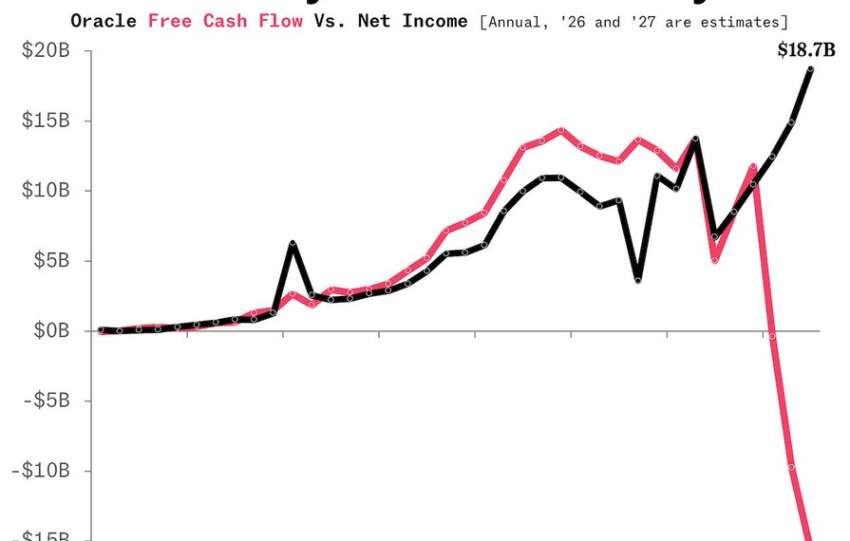
Circular financing in the AI sector refers to a tightly interlinked system of equity investments, compute commitments, guarantees, and off-balance-sheet structures among chipmakers, hyperscalers, AI labs, and data-center operators. Money and obligations circulate among a small group of counterparties, accelerating infrastructure buildout while amplifying downside risks if end-user monetization falls short.
How It Works. A supplier (e.g., Nvidia, Microsoft, Amazon, Google) provides equity capital, cloud credits, residual-value support, lease guarantees, or arranges third-party debt for an AI lab or infrastructure provider. In return, the recipient commits to multi-year purchases of chips, cloud capacity, or services from the same or related suppliers. Revenue is booked on both sides, valuations rise with commitments, and the loop repeats.
Key patterns as of August 2026 include:
– Microsoft’s ~27% stake in OpenAI, paired with large Azure compute commitments from OpenAI.
– Nvidia’s equity stakes (including ~$30 billion in OpenAI) and stakes in Anthropic, CoreWeave, etc., along with purchase commitments and data-center guarantees (e.g., support for up to ~$105 billion for an OpenAI-related Ohio campus).
– Nvidia platforms with Apollo, BlackRock, Blackstone, Brookfield, Goldman Sachs, KKR aiming to mobilize $500 billion+ in third-party capital linked to Nvidia hardware.
– Amazon’s multi-billion-dollar investments in Anthropic and OpenAI, with substantial AWS and custom-chip commitments flowing back.
– Similar Google–Anthropic arrangements involving TPU supply, guarantees, and special-purpose vehicles (SPVs).
– Broader links with Oracle, AMD, CoreWeave, SoftBank, and private-credit providers. Tracked deals show tens of billions in equity circulating alongside hundreds of billions (one estimate around $879 billion) in multi-year purchase commitments. Hyperscalers also use SPVs and joint ventures to hold data-center assets financed off-balance-sheet via private credit, with long-term lease or offtake commitments. The Bank for International Settlements (BIS) describes this as “shadow borrowing,” with substantial off-balance-sheet obligations estimated at $1.65 trillion for major players.
Core Risks
1. Inflated Demand Signals: Reported cloud growth, chip sales, and AI lab valuations partly reflect internal capital recycling, not independent enterprise or consumer demand, encouraging overbuilding and supporting elevated private-market valuations (e.g., OpenAI near $852 billion, Anthropic higher in secondary markets).
2. Double Exposure and Contagion: If AI revenue disappoints (e.g., due to low-cost open-weight models or slower adoption), the AI lab struggles to service commitments. The supplier loses future product revenue and faces equity impairments or guarantee calls. Losses transmit quickly across the web due to counterparty linkages.
3. Skewed Incentives and Opacity: A supplier that is also a major shareholder may tolerate uneconomic spending. Off-balance-sheet SPVs, residual-value supports, and complex guarantees reduce transparency around true leverage and risk. Credit markets have shown sensitivity (widening CDS spreads, rating warnings).
4. Systemic Amplification: Concentration among a few firms means a setback at one major node (frontier lab or infrastructure vehicle) can cascade. The BIS flags circular financing as a feature that can turn an investment boom into a sharper bust, with spillover via private credit, equity wealth, and related sectors.
Historical Analogies: Vendor financing excesses in prior tech cycles, though the AI version is distinguished by the combination of equity stakes, long-term offtake, and physical infrastructure scale.
Mitigants and Counter-Arguments: Participants reject the “circular” characterization. Nvidia emphasizes independent underwriting, real demand from labs and enterprises, limited residual-value support, and the need to unlock capacity. Equity stakes provide upside if technology succeeds. New platforms aim to bring external institutional capital, not just internal recycling. Real technological progress, measurable usage growth, and residual value in chips and data centers provide partial buffers. Not all spending is circular; independent customers and cash-funded spending exist.
Overall Assessment: Circular financing has accelerated AI infrastructure deployment beyond what pure cash or traditional project finance would allow. However, it creates a highly coupled system where growth, valuations, and financing are interdependent. This raises the potential severity and speed of a correction if ultimate cash-generative demand from non-circular end users is insufficient to service the commitment stack and support equity valuations.
Key indicators to watch:
– Conversion of multi-year commitments into actual paid utilization and free cash flow at AI labs.
– Gap between equity mark-to-market gains and cash returns for hyperscalers.
– Performance and refinancing of SPVs.
– Credit spreads and covenant trends.
– Share of revenue growth from independent (non-affiliated) customers. In combination with broader capex intensity, debt growth, and competitive pressures, circular structures significantly elevate systemic and company-specific risks within the AI investment cycle.