1.1 Bitcoin. Core Collateral, Not an Alt
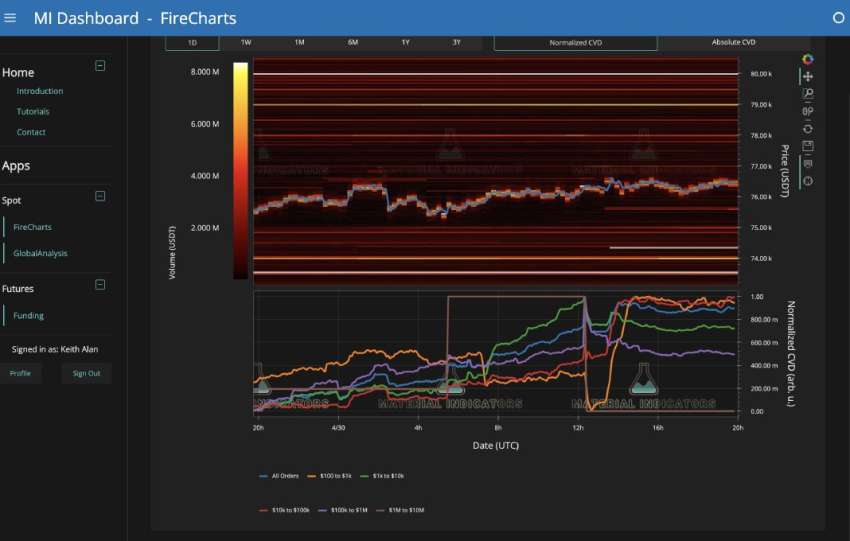
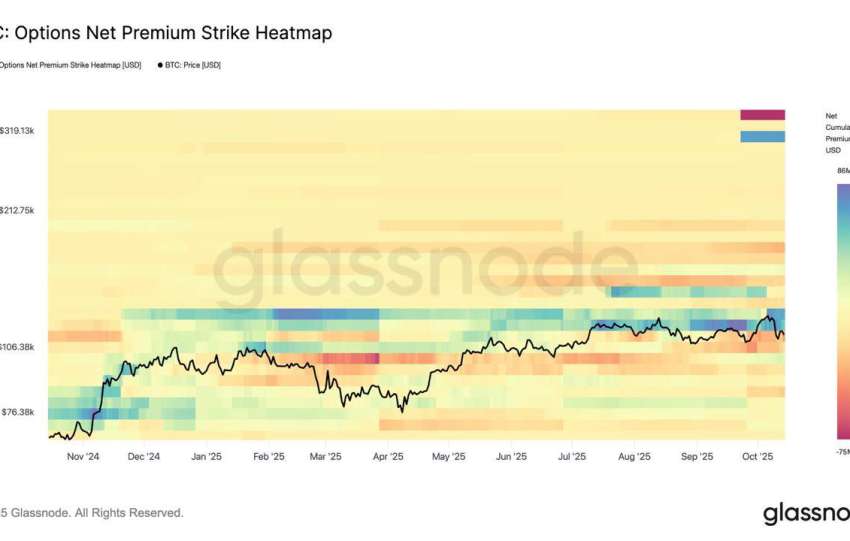
Price sits below the self-custody cost basis shelf (~$80.8k) and under the Glassnode band ($81–86k), where negative gamma dealers appear around $82.3k, short squeezes cluster up to $86k, and LTH supply converges at $83–86k.
CryptoQuant’s Bull Score hits 80, a high since Oct. 2025, indicating spot and futures demand are rebuilding together. Counter-signal: LTHs are net sellers (~−21k BTC/month) with record weekly realized profits near $1B in 2026, meaning “smart” supply distributes into strength. Flows: prior week saw ~$1.9–2.8B in spot ETF inflows, the strongest in months, though Aug 28 reversed with −$202M. 2026 cumulative inflows remain massive; AUM is ~6% of BTC’s float. The ETF channel is BTC’s modern COT. Quantum read: BTC is the complex’s numeraire; a sustained failure below $80–81k after a high Bull Score suggests a short-covering rally plus ETF flows, not yet a Glassnode-confirmed bull (requires a close above the 365-day MA at ~$83k and sustained ETF inflows). Bullish validation targets acceptance above $83–86k. Tactical invalidation for the August rebound: loss of $74–75k then retest of $68–70k—not a crash call but a leverage reset. Estimated betas (qualitative, 30–90 days): ETH >1, SOL >>1, XRP high but event-driven.
1.2 Ethereum. L1 Cash Flow + ETF Wrapper + Staking
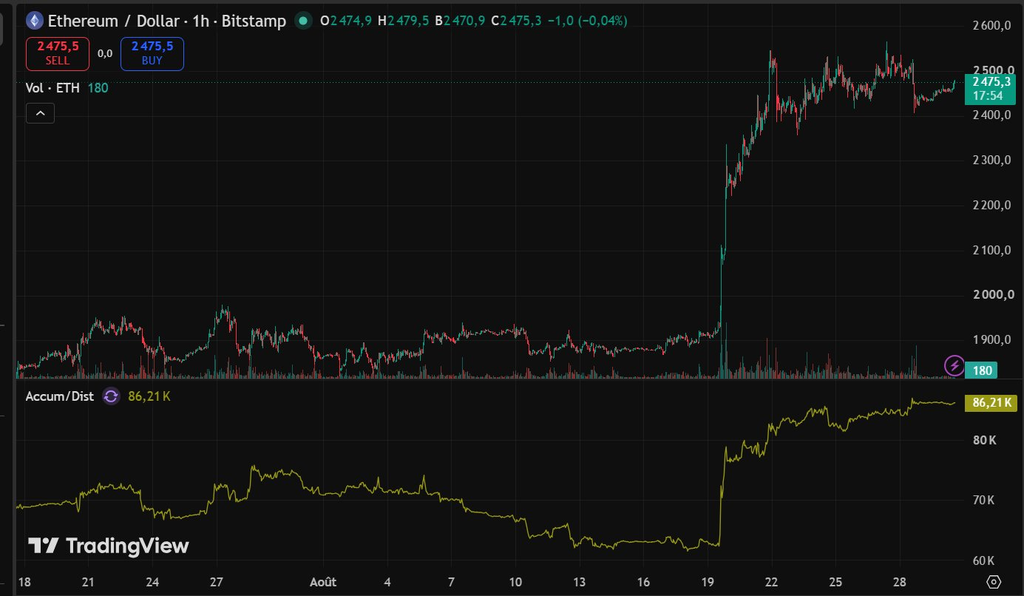
Price ~$2,44x after +~30% weekly peak. ETH/BTC reclaimed ground from 2026 lows (~0.024 to ~0.030 in July). ETH ETFs show persistent inflows while BTC saw outflow on Aug 28—intra-crypto rotation, not pure risk-off. Staking covers ~1/3 of supply. The Glamsterdam upgrade (base-layer throughput) is an H2 catalyst, not immediate. Distinctive factor: ETH is most exposed to (i) CLARITY/classification, (ii) GENIUS/stablecoin settlement on L1, and (iii) tokenized RWAs. A September Fed hike compresses duration multiples; legislative progress re-opens them. Tactical levels (rough, not signals): support $2,250–2,300; resistance $2,550–2,650 then $2,800. As long as ETH ETF inflows continue, 3–5% dips are more absorbable than for altcoins without a wrapper.
1.3 XRP. Regulatory Completeness and ETF Catch-Up
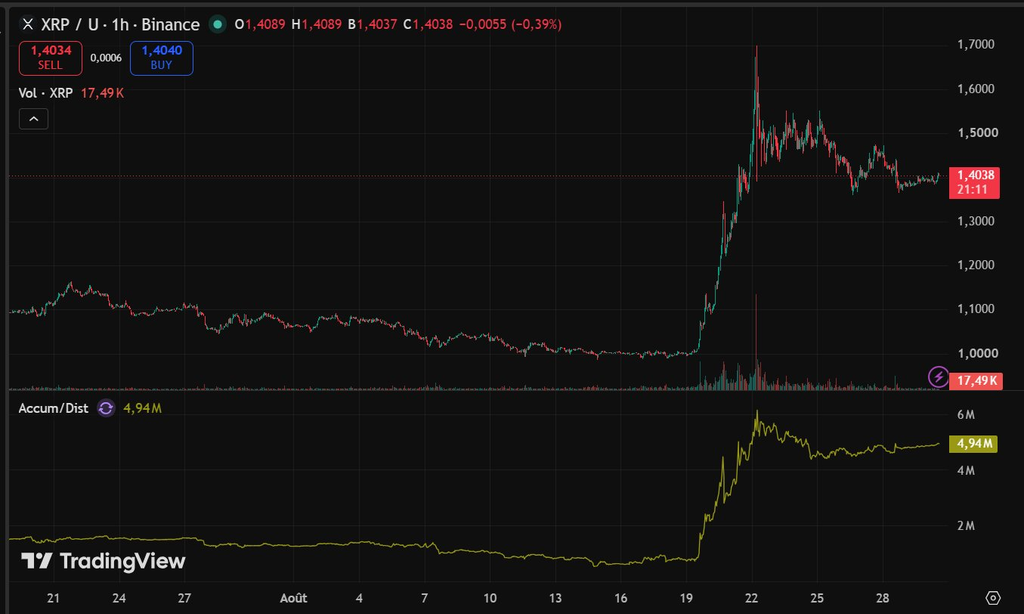
XRP was the top large-cap in the rebound week (+~45–48% to ~$1.48–1.52) then most penalized in the hawkish fade—a classic profile for regulatory convexity with retail/event-driven float.
Public institutional mosaic: 7 US spot ETFs with ~$1.44B AUM, cumulative flows ~$1.62–1.66B, and best week of 2026 (~$110M ending Aug 28) during the token’s correction, accumulation into weakness via wrapper, not pure chasing.
Ripple holds MiCA CASP license in Luxembourg with EEA passport. ETF penetration vs market cap remains low (~1.5–2%) versus BTC (~6%+). If XRP enters persistent model-portfolio allocations, flow becomes stickier than 48-hour price action.
Specific risks: supply and Ripple unlock/distribution history; extreme sensitivity to CLARITY/CFTC-SEC headlines. Without US catalyst in 2026 (14% odds), European rerating plus ETFs may sustain a higher range than H1 but not a 2025-type multiple without new binary events. Levels: $1.25–1.30 first shelf post-squeeze; $1.50–1.70 technical supply already tested.
1.4 Solana. Throughput, RWA, ETF, Upgrade Risk
SOL reclaimed $100 (first time since Feb) with +~28–40% depending on window, record July activity (4.2B tx), and rising tokenized RWAs (~$4B cited).
SOL ETFs: robust 2026 flows (>$1.2–1.3B cumulative; AUM ~$1.2–1.4B; occasionally better daily flows than XRP recently).
SOL futures OI is rising, leverage is “hotter” than BTC. Technical factor: Alpenglow (consensus) is a Q3 catalyst, bringing event volatility both ways. SOL is most exposed in the quartet to (i) historical outages/client diversity, (ii) CTA/momentum beta, and (iii) high-performance L1 rotation versus ETH.
Levels: $89–95 = moving average/rebound structure; $108–115 = extension. An intra-week RSI overbought plus high OI means a normal 4–5% fade, not regime invalidation, as long as $90 holds.