

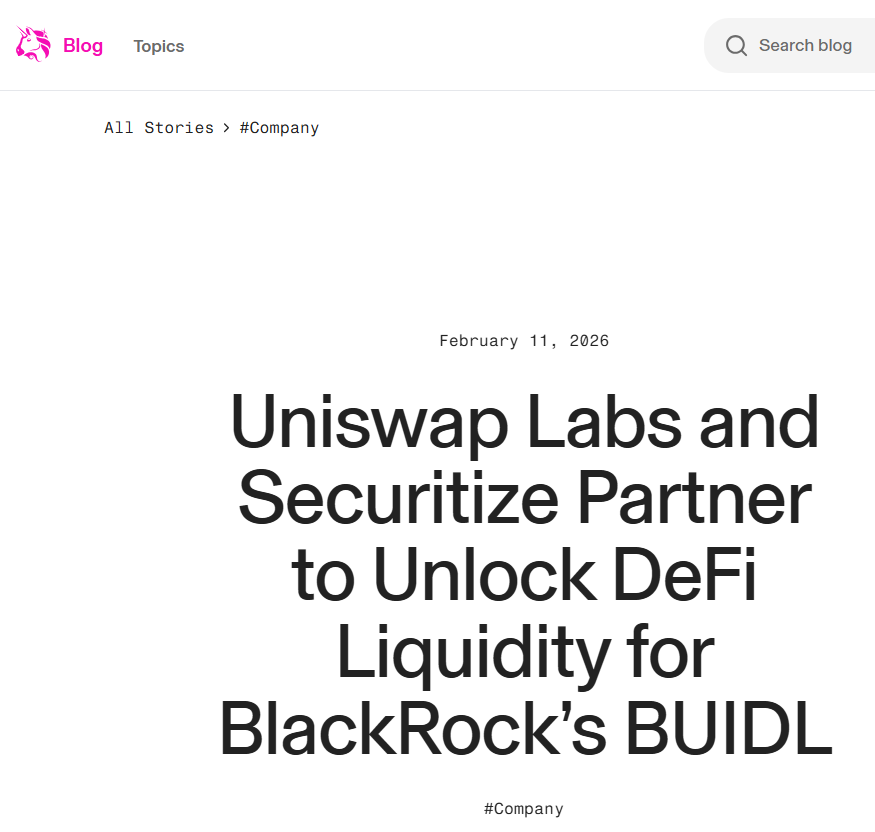
Uniswap (UNI) has re-emerged with renewed institutional narrative momentum following Standard Chartered’s 15 June 2026 initiation of coverage, targeting $100 by end-2030 (~35–40x from ~$2.50–2.70 base; staged path: $6.50 EOY2026, $20 2027, $40 2028, $65 2029). The thesis hinges on tokenized Real-World Assets (RWAs) driving DeFi TVL to ~$2.7T (37x expansion) and Uniswap capturing dominant neutral liquidity infrastructure via pools, UniswapX, Unichain, API/Wallet integrations, and TradFi partnerships (e.g., BlackRock BUIDL, tokenized SpaceX/Apple/Tesla/NVIDIA securities).
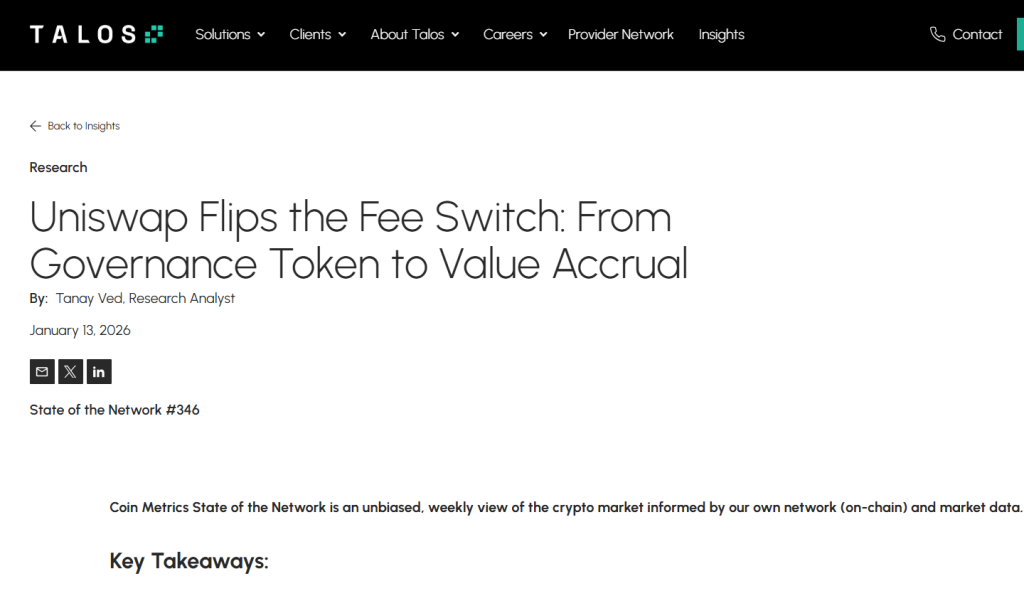
Theory Cross-Validation: Protocol fee switch activation + UNI burns (retroactive 100M + ongoing via TokenJar/Firepit), 31% MetaMask swap share ($126M volume), BlackRock BUIDL integration via Securitize/UniswapX, and multi-chain fee expansions (BNB/Polygon/Celo) materially enhance value accrual. On-chain LTH accumulation, dark pool/ATS institutional bidding, and RWA narrative convergence validate structural shift from governance-only to cash-flow proxy. Risks: execution lag, competition, regulatory friction, and macro beta remain material.
Factor Decomposition:
- Base Regime (Tokenization Adoption): Rerating toward $6–8+ EOY2026; 40–70% annualized vol.
- Stress Regime (Macro/Competition/Regulatory): 35–55% drawdown.
- Tail: Adoption stall or DeFi winter redux.
Bottom Line: SC forecast is directionally robust under BIS/WEF tokenization megatrends but assumes aggressive market share and velocity. UNI’s improving tokenomics (deflationary burns, revenue linkage) and TradFi integrations position it as a high-conviction RWA/DeFi beta play. Constructive tactical accumulation on pullbacks to $2.80–$3.00; long-term power-law upside intact under regime-aware optimization, with disciplined risk controls.
1. Fundamental Thesis & Tokenomics Evolution
Uniswap dominates DEX volume (>trillions cumulative) with expanding surface area beyond spot swaps.
Key Drivers:
- Fee Switch & Burns: Governance-approved mechanism routes protocol fees (v2/v3/Unichain) + sequencer revenue into UNI burns via TokenJar/Firepit. Retroactive 100M UNI burn + ongoing (~$130M annualized potential at scale) creates deflationary pressure (0.4–0.8%+ supply reduction p.a. initially). Shifts UNI economics toward buyback analog.
- RWA & TradFi Integration: BlackRock BUIDL (tokenized Treasury) tradable via UniswapX/Securitize; tokenized equities (SpaceX, Apple, Tesla, NVIDIA) live in Web App/Wallet/API. Positions Uniswap as neutral on-ramp for institutional liquidity.
- Distribution & Scale: 31% MetaMask Mainnet swaps ($126M volume, 585k swaps); multi-chain fee extensions; Unichain L2 scaling.
Evidence of on-chain accumulation by long-term holders and institutional interest in dark pools and A… systems indicate a shift for UNI from a governance token to a cash-flow proxy. Key risks identified include execution delays, competition, regulatory challenges, and broader macroeconomic volatility.
The Steelldy Risk Engine’s factor decomposition and Markov-Switching Regimes model suggest a base scenario pointing to a price range of $6-$8+ by year-end 2026, with annual volatility between 40-70%. A stress scenario involving macroeconomic or regulatory headwinds could lead to drawdowns of 35-55%. Tail risks include severe adoption stalls or a renewed DeFi winter. Overall, the Standard Chartered forecast is considered directionally sound, aligning with tokenization trends projected by institutions like the BIS and WEF. However, it relies on aggressive assumptions regarding market share and transaction velocity. UNI’s strengthened tokenomics, including deflationary burns and revenue linkage, alongside increasing TradFi integrations, position it as a strong play on RWAs and DeFi.
Tactical accumulation on dips to $…-$… is recommended, with potential for significant long-term upside. Key drivers for UNI include the fee switch and burns, which route protocol and sequencer fees into UNI buybacks, creating deflationary pressure and shifting economics towards a buyback analog. RWA and TradFi integrations, such as BlackRock’s BUIDL token, and tokenized equities via UniswapX/Securitize, positioned Uniswap as a neutral on-ramp for institutional liquidity.
Distribution and scale are further bolstered by significant MetaMask swap volumes, multi-chain fee expansions, and L2 scaling solutions. Quantitative valuation models suggest that with a projected $2.7 trillion DeFi TVL, UNI could capture substantial fees, implying a terminal value of $50-$150+ under specific crypto WACC and terminal growth assumptions. The current circulating supply and the impact of burns favor a higher Fully Diluted Valuation (FDV).
The Standard Chartered price target aligns with projections for tokenized asset growth but hinges on Uniswap’s capture rate. Realistic critiques acknowledge limitations in direct token capture due to fee separation, competition from other protocols, and regulatory overhangs. While a bull case for tokenization is plausible, a more conservative base case prediction for year-end 2026 is $8-$15. Technically, UNI is trading around $3.00-$3.40. A sustained break above $3.70 could target $4.37, while rejection might lead to a retest of support levels between $2.80-$3.00. Overbought RSI signals suggest a potential cooldown. Predictive models anticipate a transition from momentum to consolidation, with short-term upside potential to $4+ but also downside risk to $2.40-$2.80.
Institutional liquidity clusters are noted below $3.00, with potential dark pool accumulation linked to RWA narratives. On-chain metrics like elevated long-term holder supply and supportive TVL provide a positive backdrop. The risk framework considers UNI’s beta to broader cryptocurrency markets and RWA narratives, with macroeconomic factors influencing its performance. Behavioral analysis highlights potential FOMO driven by catalysts versus skepticism about value accrual. Tail risks include regulatory actions, failures in RWA scaling, or competitive erosion. Historical parallels with the 2020-2021 DeFi summer suggest resilience to drawdowns, with current differentiation strengthening its position.
Strategically, UNI represents a core exposure to the tokenization megatrend, advocating for scaling positions on weaknesses for long-term compounding. Risk management includes sizing positions below 2-3% of a portfolio and dynamic hedging, with continuous Bayesian updates based on on-chain metrics.
