Skip to content Skip to sidebar Skip to footer

Tag: FED

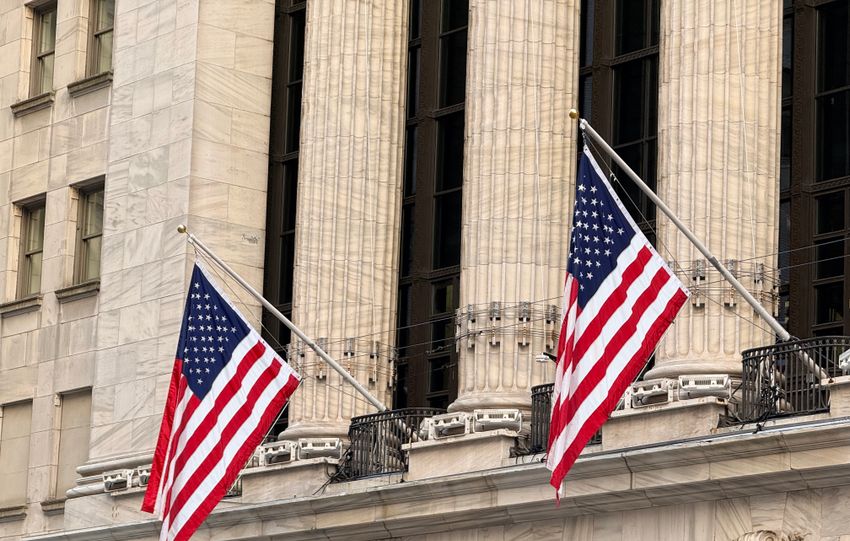
American flags displayed prominently on a historic Wall Street building in New York City.

Why Bank of America Still Sees Gold at $6,000 Despite Rate Hike Risks and Global Turmoil

Bank of America suggests gold could potentially reach $6,000, but not in the near term, due to significant headwinds from the Federal Reserve's tightening monetary policy. The bank was previously optimistic during gold's rally last year, expecting prices to hit $6,000 by spring. However, a recent correction has led its metals research team, led by…
Read more

Is Gold’s Dip a Warning or a Buying Opportunity? Unpacking the Bull Market’s Next Move

Recent news headlines have shifted as frequently as gold prices, leaving investors questioning market direction. A disconnect between record demand forecasts and sluggish price action adds to the confusion. Damian White and Joe Elkjer analyze the noise to clarify gold’s dynamics, examining whether the recent price decline is a warning or a pause in a…

Read more

BoJ Rate Hike Weakens Yen transmission, Damping Bitcoin Volatility

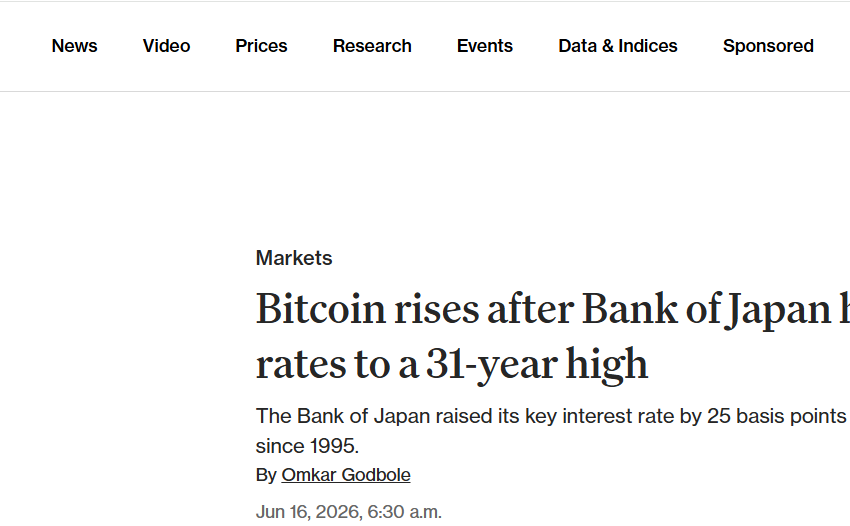
The transmission mechanism Yen strength → USD/JPY depreciation → yen carry trade deleveraging → global liquidity contraction → BTC risk-asset beta spike (~2–3x) remains empirically robust. However, it is significantly attenuated following the BoJ’s fully delivered and well-telegraphed 25 bps hike to 1.0% (highest since 1995) on 16 June 2026. Speculative net-short JPY positions elevated…

Read more

Smartphone displaying trading app with Bitcoin coins on a dark surface.

Bitcoin Struggles Near $66,000 Amidst Extreme Fear: What’s Next?

Bitcoin (BTCUSDT) trades at approximately $65,400–66,000, down ~0.8% in the observed session, within a recent consolidation range post a relief bounce from sub-$60k lows earlier in June 2026. The provided chart confirms a 1H/4H structure with MA5/10/20 clustering near $66,200–66,300, recent rejection at $67,255 highs, and downside probe the Fair Value Gap (FVG) zone around…

Read more

A dimly lit TotalEnergies gas station at night in Nairobi, Kenya, featuring prominent signage.

Refiner Margin Squeeze and the 3:2:1 Crack Spread Signal: Technical Analysis with Focus on TotalEnergies (as of mid-June 2026)

Executive Summary The 3:2:1 crack spread serves as a primary proxy for gross refining margins, calculated as: 3:2:1 Crack Spread=2×PGasoline (bbl)+1×PDistillate/Heating Oil (bbl)−3×PCrude (bbl)3\text{3:2:1 Crack Spread} = \frac{2 \times P_{\text{Gasoline (bbl)}} + 1 \times P_{\text{Distillate/Heating Oil (bbl)}} - 3 \times P_{\text{Crude (bbl)}}}{3} where prices are typically futures-settled (e.g., WTI/RBOB/NYH HO for USGC benchmarks; Brent equivalents or regional baskets for Europe).…

Read more

Two gold bars rest on a pile of US dollar bills, symbolizing wealth and prosperity.

Inflation Surge Crushes Gold & Silver Amidst Geopolitical Turbulence

Gold prices have plummeted, trading near $4,078.00, down 4.26%, and silver near $63.605, down 2.66%, following Wednesday's trading close. This decline is attributed to a higher-than-expected May inflation report, rising Treasury yields, and escalating US-Iran tensions, which have overshadowed demand for safe-haven assets. US consumer prices rose 0.5% in May and 4.2% year-on-year, with core…

Read more

A dynamic image showcasing Bitcoin, credit cards, and financial apps for investment enthusiasts.

Construction of a Conditional Hedge via MNQ Micro E-mini Nasdaq Short. Calibration on BTC Beta=0.45

This study details an advanced quantitative modeling of a conditional hedge for a crypto-exposed portfolio, employing Micro E-mini Nasdaq-100 (MNQ) futures contracts as the hedging instrument. The calibration is based on a dynamic conditional beta of BTC/Nasdaq at 0.45, estimated using a multivariate DCC-GARCH(1,1) model with Markov regime switching. Key Findings: ¤ Minimum Variance Hedge…

Read more

Analysis of the paradigmatic transition towards a “Digital Bretton Woods” and quantitative modeling of the risks/returns of Real World Asset (RWA) Tokenization

We are not in a classic crypto cycle; we are witnessing the commoditization of the settlement layer. Bretton Woods I (1944) used a gold-pegged dollar settled via correspondent banks (SWIFT/CHIPS). The current regime (post-1971) relies on the petrodollar and sovereign debt. Bretton Woods 2.0 is based on a Dual Pillar Regime: 1. Physical Pillar…

Read more

Taxonomy and Characterization of Carbon Credit Tokens (CCTs)

1.1 Direct Ownership Tokens 1.1.1 On-chain Representation of Carbon Credits Held in Custody by the Investor Direct ownership tokens constitute the most fundamental form of carbon credit tokenization, representing a digital claim on a physical carbon credit held in custody by an accredited custodian. This structure ensures a one-to-one correspondence between the issued token and…

Read more

Inflation Shock Triggers Counterintuitive 1.5% Gold Plunge as Fed Hike Bets Soar

On Tuesday, May 12, 2026, gold prices dropped by 1.5% to $4,665 despite the US Bureau of Labor Statistics reporting the April Consumer Price Index (CPI) at 3.8% year-over-year, the highest since May 2023. This counterintuitive movement occurs because high inflation data first influences the Federal Reserve's expectations, which then drives market reactions, often moving…

Read more