Contagion in AI financing cannot be understood through valuation levels or even growth rates. It must be understood through the dependency structure of counterparties and the second derivative of infrastructure spending.
Our cross-analysis shows:
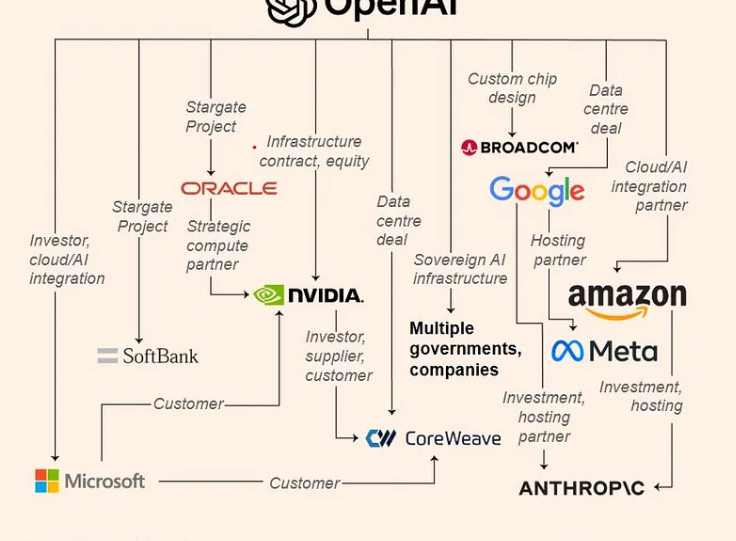
¤ The central risk is not the disappearance of AI demand, but the existence of a correlation of one around OpenAI, whose solvency depends on valuation refreshes, not operational cash flow.
¤ The dependency graph of contractual flows (take-or-pay, RPO, debts, guarantees) places OpenAI in a position of maximum betweenness centrality. A significant portion of credit paths pass through it.
¤ OpenAI’s distress probability, estimated using a Merton structural model, reaches approximately 14.7%, despite an implied valuation of $852 billion.
¤ The direct impact of an OpenAI default on hyperscaler backlogs is estimated at $63 billion in expected losses, theoretically absorbable by hyperscaler balance sheets, but triggering a freeze in refinancing for neoclouds, which have no absorption capacity.
¤ Nvidia’s 5-year CDS at 79.8 bps implies a cumulative default probability of 6.4%, with high systemic risk measured by ΔCoVaR ≈ -9.5 percentage points.
¤ The current crypto rebound (BTC ≈ $77,221) is a local short-squeeze supported by ETFs and Treasury liquidity, but fragile: the implied correlation with the AI risk factor remains high (0.45–0.60).
¤ Gold at $4,600 confirms institutional hedging against systemic risk.
The conclusion is simple: the system is vulnerable to deceleration, not recession. The correlation of one transforms an idiosyncratic shock into a systemic shock.