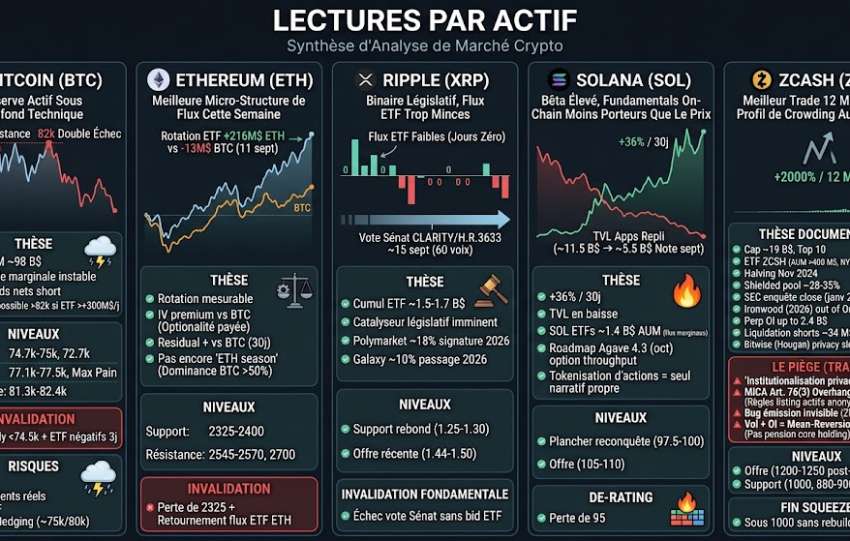
The framework is a two-regime Markov model with observable states, not a calibrated HMM
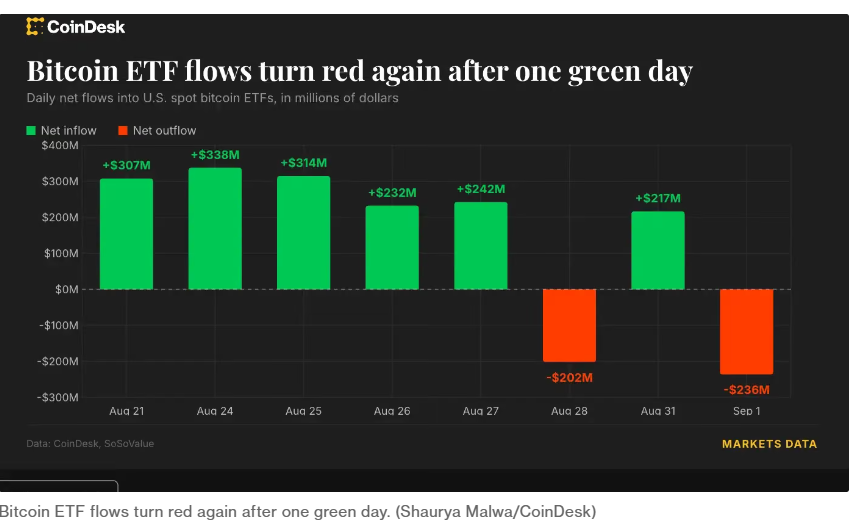
Regime 1 (Liquidity risk-on) is indicated by positive 5-day net $BTC / $ETH ETF flows, declining $DXY, funding below 0.03% per 8 hours, and BTC above 77.1k then 81.3k.
It implies overweighting ETH/ $SOL relative to BTC, with only reduced $ZEC…
The RWA market has entered an industrialization phase; the discriminating factor for allocation is no longer TVL but the structural quality of flows (liquidity, compliance, yield distribution). Key data (mid-2026). On-chain distributed value: ~$31–36 billion (+380% from 2022); “represented” value: ~$340–369 billion; stablecoins (settlement layer, counted separately): ~$290–321 billion; RWA holders: ~790,000; tokenized Treasuries: ~$15.1…
Two invisible infrastructures converge in 2026: MiCA's licensed perimeter for crypto-assets, and the ISO 20022 migration of payment messaging. One regulates assets, the other the messages that carry them. What boards need to understand before November.
Since 1 July 2026, a MiCA license is mandatory for crypto-asset service providers across all 27 EU member states,…
For a decade, the value of a digital asset depended on the promise of a higher resale price. The tokenization of real-world assets (RWA) reverses this logic: value is now read in cash flows, rents, coupons, interest—generated by the underlying asset and distributed automatically. Analysis of a paradigm shift that brings crypto closer to private…
As of September 11, 2026, the crypto market presents a mixed macro regime. Bitcoin trades near $77,200–77,400, showing a -4.7% weekly decline as it digests levels below $80,000–82,000. ETF outflows have been observed for three days. Ethereum is around $2,470–2,480 with slight daily stability but a weekly -2%, while XRP at $1.35 drops -6.6% weekly…
Thesis. The 2026 AI cycle shifts from conversational models to "digital workers" (agents) and physical AI (robots, driving, inspection); value migrates from the model layer to operational integration and automated real assets, converging directly with smart cities and tokenizable infrastructure. Key Data. ~71% of companies are expected to integrate AI agents into key functions…
Thesis. Two "invisible" projects converge in 2026: the completion of the licensed perimeter under MiCA (crypto) and the ISO 20022 mandate for structured addresses (payments). Together, they shape the compliance-execution layer of European programmable finance.
Key data. MiCA: ART/EMT applicable since 30/06/2024; CASP since 30/12/2024; end of grandfathering on 01/07/2026 (some states earlier: Germany/Ireland…
Thesis. Raw materials are regaining a core portfolio role (hedging a multipolar world and AI electrification), while European ESG shifts from an obligation-based regime to a market-driven one, less reporting, more pricing. Key Data. January 2026 records: gold ~$5,405/oz (2025 annual average: $3,431, +44%), silver >$121/oz, LME copper $13,238/t. Citi scenarios (Q3 2026): Brent…
Thesis. The European Omnibus did not kill ESG: it transformed it from a mass legal obligation into a competitive market advantage. Demand for reliable ESG data is shifting from the regulator to the investor, the bank, and the buyer and ESG ratings themselves are now under supervision.
The new regime (Directive (EU) 2026/470, in…
The macro regime as of September 2, 2026, shows a strong U.S. dollar (DXY at ~99.73-99.80) and rising 10-year U.S. Treasury yields (4.78-4.81%), pressuring risk assets. An oil supply shock (Brent ~$95.3, WTI ($4,290-4,325/oz) is declining due to real yields and dollar strength. A Hidden Markov Model (HMM) identifies the current regime as "Transition"…
Analyse de marché
Carbon Credit Market