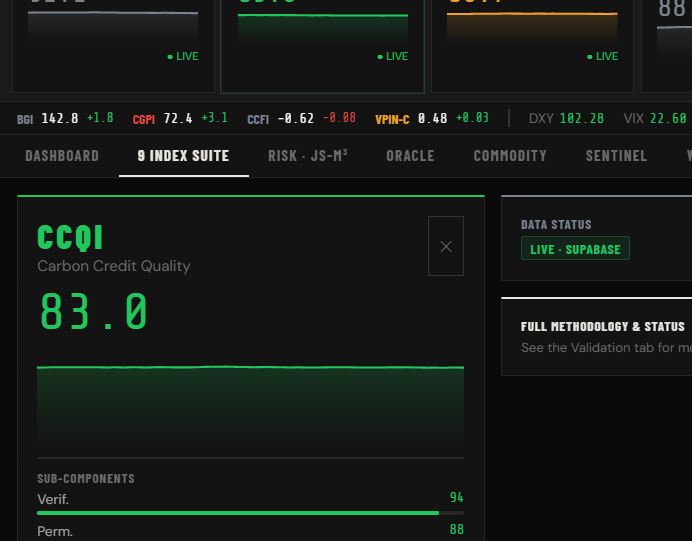
1.1 Adaptation of the Merton Model: Adjustment of the Probability of Default (PD) using the CCQI Index
The integration of the CCQI Index into credit risk models relies on adapting the structural framework of Merton (1974), where a borrower's Probability of Default (PD) is determined by the distance between the value of their assets and…
CCQI index and characterization of TCMs: Tracking Tokenization of RWAs and Carbon Credits
1.1 Methodology for the STEELLDY CCQI (Climate Credit Quality Index)
1.1.1 Definition and Objectives of the Index: Carbon Credit Quality Benchmark for the Voluntary Market
The Climate Credit Quality Index (CCQI), developed by STEELLDY, is a proprietary benchmark for the quality of…
(1) XRP — Settlement Layer and Liquidity Bridge
XRP serves as a neutral liquidity bridge between different fiat currencies and tokenized assets. The arrival of seven US spot XRP ETFs (approximately $1 billion in AUM) signals progressive institutionalization. Demand for XRP structurally stems from the volume of transactional flows, which creates continuous buying pressure…
The gradual shift of the XRP Ledger (XRPL) from a simple payment network to a true institutional settlement layer (RWA, tokenization, interbank cross-border settlements) is empirically observable.
J.P Morgan recently revealed its utilization of the XRPL.✅ Up next? 🙇♂️ Goldman Sachs and Citi.😏💨 https://t.co/nCu062uXxz — SMQKE (@SMQKEDQG) May 9, 2026
Quantitative Validation Elements …
The impact of the Pillar Two international tax regime (OECD) on the valuation and structuring of tokenized carbon credit (TCC) investments, particularly in France.
(A) Structural effect of Pillar Two on the taxation of TCCs
¤ Pillar Two imposes a minimum effective rate of 15% on the profits of multinational corporations, neutralizing tax optimization…
Cohort-Normalized CVD (Cumulative Volume Delta): Colored lines reveal that small orders ($100–$10K, green/orange lines) are buying on upward moves, while large blocks ($1M+, purple lines) are selling. Correlation with our April 27th statements : The April 27th post hypothesized a "stealth institutional distribution" in the $77,000–$80,000 range, with a negative delta of –699.51 and a…
Notre analyse multi-modèles appliquée aux données publiques confirme que TotalEnergies utilise une architecture complexe d’optimisation fiscale via sa filiale de trading à Genève. La catégorie "reste du monde" dans ses rapports fiscaux agit comme une variable proxy pour des juridictions à fiscalité réduite, principalement la Suisse.
Les travaux empiriques de l’Institut de Genève ont démontré…
UBS analysts forecast a significant increase in gold prices, predicting a rise of 20% to reach $6,200 per ounce by the end of 2026, up from current levels. This projection persists despite gold's subdued performance following the conflict with Iran, where it failed to act as a strong safe-haven asset, contrasting with its 65% surge…
In a podcast discussion, Mike Maharrey of Money Metals interviewed Brian Lundin, President and CEO of Jefferson Financial, regarding factors influencing the gold and silver markets. Lundin argued that long-term monetary trends, rather than short-term geopolitical events, fundamentally drive metal prices.
While global conflicts like tensions involving Iran caused brief spikes in gold prices…
1. RÉSUMÉ EXÉCUTIF
Les amendements FinSA/FinIA et la Loi fédérale sur l’adaptation du droit fédéral aux développements de la technologie des registres électroniques distribués (dès 2021) ont restructuré le paysage des actifs numériques suisses, modifiant les profils de risque des contreparties et provoquant une fragmentation mesurable de la liquidité sur les marchés d'options crypto. …
Analyse de marché