The Trans-Saharan Gas Pipeline (TSGP) — a 4,128 km project linking Nigerian gas fields (Warri region) through Niger to Algeria’s Hassi R’Mel hub, with onward connection to European markets via existing Algerian infrastructure — represents a geostrategic diversification play for Europe amid categorical reduction of Russian fossil fuel dependence (oil imports down to <3-5% of…
Executive Summary
Satellite signatures combined with AIS vessel tracking and OSINT currently indicate elevated refinery activity in US/Europe amid global disruptions, but severe anomalies in Middle East tanker flows through the Strait of Hormuz. As of mid-June 2026, Hormuz transits are near-historic lows (often <10 vessels/day, down 70-97% from baseline), with widespread "dark" operations…
Executive Summary
Reduction in refined fuel demand (gasoline/diesel) is primarily driven by electrification (EV penetration ~25% global new sales 2025, displacing ~1.2 mb/d oil equivalent), efficiency gains (MPG improvements offsetting VMT growth), and behavioral shifts, not dominantly by 15-minute city models. The 15-minute city (proximity-based urbanism) and smart digitalized local economies contribute secondarily via…
Executive Summary
Transition risks under 2°C pathways (IEA NZE/APS equivalents) drive structural demand destruction for refined products, compressing refining margins via volume contraction, utilization drops, and policy/carbon cost overlays. Carbon Tracker’s foundational 2017 “Margin Call” analysis projected >50% EBITDA decline by 2035 for ~94% of global capacity under a 2D scenario (oil demand -23%…
1. Carbon Pricing Framework: Explicit (EU ETS) vs. Implicit/Internal Shadow Pricing
TotalEnergies employs an internal carbon price (ICP)1 or shadow price in its project evaluations and asset impairment testing. Currently, its base case includes a minimum price of $100/tCO₂ (or higher jurisdictional prices) starting in 2023, with a 2% annual increase after 2030.
Sensitivity…
Executive Summary
The 3:2:1 crack spread serves as a primary proxy for gross refining margins, calculated as:
3:2:1 Crack Spread=2×PGasoline (bbl)+1×PDistillate/Heating Oil (bbl)−3×PCrude (bbl)3\text{3:2:1 Crack Spread} = \frac{2 \times P_{\text{Gasoline (bbl)}} + 1 \times P_{\text{Distillate/Heating Oil (bbl)}} - 3 \times P_{\text{Crude (bbl)}}}{3}
where prices are typically futures-settled (e.g., WTI/RBOB/NYH HO for USGC benchmarks; Brent equivalents or regional baskets for Europe).…
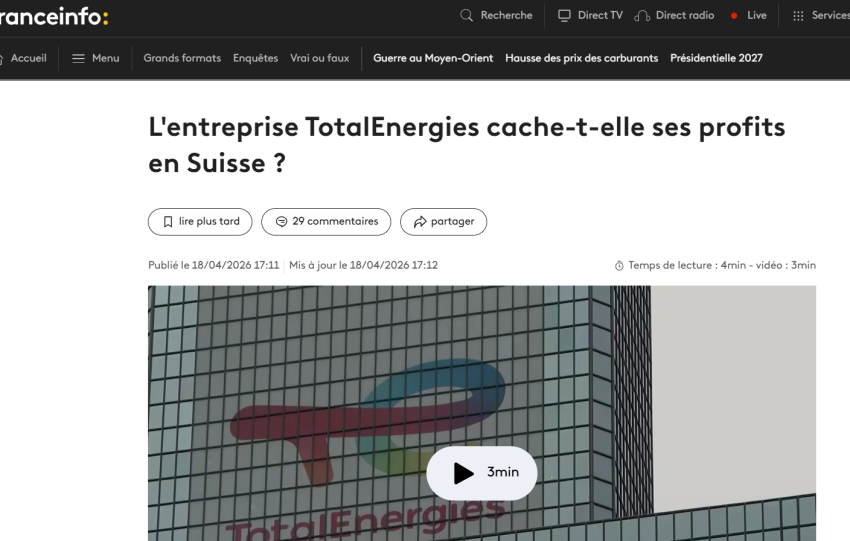
Notre analyse multi-modèles appliquée aux données publiques confirme que TotalEnergies utilise une architecture complexe d’optimisation fiscale via sa filiale de trading à Genève. La catégorie "reste du monde" dans ses rapports fiscaux agit comme une variable proxy pour des juridictions à fiscalité réduite, principalement la Suisse.
Les travaux empiriques de l’Institut de Genève ont démontré…
L'interdiction par l'Union européenne d'importer des produits pétroliers d'origine russe, y compris ceux raffinés hors de Russie depuis le 21 janvier (suite à la 18e série de sanctions adoptée en juillet 2025), force les transporteurs à modifier leurs schémas logistiques. Auparavant, les pétroliers transportant des produits russes pouvaient se recharger en Inde ou dans d'autres…
Analyse de marché
Décarbonisation