Synthetic carbon credit tokens provide derivative exposure to carbon markets (e.g., ICE EUA, voluntary indices) via futures, total return swaps, or oracle-replicated performance, without physical custody or retirement of underlying credits. This delivers operational efficiency (fractionalization, 24/7 liquidity, reduced verification costs) but introduces material counterparty risk (issuer solvency/fulfillment), basis/tracking error risk (deviation from reference index…

Tech
Artificial intelligence, Semiconductors, Cyber Security, Social Media
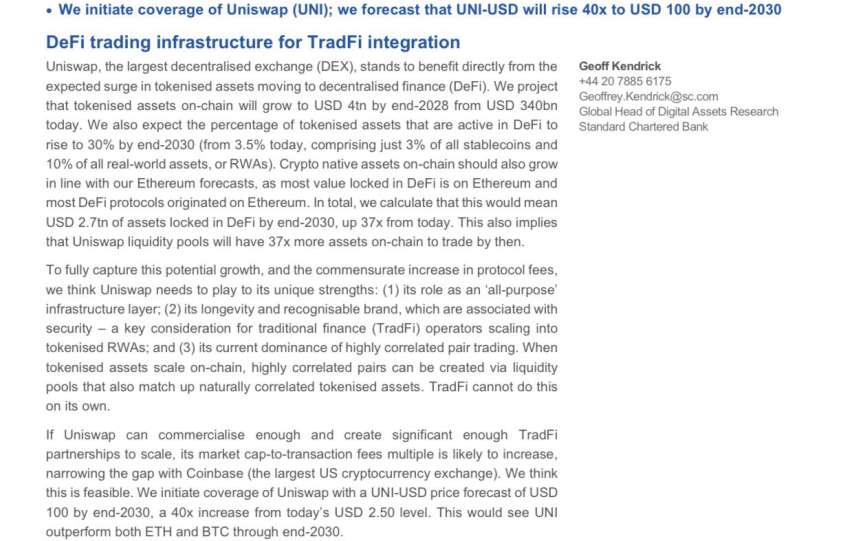
Uniswap (UNI) has re-emerged with renewed institutional narrative momentum following Standard Chartered’s 15 June 2026 initiation of coverage, targeting $100 by end-2030 (~35–40x from ~$2.50–2.70 base; staged path: $6.50 EOY2026, $20 2027, $40 2028, $65 2029). The thesis hinges on tokenized Real-World Assets (RWAs) driving DeFi TVL to ~$2.7T (37x expansion) and Uniswap capturing dominant…
Uniswap’s UNI token (current price ~$3.00–3.40 post-surge, market cap ~$1.9–2.1B) experienced a +25%+ daily move on Standard Chartered’s initiation coverage with a $100 target by 2030 (from ~$2.50–2.70 base, implying ~35–40x upside). The thesis centers on tokenized Real-World Assets (RWAs) migrating on-chain, driving DeFi TVL to ~$2.7T (37x expansion) and Uniswap capturing dominant DEX liquidity/trading…
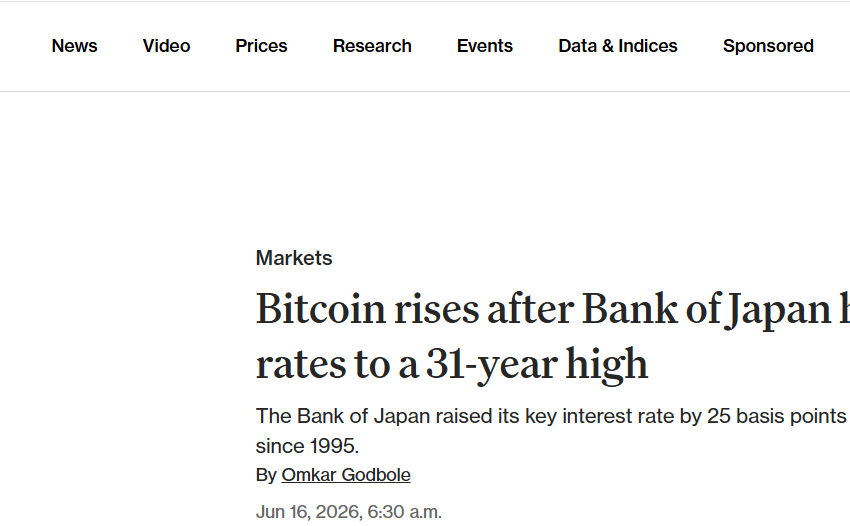
While the BoJ’s 25 bps hike to 1.0% (highest since 1995) keeps the yen carry transmission channel active but damped, real risks to BTC increasingly reside elsewhere: a maturing macro slowdown (US Q1 2026 GDP +1.6% annualized, Eurozone ~0.8% projected for 2026), volatile Bitcoin ETF flows (recent outflows amid cumulative ~$54B+ inflows since launch but…
The transmission mechanism Yen strength → USD/JPY depreciation → yen carry trade deleveraging → global liquidity contraction → BTC risk-asset beta spike (~2–3x) remains empirically robust. However, it is significantly attenuated following the BoJ’s fully delivered and well-telegraphed 25 bps hike to 1.0% (highest since 1995) on 16 June 2026.
Speculative net-short JPY positions elevated…
Bitcoin (BTCUSDT) trades at approximately $65,400–66,000, down ~0.8% in the observed session, within a recent consolidation range post a relief bounce from sub-$60k lows earlier in June 2026. The provided chart confirms a 1H/4H structure with MA5/10/20 clustering near $66,200–66,300, recent rejection at $67,255 highs, and downside probe the Fair Value Gap (FVG) zone around…
This study details an advanced quantitative modeling of a conditional hedge for a crypto-exposed portfolio, employing Micro E-mini Nasdaq-100 (MNQ) futures contracts as the hedging instrument. The calibration is based on a dynamic conditional beta of BTC/Nasdaq at 0.45, estimated using a multivariate DCC-GARCH(1,1) model with Markov regime switching. Key Findings:
¤ Minimum Variance Hedge…
CTAs, large systematic trend-following funds, can trigger massive redemptions and forced selling during correlated drawdowns in tech indices like the Nasdaq-100. This poses a liquidity risk for crypto portfolios exposed to tech beta. The study models BTC's exposure to the Nasdaq-100 using a time-varying beta derived from DCC-GARCH, empirically calibrated at 0.45. This indicates that…
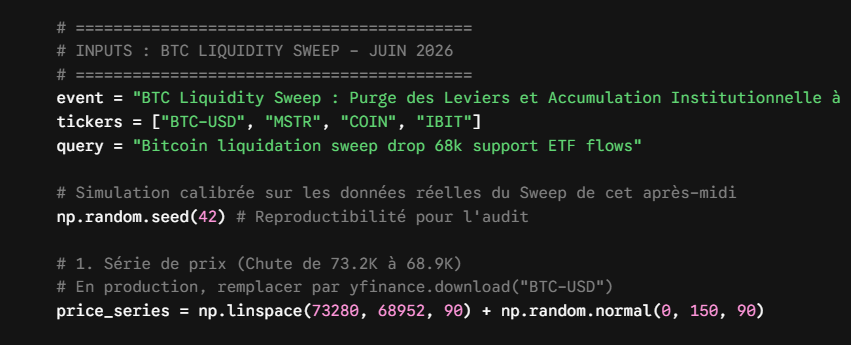
The current BTC price is part of a deep liquidity hunt orchestrated by |...| algorithms to trigger the programmed liquidation of CTAs, who must purge 2.4 million Long contracts. This 66,752 USD price is not a fundamental discovery but a microstructure artifact. Institutional |...| are using D Pools and O orders to absorb CTA and…
The announcement of a partnership between the DTCC and the Stellar Development Foundation (SDF) for asset tokenization on Stellar by mid-2027 represents a major institutional event for a public blockchain. This partnership could include equities, ETFs, and US Treasury bonds. However, a detailed analysis reveals several points:
1. Solid but not exclusive fundamental thesis:…