The expansion of AI data centers between 2019 and 2026E represents a structural shift from incremental cloud growth to a physical capacity race. Electricity availability at grid interconnection points and rack thermal capacity, rather than financial capital, have become the principal constraints. Net annual capacity additions accelerated by a factor of 7.4x between 2020–2022 and 2025–2026E, with AI infrastructure accounting for 84,9 % of additions over 2024–2026. This shift requires reassessing asset lifetimes, volatility, correlations and investment valuation models.
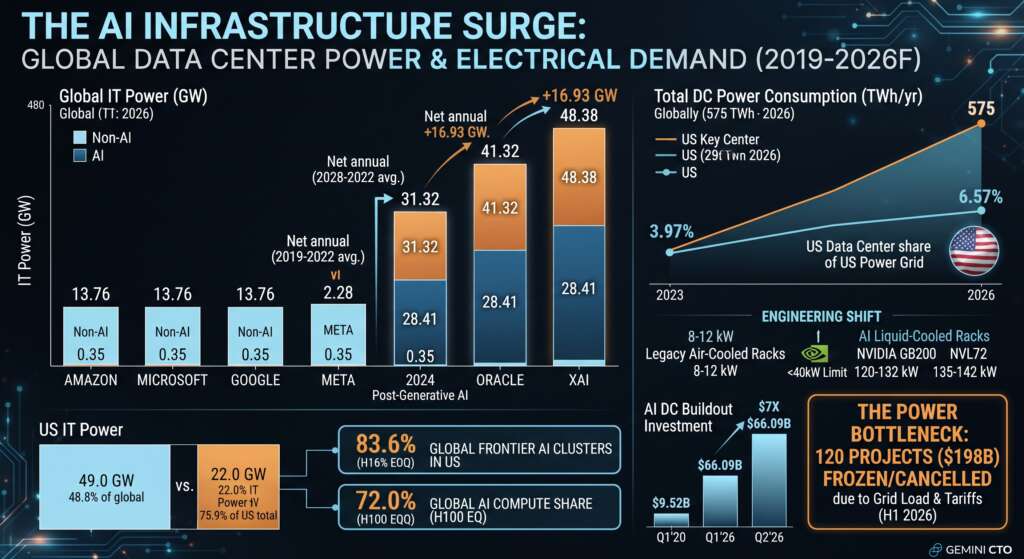
Installed IT capacity across the six largest operators (Amazon, Microsoft, Google, Meta, Oracle and SpaceX/xAI) increased from 6,91 GW in 2019 to 48,38 GW in 2026E, a 7,0x increase. Annual net additions reached +16,93 GW in 2026E, compared with +2,70 GW in 2022. The United States accounts for 30,37 GW, or 62,8 %, of the Top-6 capacity and 49,0 GW, or 48,8 %, of global installed IT capacity. Global data center capital expenditure is projected by Morgan Stanley to approach 850 milliards de dollars in 2026, while physical infrastructure represents an increasing share of hyperscaler spending.
Physical construction is increasingly undertaken before servers and chips are deployed, making construction delays and electricity connections major execution risks. The time between capital commitment and operational capacity depends particularly on grid congestion and installed cooling capacity. Large-load interconnection delays exceed eight years in some cases, leaving tens of gigawatts of planned capacity without grid access. Electricity connection constraints therefore shift investment risk away from GPU supply chains toward construction and electrical infrastructure.
The financing of AI infrastructure increasingly relies on GPU-backed loans and private credit. In March 2026, CoreWeave secured an 8,5 milliards de dollars term loan backed by HPC infrastructure and a customer contract, receiving an A3 investment-grade rating from Moody’s. However, the BIS identifies investment concentration, rising leverage, opaque financing arrangements and growing connections between traditional banking and private credit as structural risks. Basel III capital requirements and special purpose vehicle structures further shape financing conditions.
Electricity consumption and cooling requirements have become central physical constraints. Traditional cloud racks dissipated 8–12 kW and used air cooling, whereas NVIDIA GB200 NVL72 racks require 120–132 kW and GB300 racks up to 142 kW. The 40 kW air-cooling threshold has been exceeded, and 76 % of new AI capacity requires direct liquid cooling. Existing air-cooled facilities cannot be converted without major work, shortening their economic lifetimes and reducing their recovery values.
Energy efficiency also differentiates new and legacy facilities. The global average PUE has remained at 1,54 for six consecutive years, while the US building-power scenario for 2026E uses a PUE of 1,31. New-generation liquid-cooled facilities can reach 1,18. The improvement from 1,54 to 1,18 represents a 23 % reduction in total energy consumption for a given IT load, potentially avoiding several gigawatts of electricity demand across the 49 GW US IT capacity.
Financial models show that location and operational flexibility strongly influence project value. A 100 MW reference facility produces a positive NPV of +79,15 million dollars under PJM calibration, while ERCOT reaches 60,82 M$. Although waiting can create real-option value, competitive pressure encourages hyperscalers to invest even when expected returns approach zero NPV. This produces a repeated prisoner’s dilemma and a Nash equilibrium in which reducing capital expenditure risks losing market share. Monte Carlo simulations indicate a median NPV of 2 424 million dollars and P(NPV > 0) = 99,9 %, but shorter GPU lifetimes, lower rental rates, tenant concentration and refinancing costs create substantial downside risks.
Systemic concerns include the gap between infrastructure investment and measurable productivity. At the end of 2025, 95 % of surveyed organizations reported no measurable return on investment, while nearly two-thirds had failed to scale beyond pilot projects. On 22 January 2026, Elizabeth Warren and colleagues requested a formal FSOC investigation into opaque and risky AI-sector financing. The BIS nevertheless characterized the financing risk as moderate, not acute, while identifying private credit growth as a potential systemic risk amplifier.
The central 2026 scenario projects global data center electricity consumption of 565 TWh, up 26 % from 447 TWh in 2025, and global installed IT capacity of 100,5 GW. AI represents 21,2 GW, or 43,3 %, of US capacity. Interconnection delays could sharply reduce project returns: a 60 MW installation’s IRR falls from 17,1 % to 12,6 % after three months of delay and 8,8 % after six months. A broader credit repricing could also increase borrowing costs, freeze projects and depreciate GPU collateral.
For investors, data centers increasingly resemble infrastructure assets whose returns depend on long-term rental contracts, electricity costs and utilization. Electricity access time requires a separate congestion-risk premium reflecting location, load flexibility and behind-the-meter generation. GPU collateral also carries significant depreciation risk because accelerators lose substantial value within 18 to 24 months. The concluding recommendations are to prioritize projects with contractual speed-to-power, stress-test prolonged interconnection delays and lower GPU recovery values, and monitor the gap between capital expenditure announcements and actual revenues, alongside private-credit spreads. The fundamental constraint is no longer capital availability but access to electricity, cooling, land, water and regulatory approvals.