Société Générale projects a more moderate pace of gold purchases by central banks in the future. While central bank demand has been a key driver of gold's multi-year rise to an all-time high of $5,600, and a recent World Gold Council survey indicates continued official sector buying, one bank adopts a cautious stance, warning that…

While the BoJ’s 25 bps hike to 1.0% (highest since 1995) keeps the yen carry transmission channel active but damped, real risks to BTC increasingly reside elsewhere: a maturing macro slowdown (US Q1 2026 GDP +1.6% annualized, Eurozone ~0.8% projected for 2026), volatile Bitcoin ETF flows (recent outflows amid cumulative ~$54B+ inflows since launch but…
Executive Summary
The 3:2:1 crack spread serves as a primary proxy for gross refining margins, calculated as:
3:2:1 Crack Spread=2×PGasoline (bbl)+1×PDistillate/Heating Oil (bbl)−3×PCrude (bbl)3\text{3:2:1 Crack Spread} = \frac{2 \times P_{\text{Gasoline (bbl)}} + 1 \times P_{\text{Distillate/Heating Oil (bbl)}} - 3 \times P_{\text{Crude (bbl)}}}{3}
where prices are typically futures-settled (e.g., WTI/RBOB/NYH HO for USGC benchmarks; Brent equivalents or regional baskets for Europe).…
UBS has lowered its 2026 gold price target to $5,500 from $5,900, citing higher Treasury yields and a stronger dollar. Analysts Dominic Schnider and Wayne Gordon at UBS noted that "alternative costs" are becoming more significant as real interest rates remain high, making non-yielding assets like gold less attractive. However, the core reasons for a…
Estimated losses in the oil market reached 800 million barrels in March-April, growing to 1 billion barrels by mid-May, according to the IEA. This compares to a cumulative intervention of 400 million barrels, including the US. Before the conflict, global observable reserves in February stood at 8,185 million barrels; however, a significant portion is operational,…
Global gold ETFs registered inflows despite inflationary risks, with gold prices hovering near 4,700 per ounce at the start of the week. Analysts remain optimistic about a price recovery in the second half of the year due to sustained investment demand, evidenced by global gold-backed ETF inflows in April.
According to the World Gold…
The convergence of physical, behavioral, and microstructural signals confirms that Europe, and particularly France, has entered a regime of asynchronous systemic energy shortage. The three pillars of the breakdown:
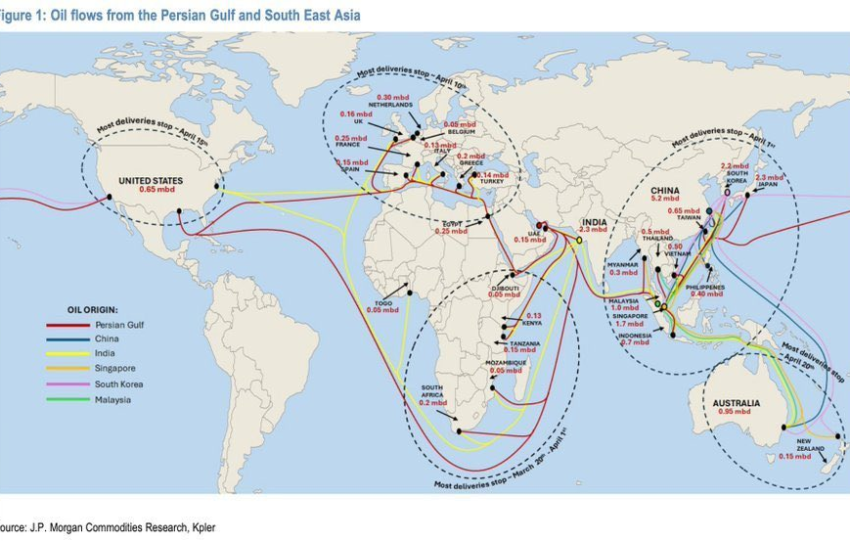
(a) Physical Pillar. The Strait of Hormuz has been practically blocked since February 28, 2026: more than 20% of global oil traffic and 25% of…
IATA chief says jet fuel supply could take months to recover after Hormuz reopening https://t.co/0KqLSqjPPM pic.twitter.com/H0qhi64avY — Alma Angeles (@AlmaANET25) April 8, 2026
IATA Director General Willie Walsh warning that jet fuel supply restoration in the Middle East will require months even after Strait of Hormuz reopening, due to major refining capacity damage. The statement follows…
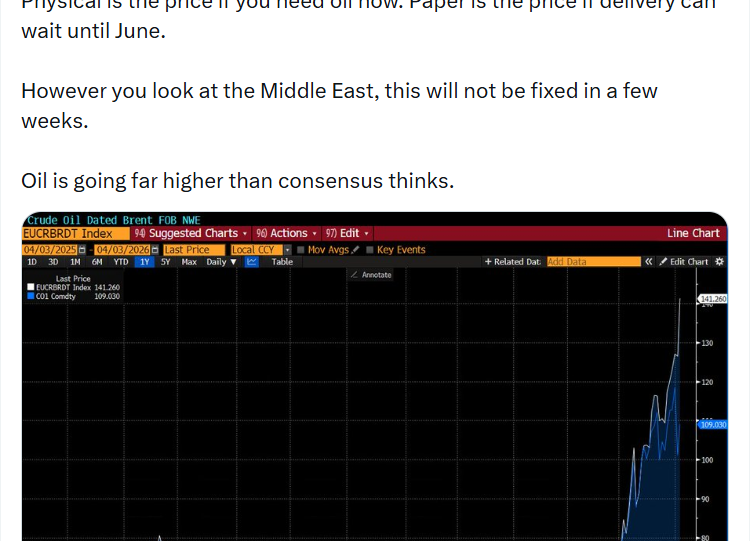
The Brent oil market shows an extreme divergence between the paper price (futures contracts) at $109 and the physical price (spot) at $141, a $32 gap reflecting a strong "backwardation." Normally, future prices are higher than spot prices (contango) due to storage costs; this inversion signals an immediate scarcity of physical oil. The $141 price…
Multi-engine analysis suggests that the closure of the Strait of Hormuz, leading to a supply shock of 20 Mb/d (20% of world consumption), has established a regime of "structural energy constraint." This regime is characterized by a high conditional probability of activating restrictive measures on mobility ("energy lockdown"), estimated at 81.3% for 03/31/26, according to…
Analyse de marché