$314.68B as of 21/06/2026 (382 issuers, DefiLlama), ~$323B at all-time high in May 2026, with remarkable resilience during a crypto bear market of -48%. Concentration: USDT $186.35B (59.22%) and USDC ~$77B = 83.02% of the market. USDC: +28% outstanding in Q1 2026, on-chain volume +263% to $21,500B.
The market processed >$33,000B in on-chain transactions…

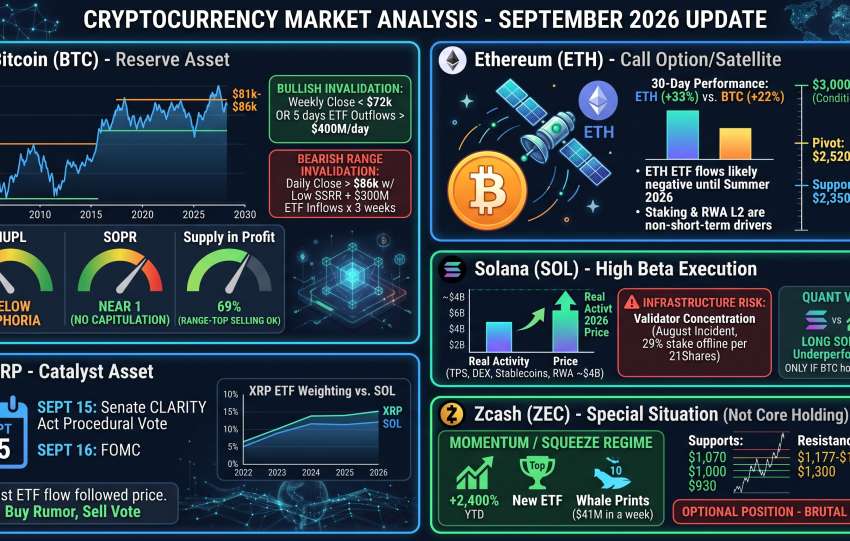
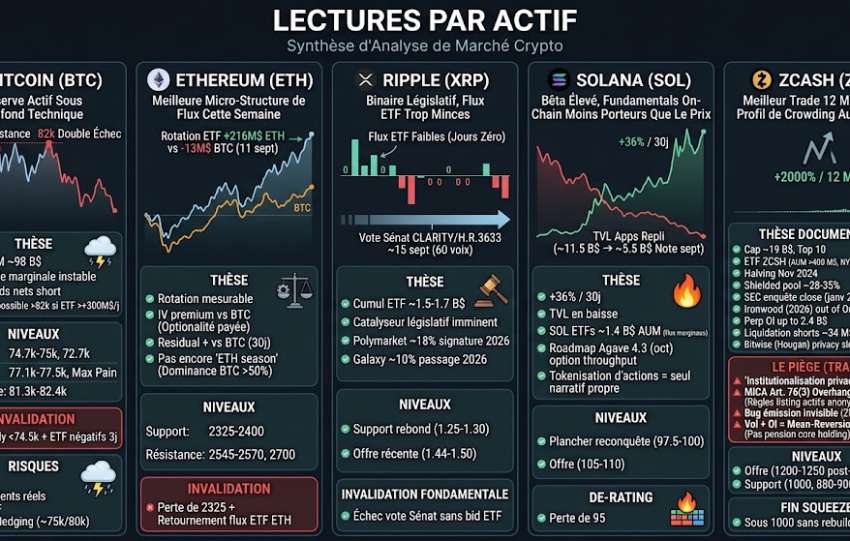
Bitcoin remains a reserve asset with a structure showing recovery from $58-62k, rejection under $81-86k, and consolidation around $77k. NUPL is below euphoria, SOPR near 1 (no capitulation or aggressive distribution), and 69% of supply is in profit—enough for range-top selling but insufficient for a blow-off. Bullish invalidation: weekly close below $72k or 5 days…
The framework is a two-regime Markov model with observable states, not a calibrated HMM
Regime 1 (Liquidity risk-on) is indicated by positive 5-day net $BTC / $ETH ETF flows, declining $DXY, funding below 0.03% per 8 hours, and BTC above 77.1k then 81.3k.
It implies overweighting ETH/ $SOL relative to BTC, with only reduced $ZEC…
The RWA market has entered an industrialization phase; the discriminating factor for allocation is no longer TVL but the structural quality of flows (liquidity, compliance, yield distribution). Key data (mid-2026). On-chain distributed value: ~$31–36 billion (+380% from 2022); “represented” value: ~$340–369 billion; stablecoins (settlement layer, counted separately): ~$290–321 billion; RWA holders: ~790,000; tokenized Treasuries: ~$15.1…
As of September 11, 2026, the crypto market presents a mixed macro regime. Bitcoin trades near $77,200–77,400, showing a -4.7% weekly decline as it digests levels below $80,000–82,000. ETF outflows have been observed for three days. Ethereum is around $2,470–2,480 with slight daily stability but a weekly -2%, while XRP at $1.35 drops -6.6% weekly…
Thesis. The 2026 AI cycle shifts from conversational models to "digital workers" (agents) and physical AI (robots, driving, inspection); value migrates from the model layer to operational integration and automated real assets, converging directly with smart cities and tokenizable infrastructure. Key Data. ~71% of companies are expected to integrate AI agents into key functions…
Thesis. Two "invisible" projects converge in 2026: the completion of the licensed perimeter under MiCA (crypto) and the ISO 20022 mandate for structured addresses (payments). Together, they shape the compliance-execution layer of European programmable finance.
Key data. MiCA: ART/EMT applicable since 30/06/2024; CASP since 30/12/2024; end of grandfathering on 01/07/2026 (some states earlier: Germany/Ireland…
Thesis. Raw materials are regaining a core portfolio role (hedging a multipolar world and AI electrification), while European ESG shifts from an obligation-based regime to a market-driven one, less reporting, more pricing. Key Data. January 2026 records: gold ~$5,405/oz (2025 annual average: $3,431, +44%), silver >$121/oz, LME copper $13,238/t. Citi scenarios (Q3 2026): Brent…
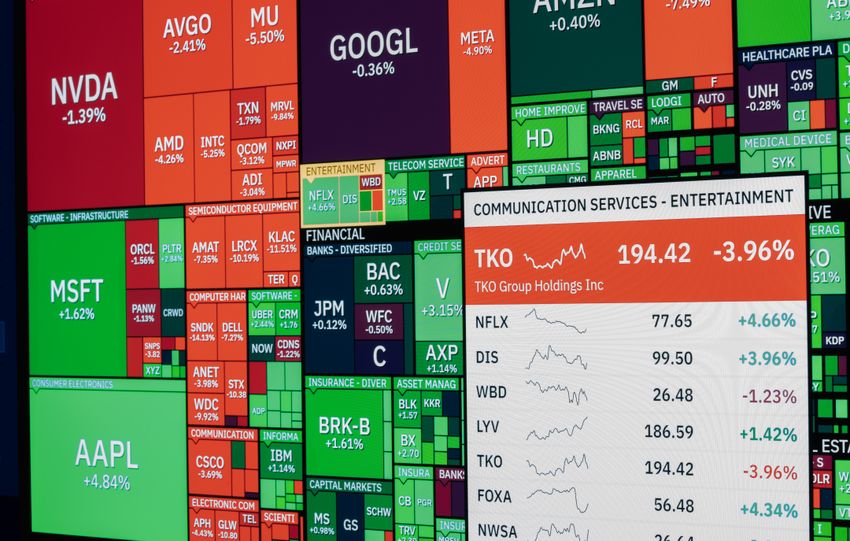
Gold was indeed a high-Sharpe asset during certain windows from 2025 to early 2026, and long-term bonds did under perform. However, as of September 7, 2026, gold does not "beat tech stocks" over 12 months. NVDA and the S&P have higher TTM returns than those shown in the table.
The illustrative recalibration (TTM window,…
Oil prices surged sharply after the US announced new strikes on southern Iran. Brent crude exceeded $92 per barrel, while WTI approached $90. Yields on 30-year Japanese government bonds (JGBs) surpassed 4.18%, and Nvidia exited the corporate bond market. How does this affect gold? Several explosions were reported near Bandar Abbas, Qeshm, and the Strait…
Analyse de marché