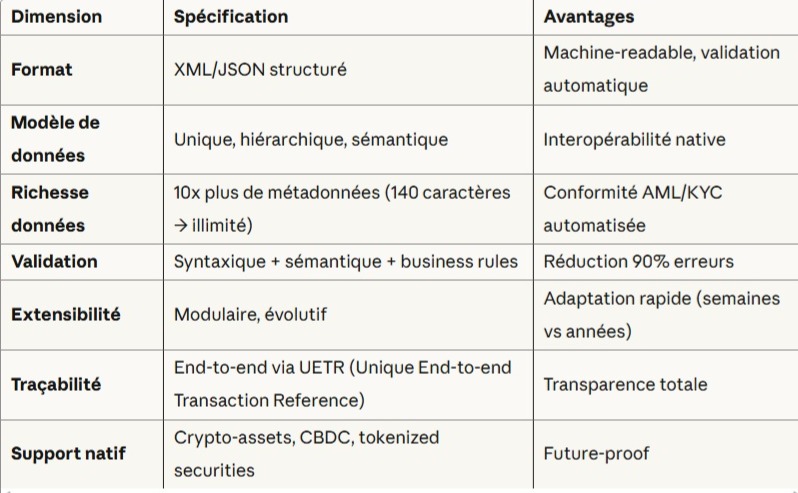
While the market focuses on tokens, the biggest financial data upgrade in history is being completed: after the end of the MT/MX coexistence (November 22, 2025, 97% of cross-border payments now in ISO 20022), November 14, 2026 mandates structured/hybrid addresses on SWIFT CBPR+ (SEPA on the 15th), with 65% of messages still non-compliant and 44% of banks behind schedule just four months from the deadline. Then: investigation management in camt.110/111 (November 2027), retirement of MT9xx statements (November 2028), migration of securities from ISO 15022 to 20022 (~2030).
Key data. Rejection of a message = $25-75 in manual intervention per transaction; reduction of AML false positives by 15-40% on structured data; investigation cycles reduced from 5-7 days to <48 hours on full-MX corridors; XRPL, native ISO 20022, operates 40+ ODL corridors and 120+ operators.
Analysis (quant lens). The desk’s angle is threefold:
1. Operational risk priced at zero. No curve reflects the probability of corridor disruption in November 2026. FX desks and treasuries mapping their counterparties’ exposure to non-compliance hold free asymmetric information.
2. Data becomes a product. Automated reconciliation at the invoice level for corporates, field-based screening (not free text), new revenue streams for banks: the migration is a P&L event, not just a cost.
3. Structural premium for native rails. A network with natively programmable data does not “migrate”: when compliance demands end-to-end structured fields, ISO-native DLT ledgers gain settlement quality points without doing anything. Our XSQI/XCDI indices already measure this, the gap will widen and become tradeable information.
Positioning. Long middleware/data remediation providers (the segment is having its record year), long ISO-native rails, short complacency: any institution “ready since November 2025” but whose ERP spits out free-text addresses is actually behind. Risks.
A partial deadline extension (unlikely: SWIFT’s community voting process allows for neither extension nor grace period); saturation of integration capacity (10-16 weeks implementation + 8-12 weeks procurement: the decision window closed in Q1 2026).
Overweight structured payment data. History will remember that programmable finance was won by those who mastered XML fields, not by those who minted tokens.