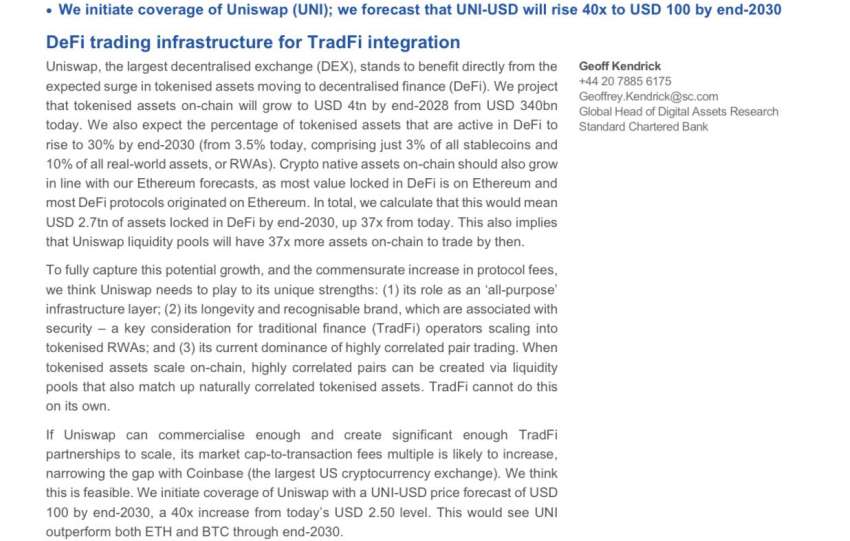
Uniswap (UNI) has re-emerged with renewed institutional narrative momentum following Standard Chartered’s 15 June 2026 initiation of coverage, targeting $100 by end-2030 (~35–40x from ~$2.50–2.70 base; staged path: $6.50 EOY2026, $20 2027, $40 2028, $65 2029). The thesis hinges on tokenized Real-World Assets (RWAs) driving DeFi TVL to ~$2.7T (37x expansion) and Uniswap capturing dominant…
Uniswap’s UNI token (current price ~$3.00–3.40 post-surge, market cap ~$1.9–2.1B) experienced a +25%+ daily move on Standard Chartered’s initiation coverage with a $100 target by 2030 (from ~$2.50–2.70 base, implying ~35–40x upside). The thesis centers on tokenized Real-World Assets (RWAs) migrating on-chain, driving DeFi TVL to ~$2.7T (37x expansion) and Uniswap capturing dominant DEX liquidity/trading…
The announcement of a partnership between the DTCC and the Stellar Development Foundation (SDF) for asset tokenization on Stellar by mid-2027 represents a major institutional event for a public blockchain. This partnership could include equities, ETFs, and US Treasury bonds. However, a detailed analysis reveals several points:
1. Solid but not exclusive fundamental thesis:…
The gradual shift of the XRP Ledger (XRPL) from a simple payment network to a true institutional settlement layer (RWA, tokenization, interbank cross-border settlements) is empirically observable.
J.P Morgan recently revealed its utilization of the XRPL.✅ Up next? 🙇♂️ Goldman Sachs and Citi.😏💨 https://t.co/nCu062uXxz — SMQKE (@SMQKEDQG) May 9, 2026
Quantitative Validation Elements …
1. Smart City Thematic ETFs: An Already Mature Vector for Institutional Investment
Smart City ETFs are a mature investment vehicle attracting significant capital, with around 40 products totaling approximately $15.6 billion in assets under management as of April 2024. Key examples include BlackRock's iShares Smart City Infrastructure UCITS ETF (CITY). These funds directly finance urban…
I. EXÉCUTIF QUANTITATIF. ARCHITECTURE UNIT
A. Caractéristiques techniques de la monnaie UNIT
PARAMÈTRE SPÉCIFICATION RISK TIER
────────────────────────────────────────────────────────────────────
Type d'actif Digital Trade Currency nouveau
Backing 40% or physique et 60% BRICS médium
Émetteur …
I. LE CONTEXTE MACRO : POURQUOI MAINTENANT?
A. La mort du monopole bancaire (2008-2025)
Évolution réglementaire post-GFC :
L'ère du monopole bancaire touche à sa fin, principalement à cause de l'évolution réglementaire post-crise financière mondiale (GFC). Les exigences de fonds propres (Bâle III et finalisation "Bâle IV") ont drastiquement augmenté les ratios (CET1, Leverage,…
Thèse principale
Nous avons atteint la phase terminale de la bulle IA 2.0, qui présente des ressemblances structurelles avec la bulle dot-com, cependant dissimulée par une liquidité abondante et une concentration intense au sein du S&P 500.
Le Bitcoin se présente comme l'actif anti-bulle qui est rare, décentralisé, non admissible au sauvetage financier,…
L'intégration des indices de stress financier (OFR FSI et Fed FSI Delta) valide la thèse que le marché Bitcoin évolue dans un environnement macroéconomique idéal pour la continuation haussière. L'absence de stress systémique élimine le risque d'un krach fondamental, confirmant que toute volatilité à court terme sera de nature purement technique. ◙ Variables Financial Stress…
Au troisième trimestre 2025, le volume des échanges de stablecoins a grimpé à un niveau sans précédent de 15,6 billion de dollars, avec 71% de ces transactions attribuées aux robots de trading. Néanmoins, les experts estiment que l'usage des stablecoins par les investisseurs individuels se dirige vers une année qui pourrait être la plus significative…
Analyse de marché