I. The Crunch Spread is the difference between a token’s production cost and its market price. It is calculated as (P_token,t – C_token,t) / C_token,t, where C_token,t includes GPU amortization, energy, and labor, and P_token,t is the market selling price. Data show that P_token fell by -92.5% between 2023 and 2026, while C_token rose due to higher energy and GPU rental costs. As a result, the Crunch Spread is negative for many actors, meaning they sell at a loss. For a B300 cluster, the breakeven point increased by +138.5% from May to November 2026, while the token price fell -36.3% over the same period, an economic disaster for GPU operators without a cost advantage.
II. Open-source models (Llama, Mistral, etc.) captured 74% of inference volume in 2026, intensifying price competition as clients can self-host on rented GPUs, eroding proprietary providers’ margins. Neoclouds hosting these open models are price-takers, suffering token deflation without passing on higher costs. G. theory describes this as a complementary goods game: open models push token prices down but increase computing demand; the net revenue effect is ambiguous, and breakeven requires a price elasticity of demand greater than 1 in absolute value. Short-term data suggest elasticity is below 1, compressing margins.
III. Neoclouds (CoreWeave, Crusoe, Nebius) are heavily indebted.
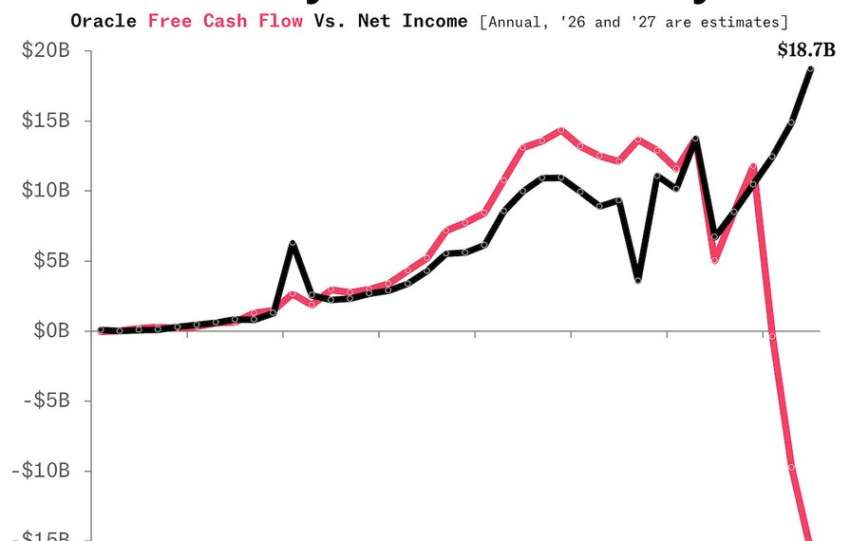
CoreWeave has $66.22 billion in debt (including leases) against $4.03 billion in equity, a leverage of 16.4x. Its EBITDA is 61.6% of revenue, but amortization is 53.1% and interest 24.4%, leading to a GAAP loss of -$2.53 billion and a free cash flow of -$20.42 billion. This financial profile is typical of an investment bubble: actors over-invest for market share without profitability.
Rational bubble theory (Abreu and Brunnermeier, 2003) predicts that rational investors may bid up prices expecting to sell higher, but when price growth slows, the bubble bursts and the most indebted fail.
Credit risk is systemic because banks and private credit funds (Blackstone, Goldman Sachs, JPMorgan) have lent massively to neoclouds, often backed by GPUs with uncertain recovery value; a GPU price correction would trigger margin calls and forced sales, amplifying declines.
The BIS (Bulletin no. 120, January 2026) explicitly identified this contagion channel as an emerging financial stability risk.