Between 2023 and 2026, the U.S. market for computing power rentals underwent a structural divergence that challenges the assumption of continued deflation in computing costs. Three developments stand out: inflation in physical infrastructure and energy, stagnation in traditional CPU cloud prices, and a V-shaped GPU price cycle. Wholesale colocation rates increased by +25.2% for small blocks and +41.1% for hyperscale blocks between 2023 and the first half of 2026. Industrial electricity prices rose by +13.7% nationally, with an increase of +45.4% in Ohio. Conversely, x86 instances remained within a range of $0.045–0.053/vCPU-hour. After falling by 55–62% through the third quarter of 2025, GPU prices rebounded in 2026: +48.8% for the H100, +72.2% for the B200, and +51.9% for the B300. This recovery is primarily driven by energy scarcity. Economic value is therefore shifting from chips to power and real estate infrastructure, while neoclouds are facing rising costs and a -92.5% collapse in token prices, a situation referred to as the “Crunch Spread.”
The theoretical framework breaks down rental prices into three components: marginal cost, scarcity premium, and risk premium. For colocation, costs depend primarily on electricity and construction, while scarcity stems from land constraints and interconnection queues. For GPUs, it depends on chip availability and cooling capacity. Congestion theory explains how short-term supply rigidity allows infrastructure owners to capture increasing economic rents. A Markov model then distinguishes between a deflationary regime from 2023 to 2025 and an inflationary regime in 2026. The shift occurs in the third quarter of 2025, when the H100 reaches $2.07/hour before rising again to $3.08/hour in November 2026. The estimated probability of the inflationary regime persisting exceeds 0.7. Meanwhile, hyperscalers AWS, Google, and Microsoft benefit from advantages associated with their proprietary chips and access to energy, unlike neoclouds CoreWeave, Crusoe, and Nebius, which are more dependent on market conditions.
The empirical analysis confirms the existence of real estate scarcity rents. Small colocation blocks increased from $120.36 to $204.69/kW/month between 2021 and the first half of 2026, a rise of +70.1%, while large blocks increased from $117.19 to $165.31/kW/month, a rise of +41.1%. The discount granted for large-volume commitments narrowed from -28.3% in 2023 to -19.2% in 2026. Equinix increased its per-rack rate from 2,527 to 2694 (+6.6%), while Digital Realty recorded renewal spreads of +11.8%, reaching +26.3% for leases exceeding 1 MW. Its development yield stands at 11.6%. Discounted cash flow models assign additional value to this rental growth. By contrast, x86 instance pricing remained stable at $0.0504/vCPU-hour (AWS m7i), indicating commoditization and low margins.
GPUs exhibit particularly high volatility: the H100 fell from $8.81/hour in October 2023 to $2.07/hour in the third quarter of 2025, before recovering to $3.08/hour in November 2026. The B200 then reaches $6.99/hour and the B300 $7.72/hour. The correlation between GPU prices and electricity prices turns positive in 2026. GPU value now also depends on access to electrical grid interconnections. The NYMEX H100/B200 futures contracts, introduced in October 2026, make it possible to hedge this risk and discover forward prices.
The Crunch Spread measures the difference between the cost of producing a token and its selling price. The -92.5% decline in token prices, combined with rising energy and GPU rental costs, makes this spread negative for many operators. For a B300 cluster, the break-even threshold increased by +138.5% between May and November 2026, while the token price fell by -36.3%. Open models, particularly Llama and Mistral, account for 74% of inference volume in 2026 and intensify price competition. They potentially stimulate demand for computing power, but the data indicate short-term price elasticity below 1, which compresses neocloud margins.
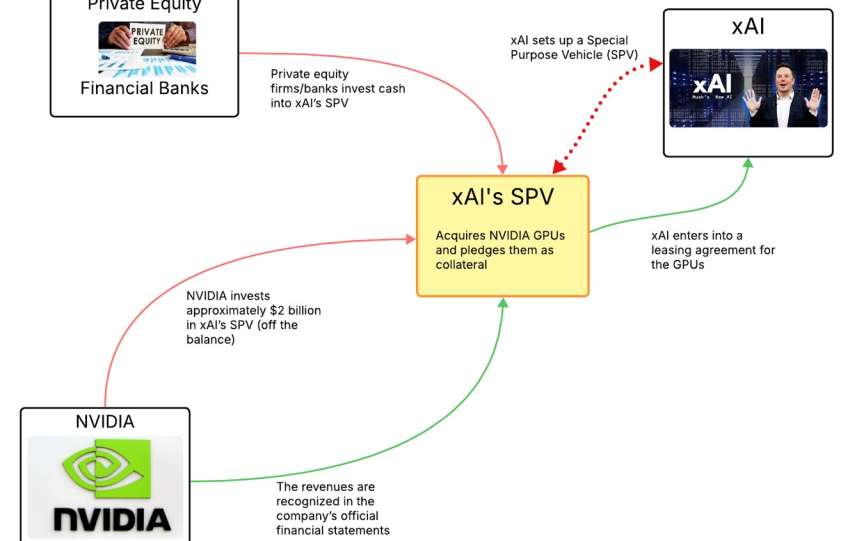
Financial risks are particularly high for neoclouds. CoreWeave reports $66.22 billion in debt, compared with $4.03 billion in shareholders’ equity, representing leverage of 16.4x. Despite EBITDA accounting for 61.6% of revenue, depreciation, amortization, and interest expenses result in a GAAP loss of -$2.53 billion and free cash flow of -$20.42 billion. High debt levels and substantial capital expenditures expose these companies to bankruptcy risk. Banks and private credit funds, particularly Blackstone, Goldman Sachs, and JPMorgan, are also exposed through their GPU-backed loans. A price correction could trigger margin calls and forced sales. The BIS identified this mechanism as an emerging financial stability risk in its Bulletin No. 120, published in January 2026.
Colocation REITs have a more defensive profile: their buildings have a useful life of 30–40 years, their contracts last 5–10 years and are indexed to inflation, and their leverage is more moderate, with a debt/EBITDA ratio of approximately 3.5x for Equinix. A dividend model based on a cost of equity of 7.5% and growth of 4.0% yields a justified multiple of 28.6x. Equinix’s approximately 25x FFO multiple therefore suggests an opportunity for long-term investors. Conversely, neocloud valuations must account for accelerated GPU depreciation, refinancing, and a WACC of 10–12%. CoreWeave’s negative FCF makes DCF difficult to apply without assuming a turnaround.
Stress tests show that a +20% increase in electricity prices reduces CoreWeave’s EBITDA by -15%, a -20% decline in GPU rental rates reduces project NPV by -30%, and a +200 bps increase in interest rates raises interest expenses by +25% and net losses by +40%. These results confirm the vulnerability of neoclouds and the relative resilience of REITs. The proposed allocation involves overweighting Equinix and Digital Realty, underweighting CoreWeave, remaining neutral on AWS, Google, and Microsoft, and tactically favoring electrical equipment suppliers. The strategies under consideration include buying REITs against selling neoclouds, using GPU futures, and hedging interest rates through swaps. The -12% backwardation on the 12-month contract reflects expectations of falling prices as new capacity comes online in 2027. Finally, the 226 GW ERCOT interconnection queue represents a favorable signal for REITs, while token deflation, margin compression, and warnings from the BIS and WEF highlight the risks facing neoclouds. The divergence therefore appears structural: owners of power capacity are capturing increasing economic rents, while GPU operators remain caught between rising costs and falling selling prices.