The Quietest Race in Monetary History
Never before have so many central banks worked simultaneously on the same transformation. According to counts by the Atlantic Council and the BIS, 137 countries and monetary unions representing nearly all of global GDP are engaged in a phase of exploration, development, piloting, or launch of a central…

Global real estate remains the dominant asset class, valued at approximately $393-448 trillion (Savills, 2026 estimates), about 3.3 times the global equity market capitalization and 2.8 times that of bonds. In this context, institutional capital is structurally shifting toward rental income streams (SFR/BTR). The institutional share of the US Single-Family Rental market remains low (2.0-3.1%…
Every structural bull market in financial history has followed the same sequence: first the asset, then the liquidity, then the index and only then the institutional capital. Equities had Dow Jones before they had pension funds. Credit had Barclays Agg before it had ETF flows. Tokenized real-world assets are trying to run the sequence in…
https://scoregex.streamlit.app
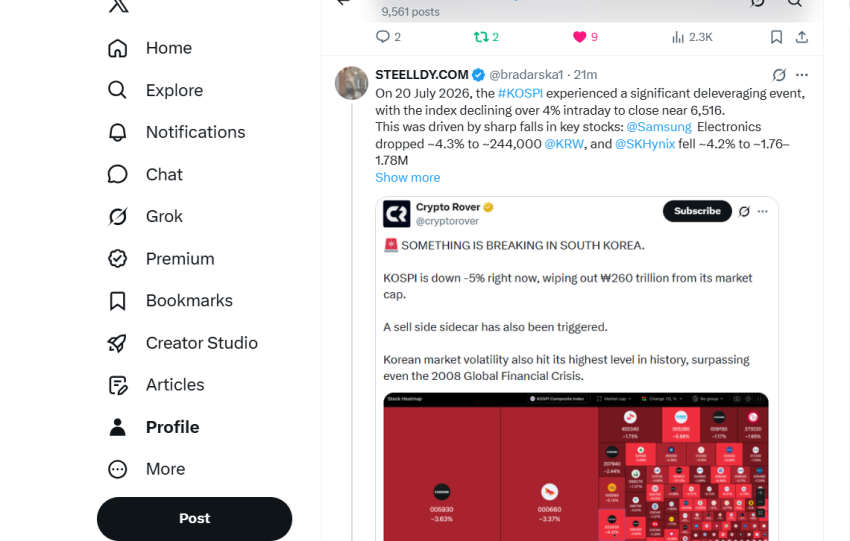
On 20 July 2026, the KOSPI experienced a sharp deleveraging event, with the index falling over 4% intraday to close near 6,516. Key stocks Samsung Electronics and SK Hynix dropped ~4.3% and ~4.2% respectively, driven by structural concentration risk in AI/HBM memory, leveraged product amplification, policy tightening by the Bank of Korea, and margin-call…
https://www.steelldy-indices.com
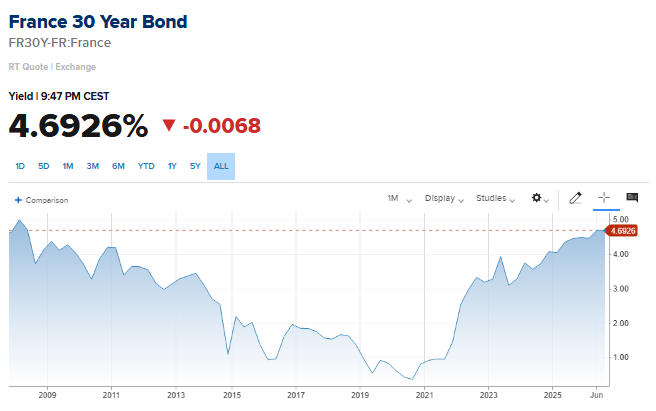
The morning fixing of the 30-year French OAT yield at 4.6926% marks a "phase transition" market event. Cross-referenced with our proprietary risk engines, this level signals a critical threshold for French debt sustainability, with non-negligible probability of a self-fulfilling confidence crisis. Key findings: the 5-year implied probability of a French fiscal accident jumped from…
1.1 Economic and Legal Basis for the Exclusion of Intangible Assets
The concept of the "substance trap," formalized by STEELDY in their research on the interaction between Pillar Two and environmental tokenization, refers to a situation where an investment vehicle holding highly intangible assets is structurally unable to reduce its tax base through the SBIE…
The quantitative analysis reveals that Nike's Effective Tax Rate (ETR) dropped from 33.6% in Q4 FY2025 to 19.6% in Q4 FY2026, a statistically extreme anomaly of -14 percentage points. This exceeds the sector standard deviation of ~3%, yielding a Z-score of -4.67σ, indicating over 99.99% certainty that this is not a normal fluctuation.
https://www.steelldy-indices.com
Compared…
Synthetic carbon credit tokens provide derivative exposure to carbon markets (e.g., ICE EUA, voluntary indices) via futures, total return swaps, or oracle-replicated performance, without physical custody or retirement of underlying credits. This delivers operational efficiency (fractionalization, 24/7 liquidity, reduced verification costs) but introduces material counterparty risk (issuer solvency/fulfillment), basis/tracking error risk (deviation from reference index…
https://www.steelldy-indices.com
Executive Summary
Reduction in refined fuel demand (gasoline/diesel) is primarily driven by electrification (EV penetration ~25% global new sales 2025, displacing ~1.2 mb/d oil equivalent), efficiency gains (MPG improvements offsetting VMT growth), and behavioral shifts, not dominantly by 15-minute city models. The 15-minute city (proximity-based urbanism) and smart digitalized local economies contribute secondarily…
Executive Summary
Transition risks under 2°C pathways (IEA NZE/APS equivalents) drive structural demand destruction for refined products, compressing refining margins via volume contraction, utilization drops, and policy/carbon cost overlays. Carbon Tracker’s foundational 2017 “Margin Call” analysis projected >50% EBITDA decline by 2035 for ~94% of global capacity under a 2D scenario (oil demand -23%…
Analyse de marché
Carbon Credit Market