https://www.steelldy-indices.com
The semiconductor memory industry (MU/Samsung/SK Hynix oligopoly controlling >95% of DRAM/HBM) is in a structural supercycle driven by AI data center demand (hyperscalers investing over $300 billion by 2026). Unlike past cycles (2001, 2008, 2013) dominated by PCs and smartphones, current demand is nonlinear, scaling with LLM size and dataset complexity. Sunk costs from…
https://scoregex.streamlit.app
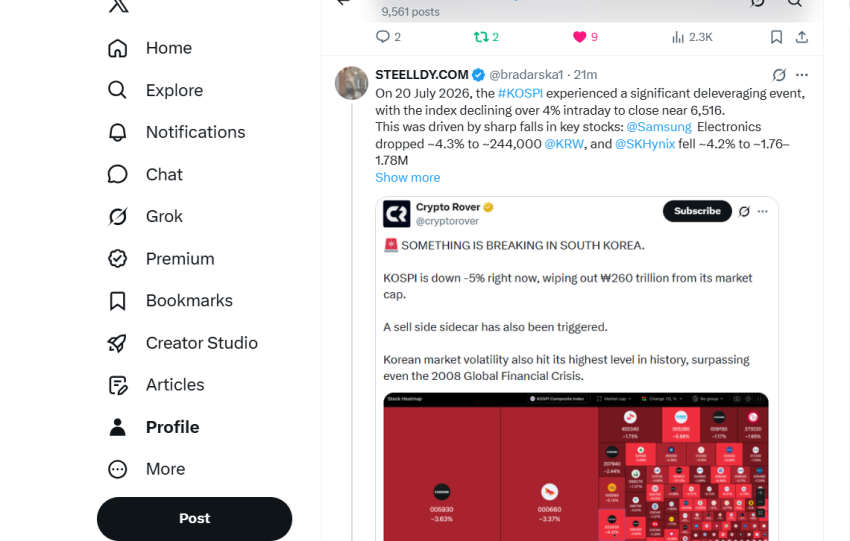
On 20 July 2026, the KOSPI experienced a sharp deleveraging event, with the index falling over 4% intraday to close near 6,516. Key stocks Samsung Electronics and SK Hynix dropped ~4.3% and ~4.2% respectively, driven by structural concentration risk in AI/HBM memory, leveraged product amplification, policy tightening by the Bank of Korea, and margin-call…
https://www.steelldy-indices.com
This article applies the tools of game theory to the strategic analysis of the global memory oligopoly. By modeling the interactions between Micron, Samsung, and SK Hynix as a three-player dynamic game, we identify Nash equilibria, potential tipping points, and the probabilities associated with each strategic scenario. This formal approach complements the quantitative models…
https://www.steelldy-indices.com
Executive Summary
The semiconductor memory sector has undergone a dramatic correction over the past eighteen months, wiping out more than $200 billion in total market capitalization. This massive erosion of valuations has been driven by a combination of macroeconomic factors, traditional cyclical fears, and growing doubts about the sustainability of artificial intelligence demand. However,…
Adam Sharp shared five charts that provide context for the current chaotic market and clarity on what might happen next. According to the expert, the world is at an exciting crossroads of markets, geopolitics, and finance. Semiconductor companies are celebrating like it's 1999.
https://www.steelldy-indices.com/
The index of US semiconductor stocks, including Nvidia, Micron, Intel,…
Analyse de marché