Synthetic carbon credit tokens provide derivative exposure to carbon markets (e.g., ICE EUA, voluntary indices) via futures, total return swaps, or oracle-replicated performance, without physical custody or retirement of underlying credits. This delivers operational efficiency (fractionalization, 24/7 liquidity, reduced verification costs) but introduces material counterparty risk (issuer solvency/fulfillment), basis/tracking error risk (deviation from reference index…
1. Carbon Pricing Framework: Explicit (EU ETS) vs. Implicit/Internal Shadow Pricing
TotalEnergies employs an internal carbon price (ICP)1 or shadow price in its project evaluations and asset impairment testing. Currently, its base case includes a minimum price of $100/tCO₂ (or higher jurisdictional prices) starting in 2023, with a 2% annual increase after 2030.
Sensitivity…
1.1 Proprietary Multidimensional Benchmark Evaluating the Integrity, Durability, and Liquidity of Carbon Credits
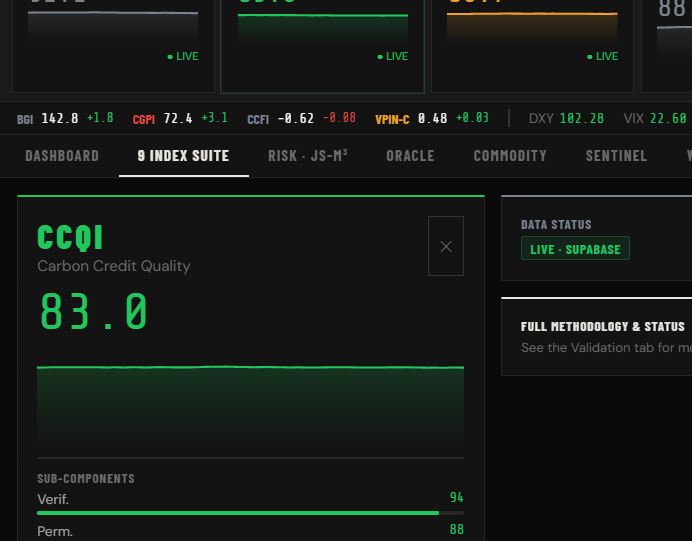
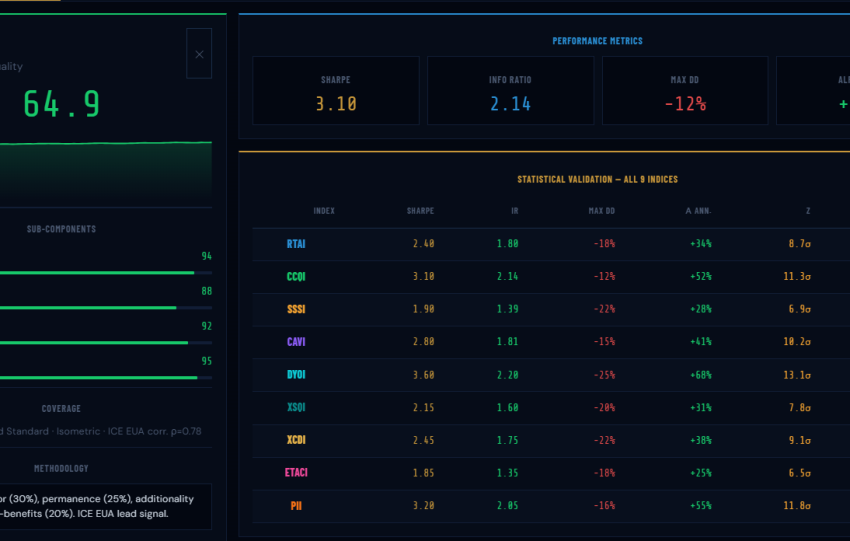
The Climate Credit Quality Index (CCQI) developed by STEELLDY is a next-generation proprietary benchmark specifically designed to address the transparency and standardization gaps characterizing the voluntary carbon credit market. Unlike traditional indices, which are limited to price aggregations or transaction volumes, the…
1.1 Collective Structuring and Pooling of Heterogeneous Quality Carbon Credits
Pool tokens represent a stake in a collective portfolio of carbon credits with heterogeneous characteristics, structured as a mutual fund or a collective investment vehicle. This form of tokenization allows for the pooling of risks specific to each carbon credit and offers increased liquidity compared…
CCQI index and characterization of TCMs: Tracking Tokenization of RWAs and Carbon Credits
1.1 Methodology for the STEELLDY CCQI (Climate Credit Quality Index)
1.1.1 Definition and Objectives of the Index: Carbon Credit Quality Benchmark for the Voluntary Market
The Climate Credit Quality Index (CCQI), developed by STEELLDY, is a proprietary benchmark for the quality of…
The Core Carbon Principles (CCP), established by the Integrity Council for the Voluntary Carbon Market (ICVCM), constitute the most stringent quality benchmark in the carbon market. CCP-qualified credits must satisfy three fundamental criteria: additionality (the emission reductions would not have occurred without the financial incentive of the carbon credit), permanence (the reductions are irreversible over…
Carbon Credit Market