Climate

1.1 Tripartite Classification Framework for Carbon Credit Tokens
The taxonomy of Carbon Credit Tokens (CCTs) proposed by STEELLDY is structured around three fundamental categories, each presenting a distinct tax risk profile under the Pillar Two framework. This tripartite classification | direct possession tokens, pool tokens, and synthetic tokens | constitutes an essential analytical framework for assessing the tax exposure of tokenized environmental asset portfolios. The relevance of this taxonomy goes beyond mere descriptive categorization; it directly conditions the calculation of the effective tax rate, the determination of the top-up tax base, and the selection of tax optimization strategies suited to each token type.
www.steelldy-indices.com
Direct possession tokens represent a digital claim on a physical carbon credit held in custody by an approved custodian, with a one-to-one correspondence between the token and the underlying credit unit identifiable by its serial number in a recognized registry (Verra VCS, Gold Standard, Climate Action Reserve). Pool tokens represent an interest in a collective portfolio of carbon credits with heterogeneous characteristics, structured as a common fund or a collective investment entity. Synthetic tokens provide exposure to carbon credit prices without physical holding, through derivative mechanisms such as futures contracts, total return swaps, or price oracles replicating a benchmark index.
1.2 Comparative Tax Exposure Matrix
The comparative analysis of the three categories of TCC reveals significantly differentiated tax risk profiles. Direct ownership tokens exhibit full exposure to the top-up tax due to the underlying asset being classified as an intangible, but they benefit from on-chain traceability that facilitates demonstrating the chain of ownership and qualifying the beneficial owner to tax authorities. This transparency, while strengthening tax control capabilities, simultaneously eliminates opportunities for optimization based on structural opacity. The optimal strategy for this type of token hinges on maximizing the CCQI and optimizing the timing of gain realizations.
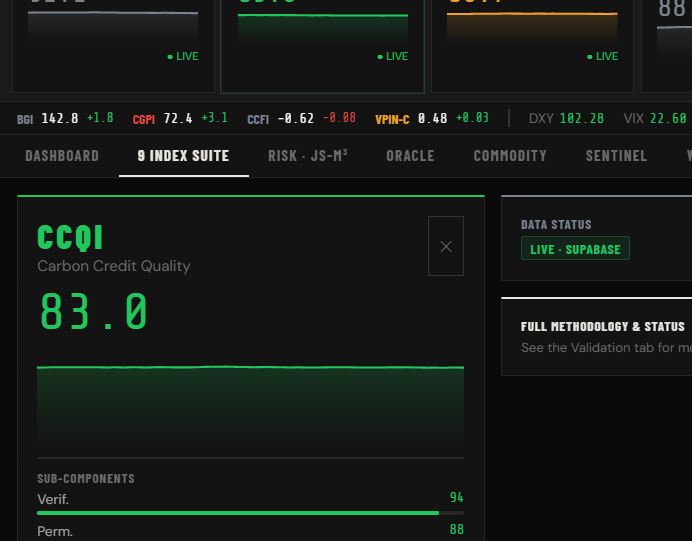
Pool tokens present a specific risk of quality dilution: integrating low-quality credits into a pool dominated by high-quality credits can lower the average CCQI below the critical threshold of 75, exposing the entire portfolio to disproportionate fiscal erosion. The tax governance of the pool is a key issue: allocating the additional tax burden between token holders and the pool manager raises complex legal questions about the nature of this burden, whether it is a deductible charge, a levy on nominal value, or a proportional personal tax liability. Synthetic tokens, meanwhile, pose a significant risk of tax reclassification, with an estimated 45% probability of being reclassified as a derivative financial instrument.