The tokenized RWA market totals ~$30-35B in AUM (rwa.xyz: ~$34.5B, ~2x year-over-year). Breakdown: Tokenized US Treasuries & money market funds ~$13.4-15.2B (76 products, ~58,700 holders; top names BUIDL ~$2.4-3.1B, USYC $2.9B, USDY ~$2.1B, BENJI $2.05B); private credit $8-18.9B depending on scope, $33.7B in cumulative originations; commodities (mostly gold) ~$5.5B with XAUT+PAXG >96% of the segment…

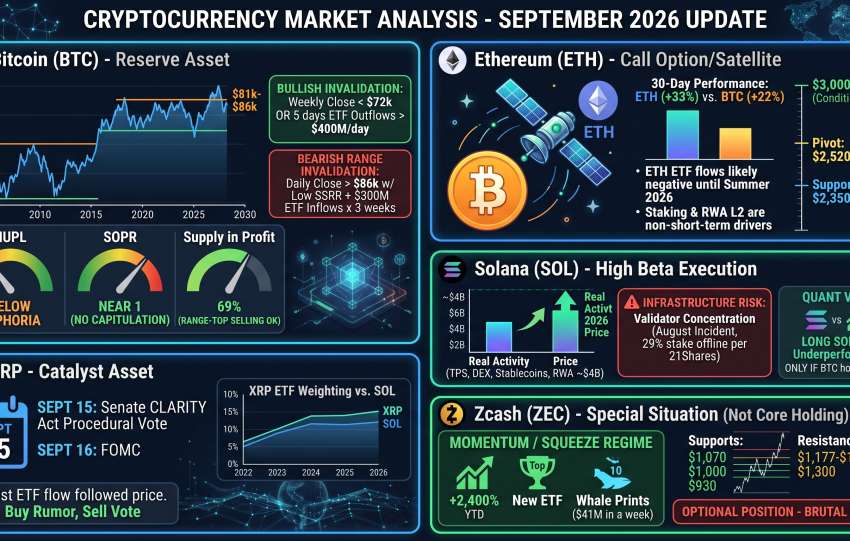
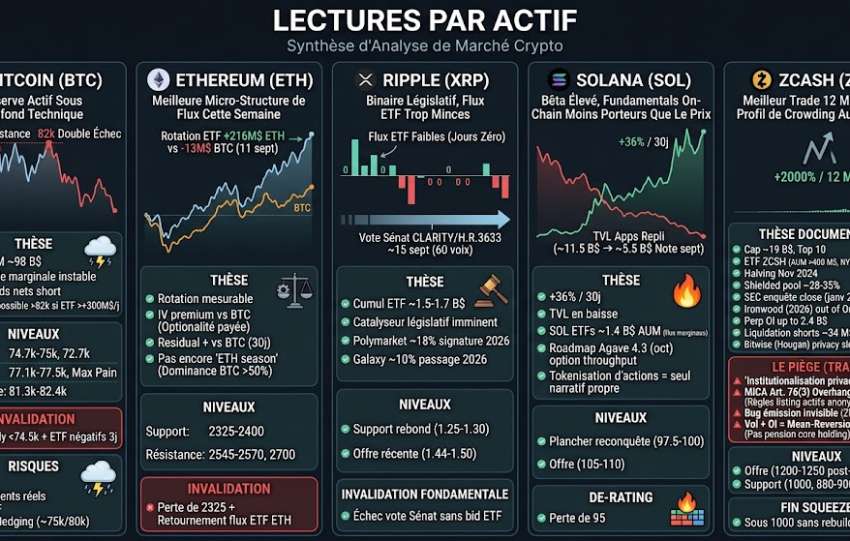
Bitcoin remains a reserve asset with a structure showing recovery from $58-62k, rejection under $81-86k, and consolidation around $77k. NUPL is below euphoria, SOPR near 1 (no capitulation or aggressive distribution), and 69% of supply is in profit—enough for range-top selling but insufficient for a blow-off. Bullish invalidation: weekly close below $72k or 5 days…
The framework is a two-regime Markov model with observable states, not a calibrated HMM
Regime 1 (Liquidity risk-on) is indicated by positive 5-day net $BTC / $ETH ETF flows, declining $DXY, funding below 0.03% per 8 hours, and BTC above 77.1k then 81.3k.
It implies overweighting ETH/ $SOL relative to BTC, with only reduced $ZEC…
Thesis. Raw materials are regaining a core portfolio role (hedging a multipolar world and AI electrification), while European ESG shifts from an obligation-based regime to a market-driven one, less reporting, more pricing. Key Data. January 2026 records: gold ~$5,405/oz (2025 annual average: $3,431, +44%), silver >$121/oz, LME copper $13,238/t. Citi scenarios (Q3 2026): Brent…
Blockchains, consolidation toward regulated infrastructure. The event of 2026 is not a new L1 but the migration of value toward layers serving regulated assets: on-chain registered transfer agents (Securitize, first registered digital agent on the NYSE tokenized securities platform¹⁴), neutral token standards (ERC-7943⁸), banking rails (BNY Mellon custodizing stablecoin reserves and tokenized treasuries¹⁴), and central…
Thesis. The European Omnibus did not kill ESG: it transformed it from a mass legal obligation into a competitive market advantage. Demand for reliable ESG data is shifting from the regulator to the investor, the bank, and the buyer and ESG ratings themselves are now under supervision.
The new regime (Directive (EU) 2026/470, in…
The macro regime as of September 2, 2026, shows a strong U.S. dollar (DXY at ~99.73-99.80) and rising 10-year U.S. Treasury yields (4.78-4.81%), pressuring risk assets. An oil supply shock (Brent ~$95.3, WTI ($4,290-4,325/oz) is declining due to real yields and dollar strength. A Hidden Markov Model (HMM) identifies the current regime as "Transition"…
The dominant factor in September is not an endogenous crypto narrative but a regime of real rates and geopolitical energy premiums.
US 10-year yields hit ~4.76-4.78%, the highest since January 2025, while the #DXY traded around 99.45-99.50.
Oil prices (WTI ~$86.5) reacted to US-Iran tensions and the Strait of Hormuz.
The Fed funds target is…
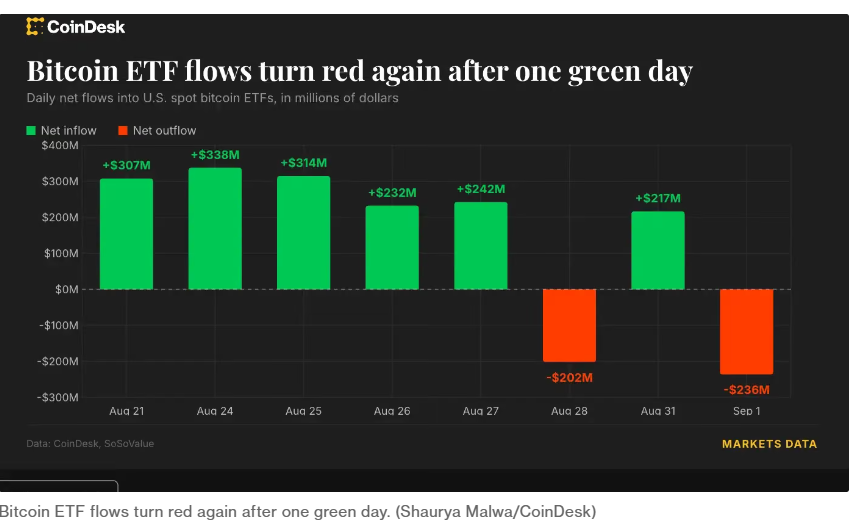
The market has exited the capitulation phase of June 2026, where BTC fell below $60k, driven by ETF creations and short squeezes pushing prices to ~$81.3k, though this does not confirm a sustained bullish cycle. Three simultaneous frictions are identified: a BTC supply wall between $81k-$86k, a potential 25bp hike at the September FOMC meeting…
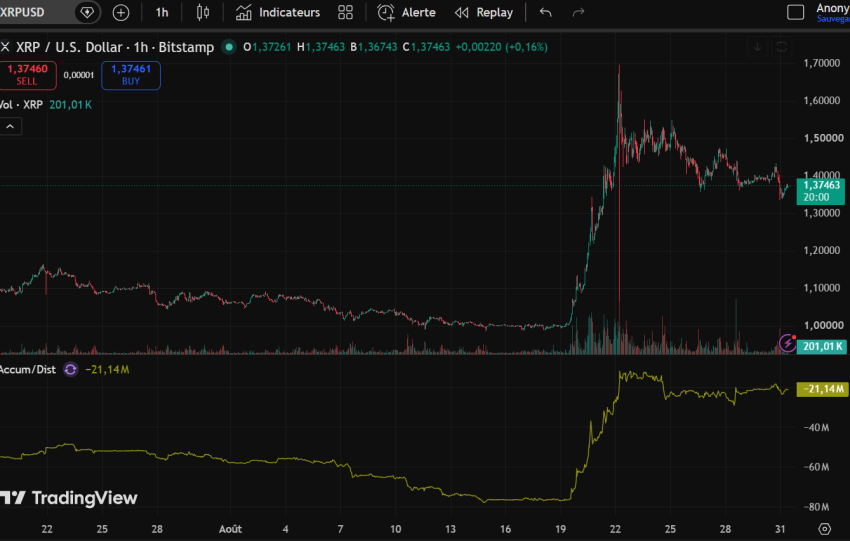
Bitcoin rallied 6% in the week of August 19, triggered by a yields at their highest since 2007, seen as a fiscal easing signal. CoinShares' James Butterfill noted the rally was driven by macroeconomic factors, not crypto-specific dynamics. T. Rowe Price identified the "debasement trade" as the key driver, where investors shift from cash and…
Analyse de marché
Carbon Credit Market