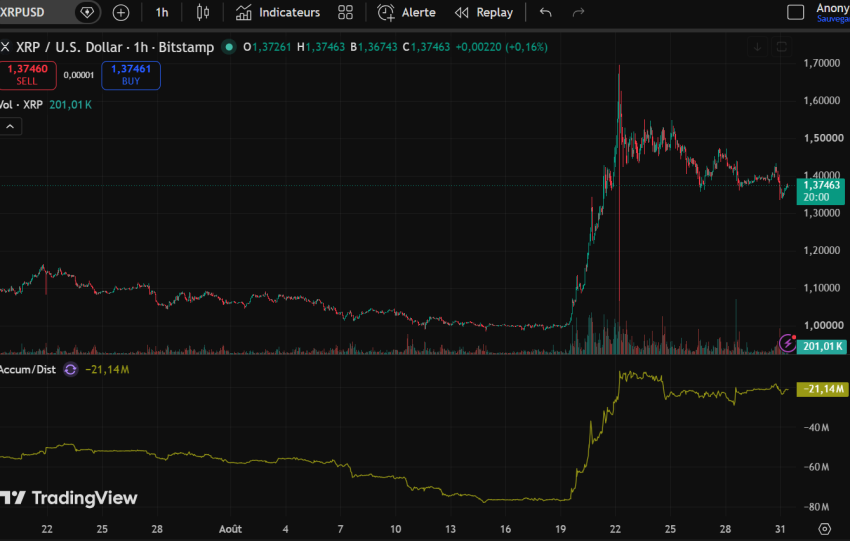
The gradual shift of the XRP Ledger (XRPL) from a simple payment network to a true institutional settlement layer (RWA, tokenization, interbank cross-border settlements) is empirically observable.
J.P Morgan recently revealed its utilization of the XRPL.✅ Up next? 🙇♂️ Goldman Sachs and Citi.😏💨 https://t.co/nCu062uXxz — SMQKE (@SMQKEDQG) May 9, 2026
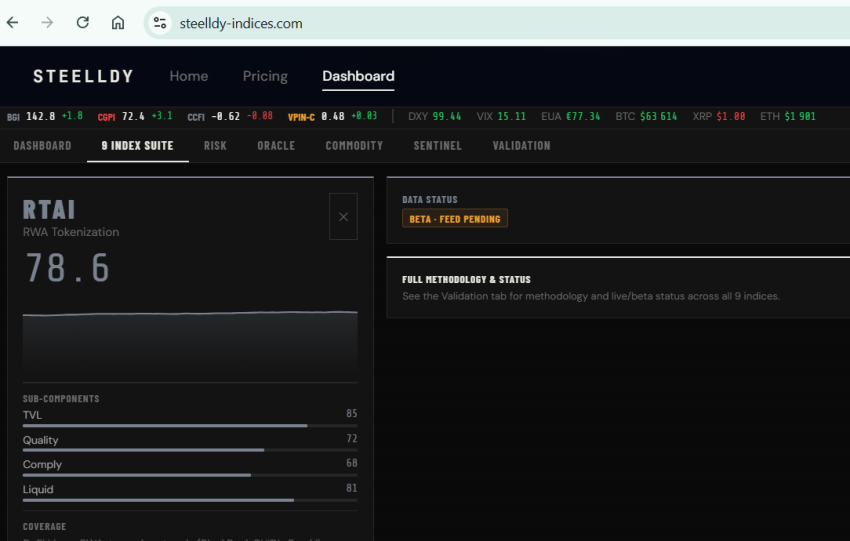
Quantitative Validation Elements …
The impact of the Pillar Two international tax regime (OECD) on the valuation and structuring of tokenized carbon credit (TCC) investments, particularly in France.
(A) Structural effect of Pillar Two on the taxation of TCCs
¤ Pillar Two imposes a minimum effective rate of 15% on the profits of multinational corporations, neutralizing tax optimization…
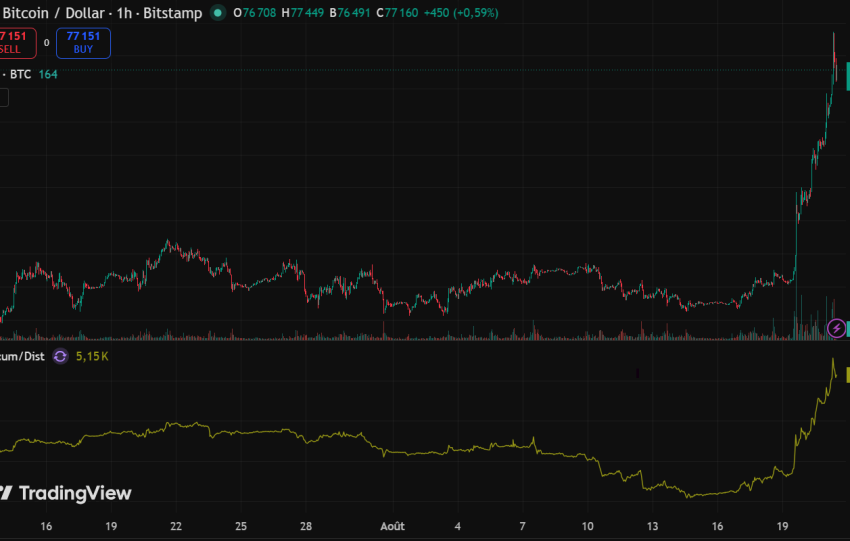
The Glassnode "Expansion, Breakdown, Stabilization" framework identifies a mature stabilization phase with volatility-adjusted support built around ~$74,000 and confluent resistance at $80,000–$83,000. This $78K–$83K zone constitutes the "Breakeven Battlefield" where the following overlap: (i) the STH Cost Basis at $78,700 (v5.0), (ii) the True Market Mean Price at ~$81,500 (v3.0), and (iii) the ETF Cost…
The distinction between a "trap" and a "trigger" in market analysis centers on their nature, observability, agents involved, and timing.
A trap is a static liquidity configuration, often visible in liquidity heatmaps as bid clusters (e.g., 76K–80K), indicating passive retail accumulation and suggesting resistance (high Kyle's Lambda). This configuration can take hours or days…
Cohort-Normalized CVD (Cumulative Volume Delta): Colored lines reveal that small orders ($100–$10K, green/orange lines) are buying on upward moves, while large blocks ($1M+, purple lines) are selling. Correlation with our April 27th statements : The April 27th post hypothesized a "stealth institutional distribution" in the $77,000–$80,000 range, with a negative delta of –699.51 and a…
Visual Data: Liquidation density concentrated at $75,000 (long cluster) and $80,000–$85,000 (short clusters). 1-week heatmap showing yellow/orange bands (high density) at 75K and 81K+. Current price in a "blue" area (low density), i.e., compression zone.
Correlation with the April 30th study:
The April 30th study modeled a bimodal distribution of liquidations:
Mode…
Visual Data:
¤ Clear resistance zone between $77,400 and $78,000 USD.
¤ Fibonacci 65% at $77,411 USD, 61.8% at $77,196 USD.
¤ Current price below resistance.
Correlation with the April 27th Study: The April 27th study identified the selling wall at $79,000–$80,000…
Visual data: ~750 days after each halving mark a cyclical top.
Subsequent capitulation period: 100–170 days. We are at ~750 days since the April 2024 halving.
Correlation with our previous macro studies: The April 28 study postulated a structural decoupling of BTC/NASDAQ with a negative correlation (–0.42). The April 30 study incorporated the…
In 2026, gold and Bitcoin are showing opposing trajectories after reaching peaks. Gold has corrected by about 14% from its $5,589 high in January 2026, while Bitcoin has fallen by over 41% from its $126,198 peak in October 2025. Gold's decline is interpreted as healthy consolidation in a structural bull market, supported by solid fundamentals:…
Multi-engine analysis suggests that the closure of the Strait of Hormuz, leading to a supply shock of 20 Mb/d (20% of world consumption), has established a regime of "structural energy constraint." This regime is characterized by a high conditional probability of activating restrictive measures on mobility ("energy lockdown"), estimated at 81.3% for 03/31/26, according to…
Analyse de marché