Analyse de marché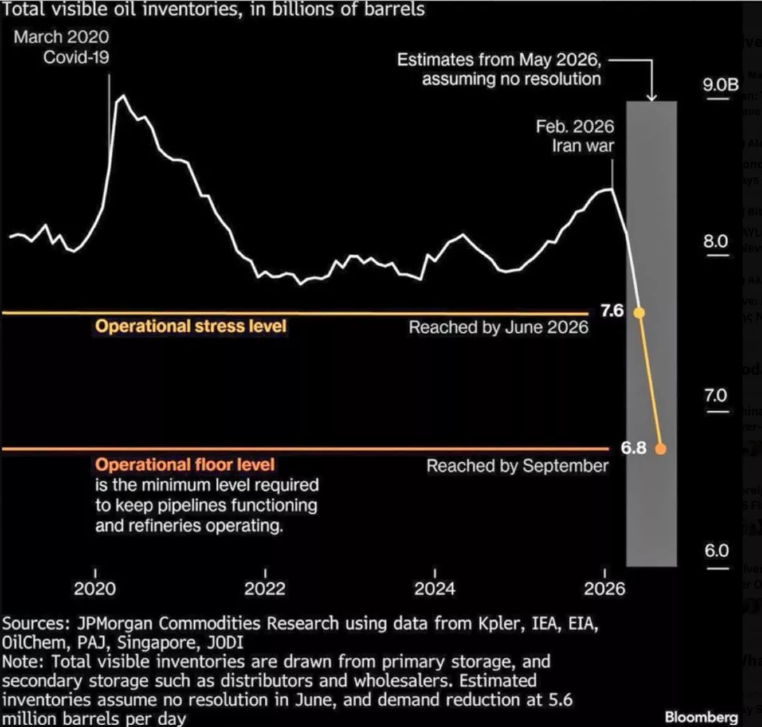

Oil reserves are rapidly depleting, eroding the world’s crucial buffer against supply shocks. A concerning JP Morgan chart, discussed by David Russell of GoldCore and featured in Bloomberg, illustrates the drastic decline in total discovered oil reserves, measured in billions of barrels.
These reserves initially built up during the COVID-19 pandemic when demand plummeted, leaving a surplus. As economies reopened and energy demand resumed, these stockpiles began to shrink. The situation has worsened recently due to supply chain disruptions, particularly the conflict in Iran threatening supplies from the Persian Gulf and potentially closing the Strait of Hormuz. JP Morgan estimates that if the Strait of Hormuz remains closed, OECD oil reserves could hit a “stress operating level” by June and an “operating minimum” by September.
Once reserves approach these minimums, a sharp rise in prices will likely be necessary to curb demand, increasing costs across transportation, aviation, manufacturing, agriculture, shipping, and for consumers. This decline is not just about the available barrels; it highlights the erosion of the system’s necessary shock absorbers. Modern economies, despite perceptions of perfect design, rely on invisible buffers like spare capacity and contingency reserves. Decades of focus on just-in-time supply, globalized production, balanced ledgers, cheap energy, and cheap money—based on the assumption that problems won’t occur simultaneously across multiple fronts—have created a fragile structure.
Bloomberg reports that global oil inventories are falling at a record pace due to supply constraints from the Persian Gulf conflict. Morgan Stanley estimates suggest global oil reserves fell by about 4.8 million barrels per day between early March and late April. The critical question is not simply how much oil remains globally, but rather how much can be utilized before the supply mechanism itself breaks down. Oil reserves function as a buffer; not every barrel is equally usable. JP Morgan defines a stress operating level (around 7.6 billion barrels) where the system begins to strain, and an operating minimum (around 6.8 billion barrels) necessary to keep pipelines and refineries functioning. This underscores that the modern economy remains fundamentally physical. Despite advancements in AI and digital finance, the real economy relies on tangible goods: oil, diesel, jet fuel, plastics, chemicals, fertilizers, and the logistics supporting food, healthcare, manufacturing, and defense. As reserves approach critical levels, the impact will ripple beyond the commodity market into the broader economy. This is characteristic of systems optimized for efficiency rather than resilience. Such systems perform excellently during calm periods by lowering costs, but they conceal underlying fragility. Without a buffer, a shock can cause an immediate collapse. This principle extends beyond oil to banking (where a loss of confidence and liquidity below a critical threshold causes failure), supply chains (which collapse without backup stock), and currencies (which degrade gradually before a rapid loss of confidence). Instability doesn’t require the total depletion of oil; it requires stocks to fall below the level needed for the supply mechanism to operate smoothly—a critical threshold applicable to banking, supply chains, currencies, and trust itself.