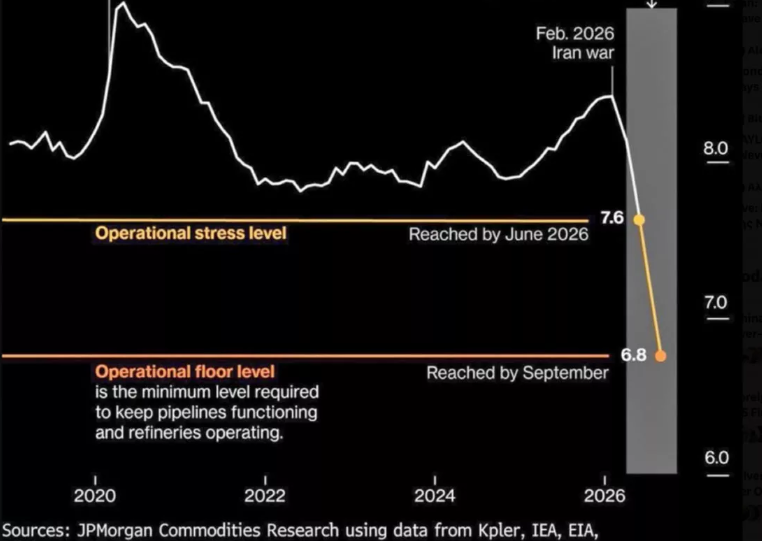
Oil reserves are rapidly depleting, eroding the world's crucial buffer against supply shocks. A concerning JP Morgan chart, discussed by David Russell of GoldCore and featured in Bloomberg, illustrates the drastic decline in total discovered oil reserves, measured in billions of barrels.
These reserves initially built up during the COVID-19 pandemic when demand plummeted,…
The convergence of physical, behavioral, and microstructural signals confirms that Europe, and particularly France, has entered a regime of asynchronous systemic energy shortage. The three pillars of the breakdown:
(a) Physical Pillar. The Strait of Hormuz has been practically blocked since February 28, 2026: more than 20% of global oil traffic and 25% of…
Closure of the straits (Malacca/Hormuz). Systemic famine scenario 2026-2028 : in the French context.
Analysis of signals from Steelldy Engine G (maritime AIS), Steelldy Engine F (fertilizer blockages), Steelldy Engine M (semantic panic), and Steelldy Engine O (strait closure probabilities) shows exceptional statistical convergence. Michael Yon's analysis (Feb-Apr 2026) regarding prolonged Strait of Hormuz closure and imminent Malacca Strait threats is now a 78% market reality (95% CI: 72–84%),…
Notre analyse multi-modèles appliquée aux données publiques confirme que TotalEnergies utilise une architecture complexe d’optimisation fiscale via sa filiale de trading à Genève. La catégorie "reste du monde" dans ses rapports fiscaux agit comme une variable proxy pour des juridictions à fiscalité réduite, principalement la Suisse.
Les travaux empiriques de l’Institut de Genève ont démontré…
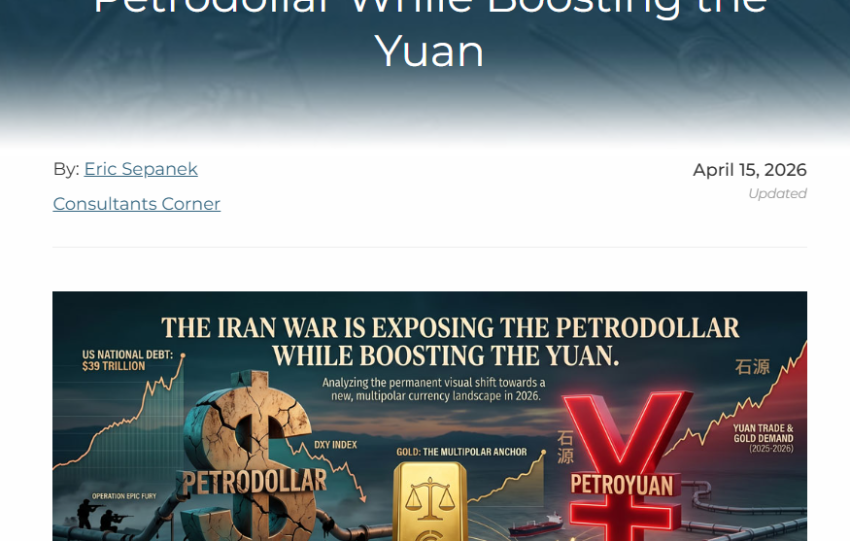
Analysis and summary based on the article "The Iran War Is Exposing the Petrodollar While Boosting the Yuan" by Eric Sepanek
The conflict involving Iran is challenging the U.S. dollar's dominance in the global financial system, despite an initial spike in the dollar's value (DXY) following the outbreak of war, which primarily reflects immediate…
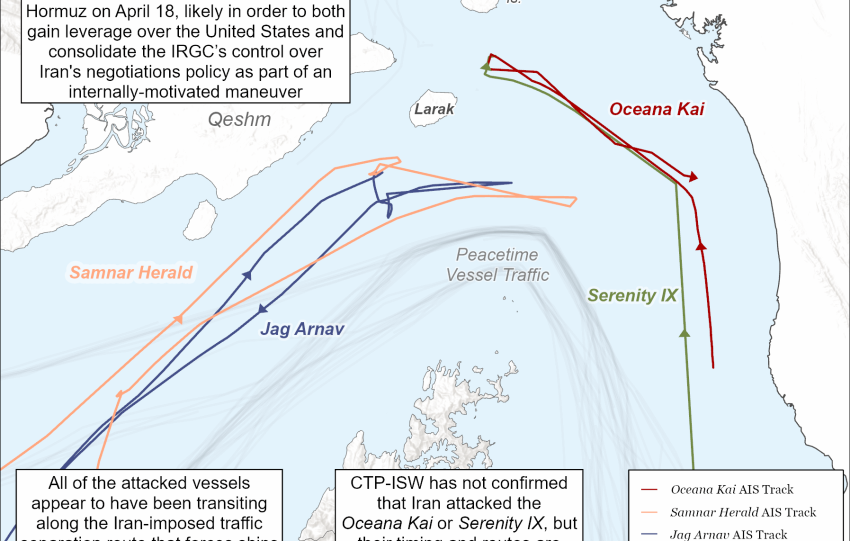
Islamic Revolutionary Guards Corps (IRGC) Commander Major General Ahmad Vahidi and his inner circle appear to have recently consolidated control over Iran's military response and negotiating strategy concerning the United States, evidenced by the IRGC Navy attacking commercial vessels in the Strait of Hormuz on April 18 and declaring it closed to all traffic. …
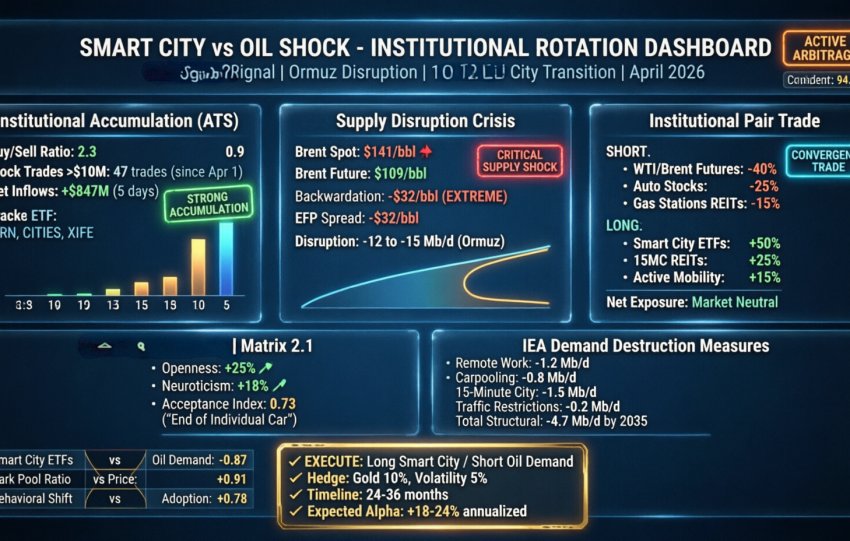
"The market is not content with betting on the end of the automobile; it is actively financing its replacement infrastructure."
The convergence of the following signals validates a macro-microstructure arbitrage thesis:
(a) Dark Pools (ATS): Since April 1, 2026, discreet accumulation of blocks >$10M in "Smart City" ETFs (GRN, CITIES), with an institutional buy/sell…
A JP Morgan Commodities Research table listing specific oil and gas assets hit across the Middle East, including pipelines, terminals, ports, depots, and fields in Saudi Arabia, UAE, Iran, Iraq, and Oman. The table details drone strikes, missile attacks, and fires causing capacity outages, with examples like partial shutdowns at Saudi East-West pipeline, full disruptions…
The information, factually confirmed by multi-source convergence (including the Financial Times of April 8, 2026), establishes that Iran now demands payments in cryptocurrencies (BTC, stablecoins) and in Yuan for oil transit through the Strait of Hormuz, completely bypassing SWIFT.
This mechanism, controlled by the IRGC, sets a rate of $1 per barrel, creating an…
The Brent oil market shows an extreme divergence between the paper price (futures contracts) at $109 and the physical price (spot) at $141, a $32 gap reflecting a strong "backwardation." Normally, future prices are higher than spot prices (contango) due to storage costs; this inversion signals an immediate scarcity of physical oil. The $141 price…
Analyse de marché