Carbon Credit Market
1.1 Collective Structuring and Pooling of Heterogeneous Quality Carbon Credits
Pool tokens represent a stake in a collective portfolio of carbon credits with heterogeneous characteristics, structured as a mutual fund or a collective investment vehicle. This form of tokenization allows for the pooling of risks specific to each carbon credit and offers increased liquidity compared to individual holdings. The pool is generally constituted according to different logics: by vintage (year of credit issuance), by project type (forestry, renewable energy, direct capture), by geography, or according to predefined quality criteria.
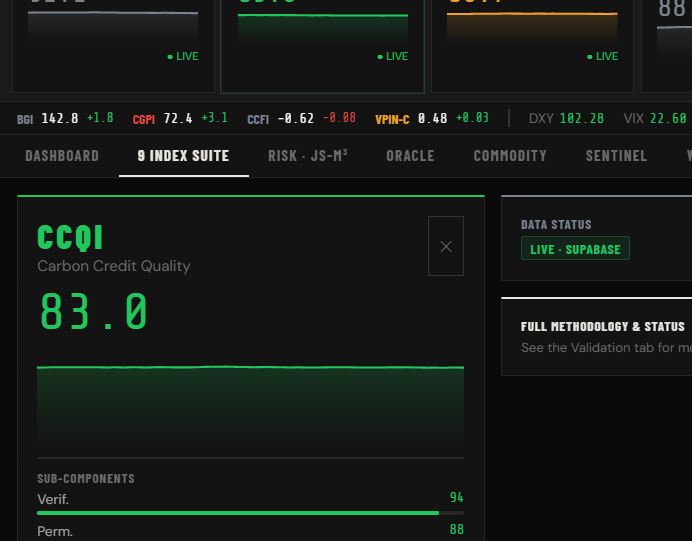
However, the inherent heterogeneity of the quality of the credits grouped in a pool poses a major challenge for the application of the Pillar Two regime. The calculation of the ETR and any exposure to top-up tax must be carried out at the level of the pool holding vehicle, without a mechanism for fiscal differentiation between components of varying quality. The average quality of the pool, measured by aweighted CCQI, then becomes the determining parameter for adjusted tax performance, with significant dilution effects: the inclusion of low-quality credits in a pool dominated by high-quality credits can reduce the average CCQI below the critical threshold of 75, exposing the entire portfolio to disproportionate tax erosion compared to the actual value of the higher-quality credits it contains.
1.2 Challenge of Calculating the Weighted Average CCQI and its Impact on the Effective Tax
Rate Calculating the weighted average CCQI [Climate Credit Quality Index] for a pool token presents a major methodological challenge with direct tax implications. Unlike a directly held portfolio where each credit is identifiable and its CCQI is stably determined, the dynamic composition of the pool introduces a probability distribution around the expected CCQI. This uncertainty propagates into the effective rate calculation model, as the quality premium associated with the CCQI directly influences the portfolio’s base return and, consequently, the margin available to absorb the fiscal shock of the top-up tax.
STEELLDY simulations demonstrate that only pools maintaining an average CCQI above the critical threshold of 75 preserve a positive net return after the application of Pillar Two. For a pool token, this condition translates into the requirement of a stably weighted average CCQI greater than 75, which imposes rigorous selection criteria at entry and continuous monitoring mechanisms for the quality of the held credits. The degradation of the average CCQI below this threshold, for example following the integration of lower quality credits for liquidity or yield reasons, exposes the pool token holder to a double penalty: reduction of the base yield and increased vulnerability to fiscal shock.
1.3 Governance Mechanisms and Allocation of the Top-up Tax Liability
The governance of pool tokens determines the methods for allocating any potential top-up tax liability between token holders and the pool operator. In current structures, the pool operator generally assumes responsibility for tax compliance and passes on any taxes via management fees or deductions from distributions. Under Pillar Two, the emergence of the top-up tax as a potentially significant liability challenges this model. If the pool vehicle constitutes an entity that is part of a MNE subject to GloBE, the QDMTT or IIR may generate a direct tax liability at the pool level. The allocation of this liability among token holders raises complex legal questions: is it a charge deductible from distributed income, a levy on the nominal value of the tokens, or a personal tax obligation of each holder proportional to their stake? Governance mechanisms must be adapted to explicitly incorporate these new tax contingencies, with rules precisely defining the trigger for an allocation of the liability, the method for calculating each holder’s share, and the collection procedures.