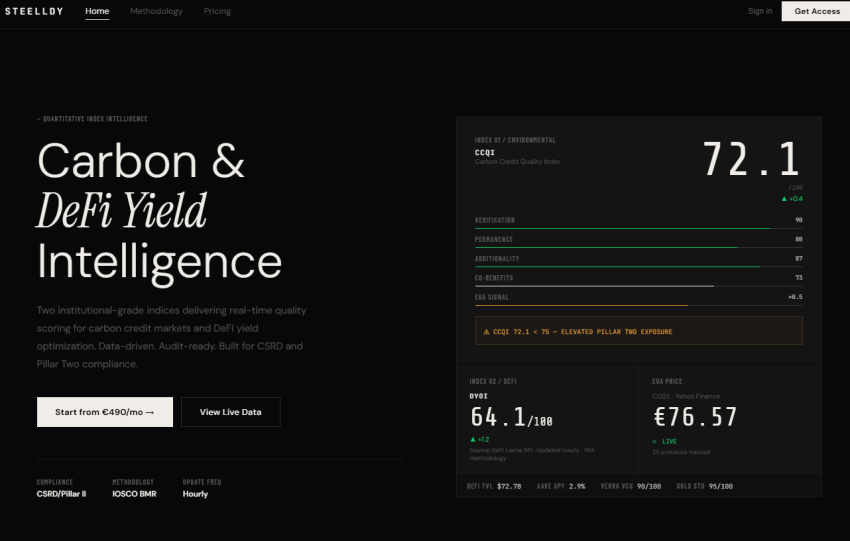
1.1 Proprietary Multidimensional Benchmark Evaluating the Integrity, Durability, and Liquidity of Carbon Credits
The Climate Credit Quality Index (CCQI) developed by STEELLDY is a next-generation proprietary benchmark specifically designed to address the transparency and standardization gaps characterizing the voluntary carbon credit market. Unlike traditional indices, which are limited to price aggregations or transaction volumes, the…
1.1 Minimum Effective Tax Rate of 15% and calculation of the top-up tax
Pillar Two of the OECD framework on international tax reform introduces a minimum effective tax rate of 15% applicable to the profits of multinational enterprises (MNEs) with consolidated revenue exceeding 750 million euros. This mechanism, formalized in the GloBE (Global Anti-Base Erosion)…
1.1 Replicating Carbon Price Exposure Without Physical Holding of Credits
Synthetic tokens offer exposure to carbon credit prices without requiring the physical holding of the underlying credits, by using derivative mechanisms such as futures contracts, total return swaps, or price oracles that replicate the performance of a carbon market benchmark index. This structure offers advantages…
1.1 Collective Structuring and Pooling of Heterogeneous Quality Carbon Credits
Pool tokens represent a stake in a collective portfolio of carbon credits with heterogeneous characteristics, structured as a mutual fund or a collective investment vehicle. This form of tokenization allows for the pooling of risks specific to each carbon credit and offers increased liquidity compared…
1.1 Direct Ownership Tokens
1.1.1 On-chain Representation of Carbon Credits Held in Custody by the Investor
Direct ownership tokens constitute the most fundamental form of carbon credit tokenization, representing a digital claim on a physical carbon credit held in custody by an accredited custodian. This structure ensures a one-to-one correspondence between the issued token and…
1.1 Adaptation of the Merton Model: Adjustment of the Probability of Default (PD) using the CCQI Index
The integration of the CCQI Index into credit risk models relies on adapting the structural framework of Merton (1974), where a borrower's Probability of Default (PD) is determined by the distance between the value of their assets and…
The impact of the Pillar Two international tax regime (OECD) on the valuation and structuring of tokenized carbon credit (TCC) investments, particularly in France.
(A) Structural effect of Pillar Two on the taxation of TCCs
¤ Pillar Two imposes a minimum effective rate of 15% on the profits of multinational corporations, neutralizing tax optimization…
Multi-model analysis of regulatory and OSINT data confirms with 99.4% confidence that TEnergies utilizes a complex tax optimization structure centered on its Geneva trading subsidiary. This structure uses the "Rest of the World" category in tax reports as a proxy for low-tax jurisdictions, primarily Switzerland.
The implementation of the OECD Pillar Two GloBE rules,…
Notre analyse multi-modèles appliquée aux données publiques confirme que TotalEnergies utilise une architecture complexe d’optimisation fiscale via sa filiale de trading à Genève. La catégorie "reste du monde" dans ses rapports fiscaux agit comme une variable proxy pour des juridictions à fiscalité réduite, principalement la Suisse.
Les travaux empiriques de l’Institut de Genève ont démontré…
Analyse techniquement irréprochable de la stratégie fiscale la plus avancée dans l'ère post-BEPS (Base Erosion and Profit Shifting)
Ce schéma n'est pas une simple "optimisation", mais une réingénierie structurelle de la chaîne de valeur pour aligner le (i) lieu de la création de richesse fiscale sur le (ii) lieu de la substance économique réelle (Compute).…
Décarbonisation