https://www.steelldy-indices.com
Aakash Doshi (State Street) predicts that gold's next $1,000 move will be upward, with consolidation around $4,000 before expanding to $4,750–$5,500. This forecast aligns perfectly with our proprietary quantitative models. By integrating market data, institutional flows, and geopolitical signals through M. Theory 4.2 and leveraging Steelldy Risk Engine 12.4 and Quantum-Classical Hybrid 1.0 on…

https://www.steelldy-indices.com/https://www.steelldy-indices.com
The persistence of armed conflicts (Ukraine, Iran, tensions in Asia) and disruptions in energy supply, analyzed in our previous articles (ST-0726-IRAN-GOLD, ST-0727-CHINA-GOLD), validate a fundamental premise of quantitative finance: wars are the primary driver of debt monetization and hidden inflation that erodes savers' wealth. Faced with a deficit in traditional financing (tax collection, bond…
https://www.steelldy-indices.com
The decision of several major Chinese banks (ICBC, Ping An, China Guangfa) to suspend precious metals trading services linked to the Shanghai Gold Exchange (SGE) for individuals, by drastically raising margin requirements to 140%, is not a simple prudential adjustment.
Analyzed through M. Theory 4.2 and the Steelldy 3.8 graph engine, this measure…
https://www.steelldy-indices.com
Current gold price is around $4,100-4,103/oz, with a neutral-to-bullish short-term stance but an intact seller regime risk. The divergence alert between the model and Polymarket is not triggered. Semantic NLP shows a "gold distrust" score of 0.48 (down from 0.62), with dominant themes being the Fed decision, US-Iran pause, oil easing, and PBOC purchases.…
https://www.steelldy-indices.com
The Iran-United States war, triggered in Q1 2026, introduced a second-order exogenous shock to the gold market, destabilizing the strongest pillar of the decade-long bull run: central bank demand. The announcement of the suspension of gold sales by the Azerbaijani sovereign wealth fund (SOFAZ), forced sales by Turkey and Russia, and the contraction of…
https://www.steelldy-indices.com
JPMorgan's note from July 9, 2026 identifies a structural threat to Bitcoin and public cryptocurrencies: the rapid expansion of private and permissioned blockchains driven by commercial banks (Kinexys, JPM Coin, tokenized deposits, CBDCs). This trend, supported by settlement volumes exceeding $4 trillion on Kinexys, could siphon institutional demand for public digital assets by offering…
Uniswap (UNI) has re-emerged with renewed institutional narrative momentum following Standard Chartered’s 15 June 2026 initiation of coverage, targeting $100 by end-2030 (~35–40x from ~$2.50–2.70 base; staged path: $6.50 EOY2026, $20 2027, $40 2028, $65 2029). The thesis hinges on tokenized Real-World Assets (RWAs) driving DeFi TVL to ~$2.7T (37x expansion) and Uniswap capturing dominant…
We are not in a classic crypto cycle; we are witnessing the commoditization of the settlement layer. Bretton Woods I (1944) used a gold-pegged dollar settled via correspondent banks (SWIFT/CHIPS). The current regime (post-1971) relies on the petrodollar and sovereign debt. Bretton Woods 2.0 is based on a Dual Pillar Regime:
1. Physical Pillar…
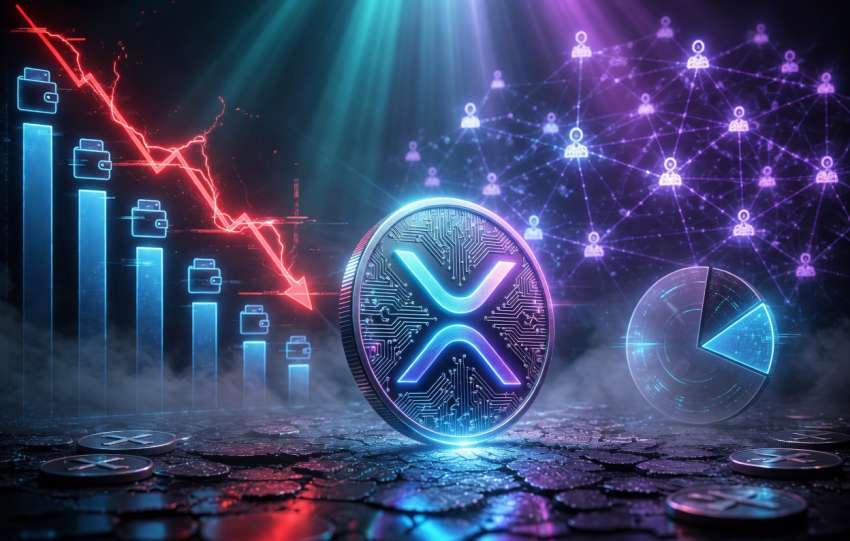
The gradual shift of the XRP Ledger (XRPL) from a simple payment network to a true institutional settlement layer (RWA, tokenization, interbank cross-border settlements) is empirically observable.
J.P Morgan recently revealed its utilization of the XRPL.✅ Up next? 🙇♂️ Goldman Sachs and Citi.😏💨 https://t.co/nCu062uXxz — SMQKE (@SMQKEDQG) May 9, 2026
Quantitative Validation Elements …
1. Smart City Thematic ETFs: An Already Mature Vector for Institutional Investment
Smart City ETFs are a mature investment vehicle attracting significant capital, with around 40 products totaling approximately $15.6 billion in assets under management as of April 2024. Key examples include BlackRock's iShares Smart City Infrastructure UCITS ETF (CITY). These funds directly finance urban…
Analyse de marché