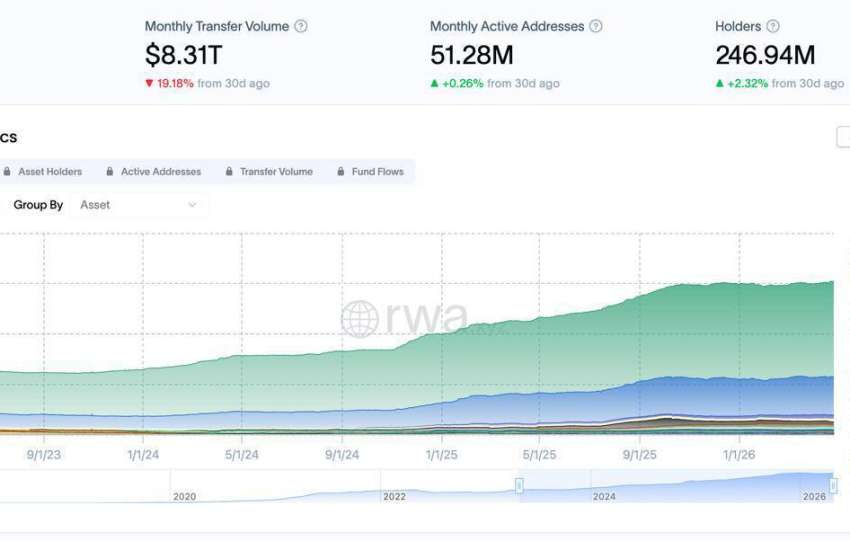
Cap: For a decade, the value of a digital asset hinged on a promise: someone would buy it higher tomorrow. In 2026, a new paradigm takes hold value is measured by the cash flow the asset distributes, automatically, every month. Welcome to the programmable rent economy.
There are numbers that mark a trend,…

1.1 Le CARF : 76 juridictions, premier échange le 30 septembre 2027
Le Crypto-Asset Reporting Framework de l'OCDE étend le standard commun d'échange (CRS) aux crypto-actifs. L'état de déploiement, vérifié à la date de notre étude : 46 juridictions engagées pour la période de reporting 2026, 29 pour 2027 et 1 pour 2028 ;…
Thesis. 2026 marks the global doctrinal shift. Private-regulated dollar (GENIUS Act), public-regulated euro (ECB), public-interest-bearing yuan (PBOC). Stablecoins become a treasury instrument; CBDCs become a sovereignty instrument.
Key Data. Stablecoin market: ~$290–321B (USDT ~$184–190B; USDC ~$73B). MiCA: fully applicable since 30/12/2024, transition period ends 01/07/2026; approximately twenty licensed EMTs (USDC, USDG, EURC, EURCV, EURI,…
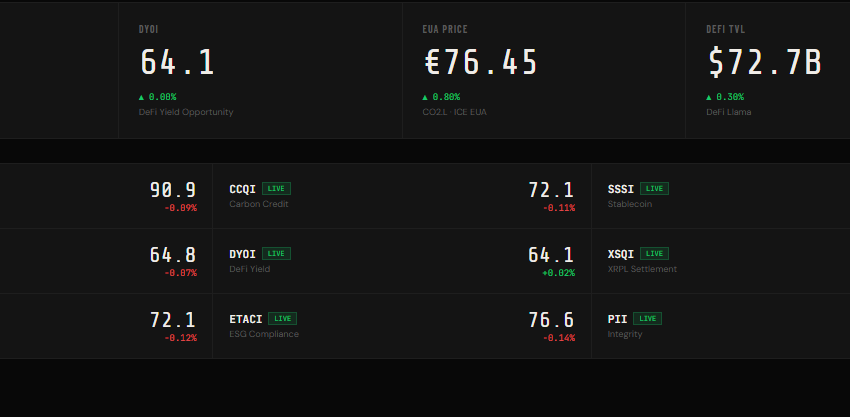
The press release from the Bank for International Settlements (BIS) acknowledges that the transparency of stablecoin ledgers exposes bank positions to the entire market, dismantling the historical information asymmetry. To quantify this phenomenon and guide investment decisions as well as technological deployment, we have constructed the Proprietary Integrity Index 1.0 (PII 1.0), a normalized composite…
The GENIUS Act mandates stablecoin issuers to hold 100% reserves in cash or T-bills with maturity ≤ 93 days. This creates a mechanical demand for T-bills, making them the collateral commodity for the new system.
By mid-2025, Tether and Circle held $160 billion in T-bills, exceeding most sovereign nations' holdings, which mechanically compresses short-term…
The gradual shift of the XRP Ledger (XRPL) from a simple payment network to a true institutional settlement layer (RWA, tokenization, interbank cross-border settlements) is empirically observable.
J.P Morgan recently revealed its utilization of the XRPL.✅ Up next? 🙇♂️ Goldman Sachs and Citi.😏💨 https://t.co/nCu062uXxz — SMQKE (@SMQKEDQG) May 9, 2026
Quantitative Validation Elements …
1. Introduction et contexte stratégique
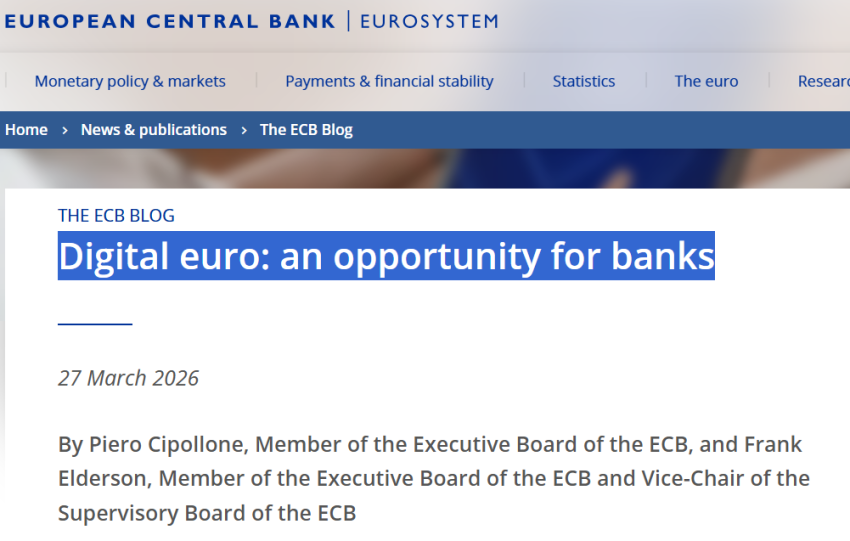
Le document de la BCE représente un tournant décisif dans l’architecture monétaire européenne. Pour un analyste quantitatif, ce texte ne doit pas être lu comme une simple déclaration d’intention, mais comme un shift structurel de paradigme où la monnaie de banque centrale (MoBC) entre en compétition directe (mais régulée) avec les solutions…
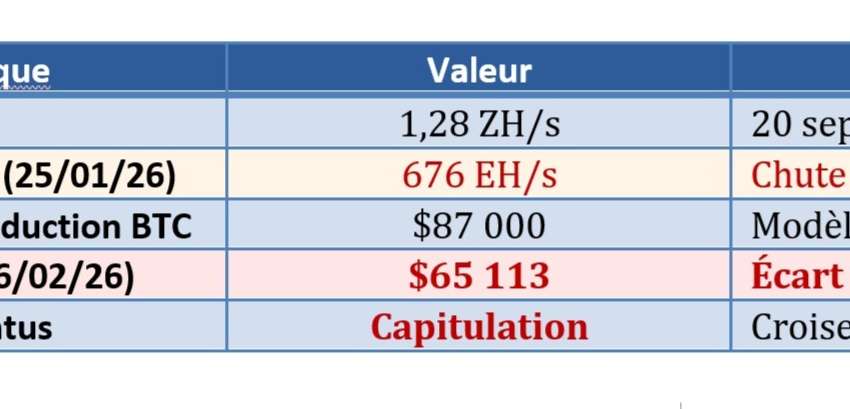
Le marché des actifs numériques subit un resserrement structurel de liquidité, rappelant les crises de FTX (novembre 2022) et le débouclage du carry trade JPY (août 2024). Une modélisation quantitative révèle trois vecteurs de transmission systémique simultanés, une première depuis 2021. Les constats majeurs incluent : une contraction monétaire crypto, avec une baisse de 7,1…
Our analysis confirms the DeFi amplifier hypothesis: the decentralized finance system functions as a pro-cyclical leverage multiplier, amplifying an FX shock (JPY appreciation) into a crypto liquidity crisis with contagion to traditional markets. The observed correlation, a BTC/USDJPY beta of -3.5x, reveals a three-step transmission mechanism: the unwinding of the carry trade, the collapse of…
In our STEEL software, USDT is modeled as the first-tier systemic collateral in decentralized finance. A 10% contraction ($12 billion USD) is a negative convexity shock. Input variables include an initial USDT supply of $120 billion, a contraction speed at T+5 days (exogenous shock like a JPY Carry Trade unwind), an LIR < 0.22 (market…
Analyse de marché