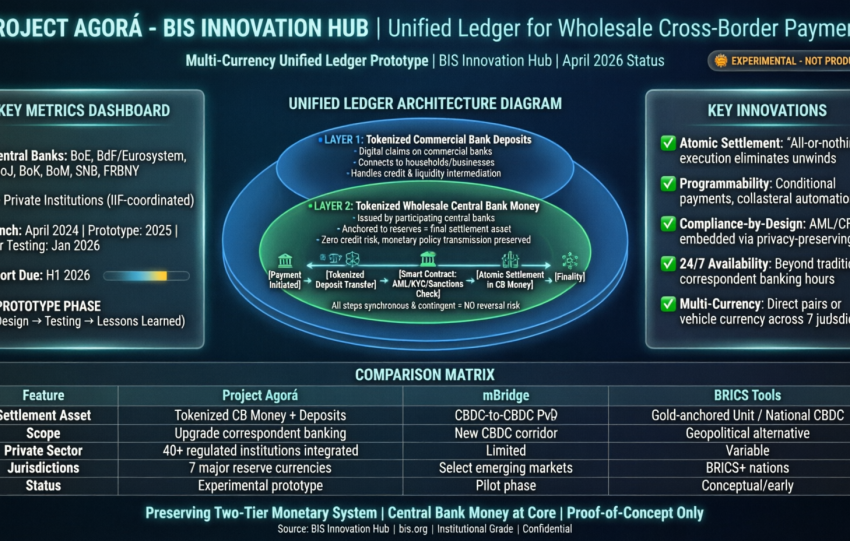
Project Agorá, launched in April 2024 by the BIS Innovation Hub, is its largest public-private collaboration, testing a multi-currency unified ledger for wholesale cross-border payments. It builds on the BIS's "unified ledger" concept, exploring how tokenization and programmability can modernize correspondent banking without replacing the two-tier monetary system (commercial banks and central banks).
This…
Project Agorá (Greek for “marketplace”) is a major BIS Innovation Hub initiative launched in April 2024. It is a public-private collaboration exploring the tokenization of wholesale central bank money (wCBDC or tokenized reserves) and commercial bank deposits on a multi-currency unified ledger—a programmable platform—to improve wholesale cross-border payments while preserving the two-tier monetary system (central…
CBDC interoperability challenges—particularly in hybrid setups like the Société Générale–Forge/Banque de France (BdF) 2024 repo pilot and ongoing Les Gardiennes/UBS collaborations—stem from bridging public Ethereum (permissionless, for tokenized collateral like bonds or uMINT funds) with proprietary/permissioned CBDC ledgers (e.g., BdF’s DL3S on Hyperledger Fabric). These pilots use mechanisms like Hashed Timelock Contracts (HTLCs), APIs, and…
Technical details on smart contracts for Ethereum-based repo tokenization pilots (e.g., Société Générale–Forge/Banque de France 2024 repo, UBS, Les Gardiennes collaborations, and related UBS uMINT/Project Guardian work) are not fully open-sourced or published in complete audited code form. These are institutional, regulated deployments focused on compliance, so details come from whitepapers, audits, press releases, and…