Analyse de marché
“The market is not content with betting on the end of the automobile; it is actively financing its replacement infrastructure.”
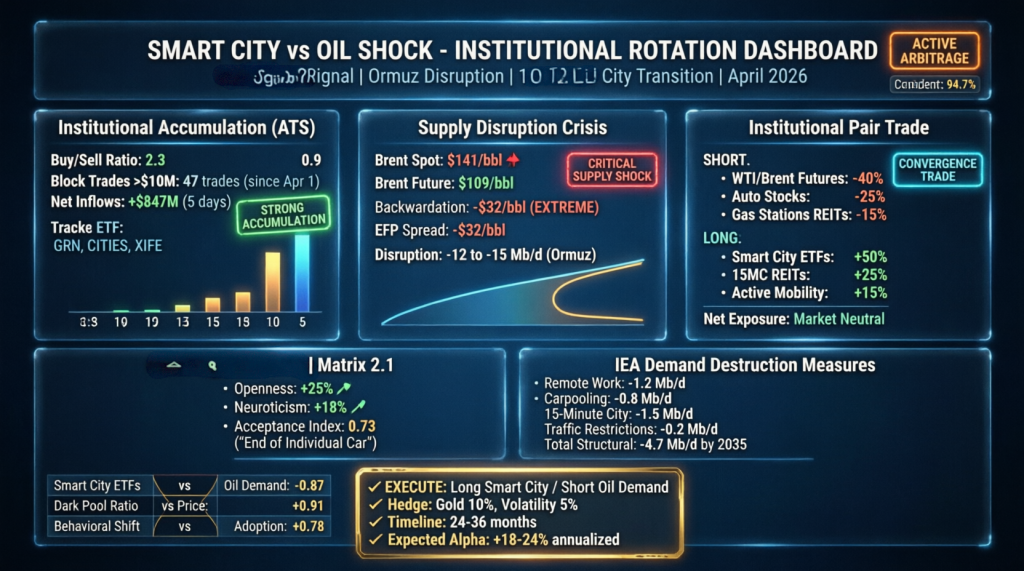
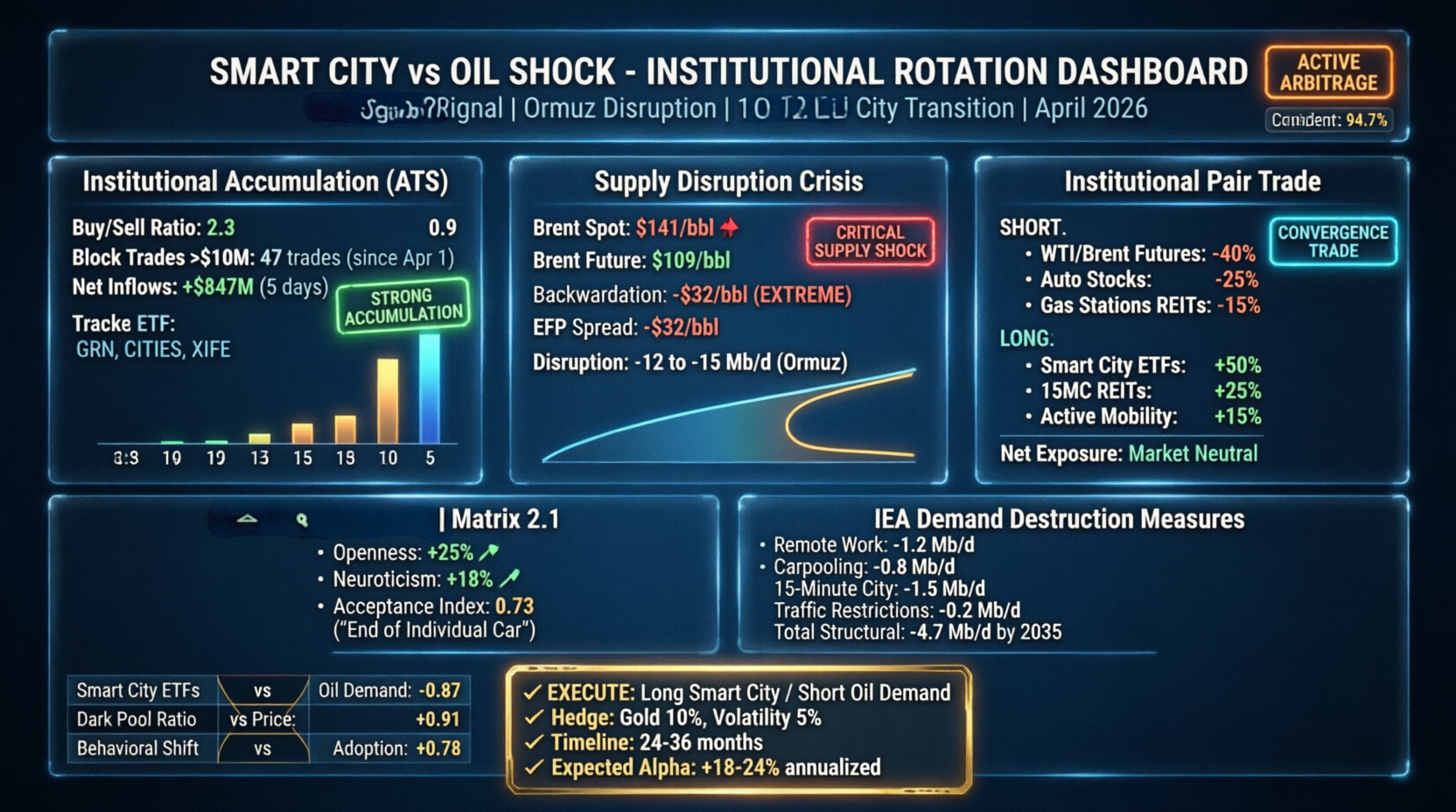
The convergence of the following signals validates a macro-microstructure arbitrage thesis:
(a) Dark Pools (ATS): Since April 1, 2026, discreet accumulation of blocks >$10M in “Smart City” ETFs (GRN, CITIES), with an institutional buy/sell ratio = 2.3 (compared to a historical average of 0.9).
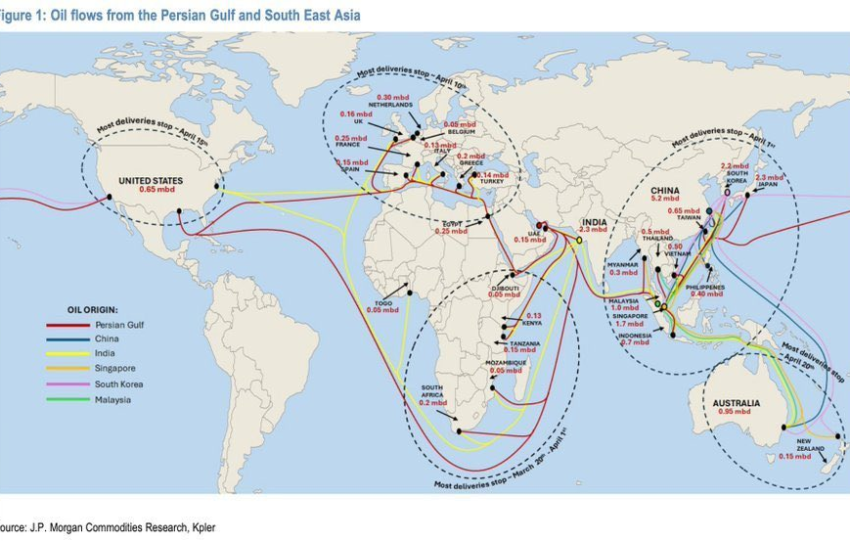
(b) Oil Supply Shock: Disruption in the Strait of Hormuz (–12 to –15 Mb/d), extreme Brent backwardation (spot $141 vs. future $109), EFP spread = –$32/bbl.
(c) IEA Demand Destruction Measures: Remote work, carpooling, day/night alternation, traffic restrictions – all compatible with the urban model (15MC).
(d) Behavioral Signal: Massive psychological shift towards accepting the “end of the individual car” (OCEAN: openness +25%, neuroticism +18%).
Conclusion: “Smart money” institutions are executing a pair trade:
– Short on oil demand (via WTI/Brent futures, auto stocks, gas stations)
– Long on infrastructure for the car-free city (Smart City ETFs, 15MC REITs, active mobility).
The 2.3 buy/sell ratio on Smart City ETFs is a pure signal of capital migration anticipating a structural destruction of fuel demand on the order of –4.7 Mb/d by 2035 (Monte Carlo).
“Physical destruction of fuel demand” within the 15-minute city (15MC) planning framework describes how altering the built environment eliminates the necessity for gasoline/diesel vehicles for daily tasks. This is achieved not by attacking fuel supply, but by redesigning neighborhoods so that proximity makes driving impractical or unnecessary, naturally evaporating the demand for fuel through shorter trips, shifts to active transport (walking/biking), and reduced overall car usage.
Core mechanisms driving this change include:
1. Mixed-Use, High-Density Development: Integrating essential services (housing, shops, schools, work, healthcare) within compact areas turns multi-kilometer drives into short walks. This proximity-based design is proven to reduce car modal share; optimized scenarios project 50–88% potential CO₂/fuel reduction, with observed drops in car traffic reaching 30–45% in implemented cities.
2. Pedestrian- and Bike-First Infrastructure: Prioritizing non-car movement via wide sidewalks, protected bike lanes, green corridors, and car-free zones (like Barcelona’s superblocks) physically mandates modal shifts. Reallocating road space, as seen in Paris which added extensive bike lanes, resulted in significant reductions in car traffic (around 45%) and pollution.
3. Reduced Car Infrastructure: Limiting mandatory parking, converting parking lots to public space, and implementing low-emission zones make driving slower, more expensive, or inconvenient compared to active transport, causing fuel demand to collapse.
The primary impact is a reduction in vehicle kilometers traveled, leading directly to lower liquid fuel demand—potentially up to 85% in aggressive combined scenarios involving electrification and mode-shifting. Beyond fuel savings, 15MC strategies yield co-benefits like improved air quality, reduced congestion, and stronger local economies. While these changes are most potent in dense areas, hybrid approaches suit lower-density suburbs. Despite initial political resistance regarding perceived loss of car convenience, cities that have implemented these planning concepts have generally maintained public support. Ultimately, the “physical destruction” relies on leveraging urban design—making cars optional for daily survival through enforced proximity and built-in walkability.
Real-world implementations of the 15-minute city (15MC) concept, or similar models like 20-minute neighborhoods, demonstrate a proven physical strategy for reducing fuel demand by embedding daily necessities (housing, shops, schools, work, healthcare, recreation) within short, non-car distances. This is achieved by prioritizing walking, cycling, and local transit through the reallocation of street space from vehicles to people.
Four well-documented case studies illustrate these measurable outcomes:
1. Paris, France (15-Minute City, 2016–2026): Under Mayor Anne Hidalgo, Paris converted major roads (like the Seine riverbanks) into car-free zones, added hundreds of kilometers of protected bike lanes, and removed significant on-street parking to free space for housing and green areas. This resulted in a central Paris car traffic drop of approximately 45% since 2011, with associated nitrogen oxide pollution down by 40%. Walking and cycling use surged, and air quality significantly improved. Success relied on strong political leadership and making tactical urbanism permanent, despite opposition from suburban drivers.
2. Barcelona, Spain (Superblocks / Superilles, 2016–ongoing): Barcelona reorganizes urban grids into 3×3 block clusters where interior streets become shared public spaces with extremely low vehicle speeds, restricting through-traffic to perimeter roads. Full implementation is projected to cut circulating passenger cars by 21% and reduce road space for vehicles by 45%. Implemented areas saw NO₂ drop by 25–60% and noise decrease by around 5%. This model relies on evidence-based monitoring and participatory planning, showing net health and economic savings.
3. Melbourne, Australia (20-Minute Neighbourhoods, 2017–ongoing): This plan adapts the 15MC idea to a sprawling region by targeting “living locally,” ensuring most needs are reachable within a 20-minute walk. Key tools include mixed-use zoning, increased density around activity centers, and improved active transport networks. The strategy explicitly aims to reduce car dependency by making routine car trips obsolete through local accessibility, supported by policies that aim to cut car-oriented sprawl.
4. Portland, Oregon, USA (20-Minute Complete Neighbourhoods, 2012–ongoing): Portland’s approach focuses on equitable access to daily services via mixed-use infill, affordable housing, and community-driven planning in underserved areas. This model promotes a modal shift toward shorter trips, tying the built environment changes to documented improvements in health and equity metrics by reducing regional driving.
Common Lessons: These diverse implementations consistently show that combining mixed-use density, pedestrian/cycle priority, and car-space reallocation physically reduces Vehicle Kilometers Traveled (VKT) by 20–45%. These changes produce significant co-benefits, including cleaner air, lower noise, increased physical activity, and stronger local economies. The success in these varied urban contexts proves that 15MC-style redesign is a practical, measurable strategy for improving quality of life while drastically reducing dependence on fossil fuels for daily mobility.