The framework is a two-regime Markov model with observable states, not a calibrated HMM
Regime 1 (Liquidity risk-on) is indicated by positive 5-day net $BTC / $ETH ETF flows, declining $DXY, funding below 0.03% per 8 hours, and BTC above 77.1k then 81.3k.
It implies overweighting ETH/ $SOL relative to BTC, with only reduced $ZEC…
Tech
Artificial intelligence, Semiconductors, Cyber Security, Social Media
Two dates, just months apart, capture the essence of what 2026 means for the global monetary architecture. On July 1, the expiration of MiCA's transitional period made the European Union the first fully licensed digital asset market. On Januaryv14 2027, SWIFT will enforce ISO 20022 structured addresses in cross-border payments, with non-compliant messages facing outright…
There are revolutions that announce themselves through noise, and others through accounting. The one unfolding before our eyes in digital finance belongs to the second category. Behind the gradual disappearance of purely speculative tokens from institutional screens, a deeper transformation is underway: tokenized Real World Assets (RWAs) are changing nature.
From products of uncertain…
The RWA market has entered an industrialization phase; the discriminating factor for allocation is no longer TVL but the structural quality of flows (liquidity, compliance, yield distribution). Key data (mid-2026). On-chain distributed value: ~$31–36 billion (+380% from 2022); “represented” value: ~$340–369 billion; stablecoins (settlement layer, counted separately): ~$290–321 billion; RWA holders: ~790,000; tokenized Treasuries: ~$15.1…
For a century, fortune was built on a bet: buy an asset, wait for it to be worth more. Real estate, stocks, gold, the logic of appreciation reigned. The tokenization of real-world assets (RWA) is now reversing that logic, and the shift runs deeper than mere technological innovation: it is a change of economic regime.…
Two invisible infrastructures converge in 2026: MiCA's licensed perimeter for crypto-assets, and the ISO 20022 migration of payment messaging. One regulates assets, the other the messages that carry them. What boards need to understand before November.
Since 1 July 2026, a MiCA license is mandatory for crypto-asset service providers across all 27 EU member states,…
For a decade, the value of a digital asset depended on the promise of a higher resale price. The tokenization of real-world assets (RWA) reverses this logic: value is now read in cash flows, rents, coupons, interest—generated by the underlying asset and distributed automatically. Analysis of a paradigm shift that brings crypto closer to private…
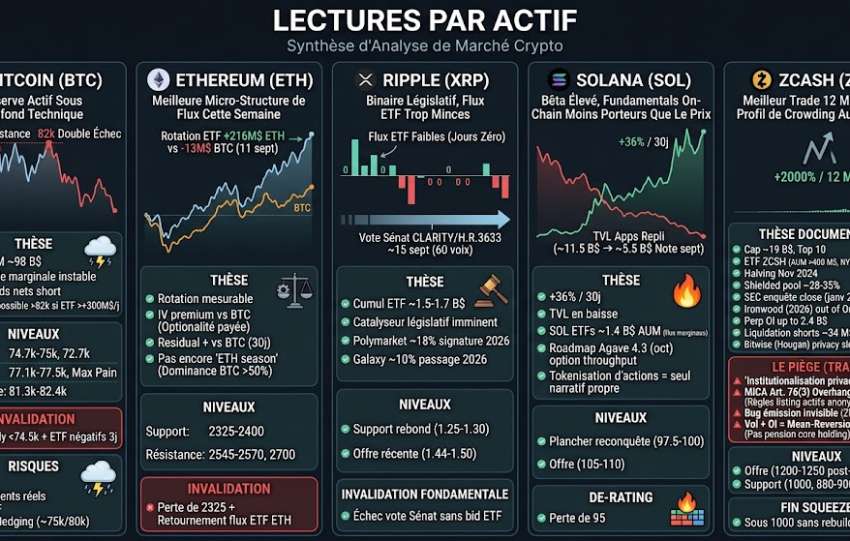
As of September 11, 2026, the crypto market presents a mixed macro regime. Bitcoin trades near $77,200–77,400, showing a -4.7% weekly decline as it digests levels below $80,000–82,000. ETF outflows have been observed for three days. Ethereum is around $2,470–2,480 with slight daily stability but a weekly -2%, while XRP at $1.35 drops -6.6% weekly…
Three macro variables dominate the pricing of five crypto assets today. The August CPI, released on September 11, is the last inflation print before the FOMC. A "hot" print raises perceived r* and compresses crypto duration, while a disinflationary print reopens the hold scenario.
The FOMC meeting on September 15-16 has hike probabilities of…
Bitcoin remains anchored as a macro duration asset, with ETF float around 6% of market cap. The repeated rejection near $82k defines a distribution range, not a structural bear market, as long as support at $75-77k and the cycle floor near $58k hold.
Post-rally outflows reflect pre-CPI rebalancing, not capitulation, with BlackRock’s IBIT concentrating flow…