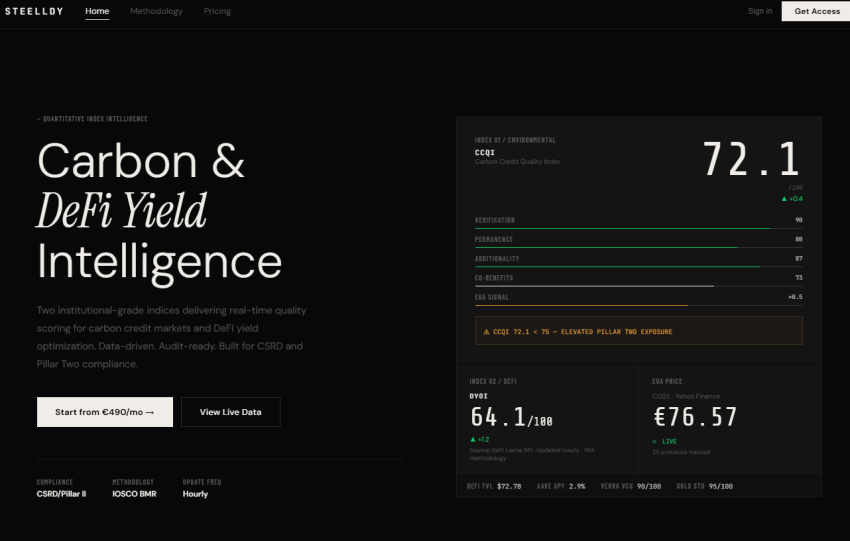
The Real Asset Shifting (RAS) module (www.steelldy-indices.com) focuses on tangible assets, notably cross-border real estate. However, intangible assets (patents, trademarks, software, know-how, databases, client lists) are historically the main channel for profit shifting in multinational groups. Unlike tangible assets, intangibles do not significantly benefit from the Substance-based Income Exclusion (SBIE), are highly sensitive to transfer…
Markets
Markets, Markets Data, Private Markets, Equities, Bonds, Stocks, Currencies, Commodities, Crypto, Monetary Policy Radar, Wealth Management, Moral Money, Money, ETF, ETF Hub, Asset Management, Private Equity.
The Substance-based Income Exclusion (SBIE) is a carve-out mechanism under Pillar Two (GloBE) that excludes part of a jurisdiction's GloBE Income before calculating top-up tax, recognizing real economic substance. Its formula for 2022 rules with 2024-2026 guidance is 5% of eligible payroll plus 5% of tangible assets' carrying value.
Payroll includes eligible employee expenses,…
Société Générale projects a more moderate pace of gold purchases by central banks in the future. While central bank demand has been a key driver of gold's multi-year rise to an all-time high of $5,600, and a recent World Gold Council survey indicates continued official sector buying, one bank adopts a cautious stance, warning that…
Gold prices are expected to fall below $3,900 per ounce this year before bottoming out, with a subsequent rally to $5,300 by 2027, according to a forecast from TD Securities. The precious metal has started the week on a disappointing note, hovering near support around $4,000 per ounce as persistent inflation concerns weigh on the…
According to precious metals market analysts at Heraeus, gold and silver prices are expected to rise soon due to declining oil prices, which ease inflation expectations and reduce bond yields, while developments in the Pacific region suggest a potential shift of the gold market's center of gravity to the East. In their latest review, analysts…
These projections come from a complete hybrid Monte Carlo simulation (incorporating coupled stochastic processes, embedded HMM regime-switching, an affine term structure for rates, and Poisson jumps for geopolitical shocks), calibrated on Steelldy Risk Engine 12.4 data (backtests 1971-2026), ECB staff projections from June 2026, and current macro flows (Bund 10Y ≈ 2.86-2.90%, ECB deposit rate…
The rise in key interest rates (ECB deposit facility at 2.25% as of June 17, 2026, following a +25 bps increase) mechanically raises the nominal yield of new sovereign bonds and monetary instruments (€STR, deposits). For a hold-to-maturity investor, this generates a stable nominal carry. However, our decomposition using Steelldy Risk Engine 12.4 (factor decomposition,…
Gold is currently weakening despite inflation, due to several key factors. In May, Germany’s inflation rate was surprisingly moderate at 2.6% annually, significantly lower than the eurozone’s 3.2%. This deviation from the European trend was primarily driven by a temporary fuel subsidy introduced by the German government, which reduced gasoline and diesel prices. However, this…
We use exclusively verifiable public data, collected and processed by our Steelldy Risk Engine 3.4 infrastructure and Bloomberg Intelligence modules:
- Treasury International Capital (TIC): Monthly and annual reports, raw and adjusted data for valuation and hedging effects, broken down by country and maturity (source: Treasury.gov).
- Official reserve flows: IMF COFER (Currency…
On June 19, Goldman Sachs analysts Lina Thomas and Daan Struyven lowered their year-end gold price forecast from $5,400 to $4,900. Specifically, Goldman Sachs no longer believes the Fed will cut rates in 2026, so the bank shifted its first expected rate cut to June 2027.
JPMorgan has not changed its position. Its year-end…