Thesis. 2026 is the year of monetary bifurcation: the United States has chosen regulated private stablecoins (GENIUS Act, explicit ban on a Fed retail CBDC), while Europe is building the public digital euro (Parliament vote in February 2026, ECB Governing Council decision on October 30, 2025, pilot possible mid-2027, first issuance envisaged in 2029, construction cost ~€1.3 billion) while allowing MiCA to organize a market for private euro stablecoins (AllUnity’s EURAU, DWS/Galaxy/Flow Traders, issued in Germany; Qivalis consortium of 9-10 banks including BNP Paribas preparing a euro stablecoin for 2026).
Key data. Stablecoins: $290-321 billion market capitalization, USDT ~$184-190 billion, USDC $73 billion. 2026 CBDC wave: up to 24 countries representing ~73% of global GDP in launch/pilot phases (digital euro, Japan’s digital yen DCJPY via Japan Post Bank — ~¥190,000 trillion in deposits —, India’s e₹ with offline payments and subsidy programmability). e-CNY already operational: ~$890 billion in cumulative transactions, 260 million active users. European wholesale component: TARGET for Digital Securities (TLDS), the Eurosystem’s DLT solution for settling DLT transactions in central bank money, launched in Q3 2026 — wholesale is advancing faster than retail.
Quantitative analysis of three dynamics:
1. Fragmentation into monetary zones (dollar-stablecoin zone / hybrid euro zone / e-CNY zone) creates heterogeneous settlement corridors, exactly what adoption indices (CAVI) and settlement quality indices (XSQI) measure. Arbitrage between zones becomes an allocation strategy, not just a treasury choice.
2. Programmability is the killer argument for CBDCs (geo-fenced and time-bound subsidies from e₹, conditional payments tested by 70+ banks and fintechs on the digital euro innovation platform) but also its Achilles’ heel: 68% of central banks cite privacy as the #1 governance challenge. The public acceptance differential is a macro variable to track like inflation.
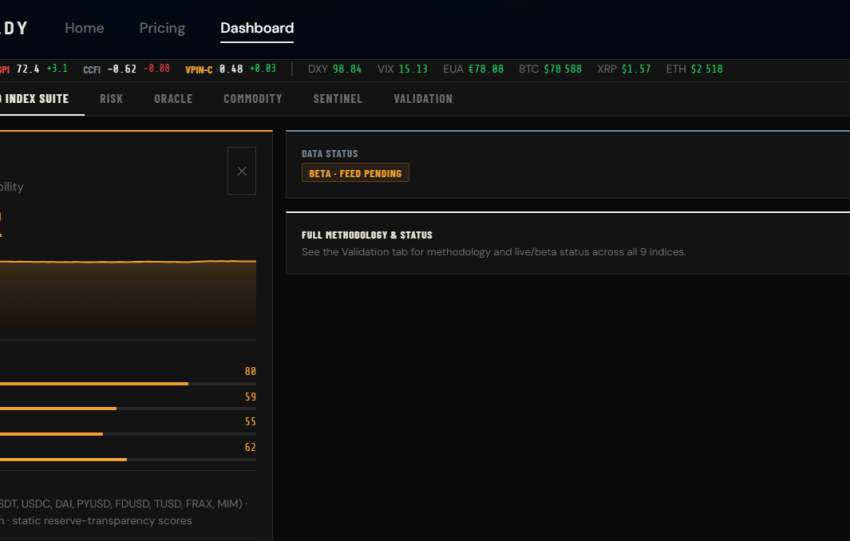
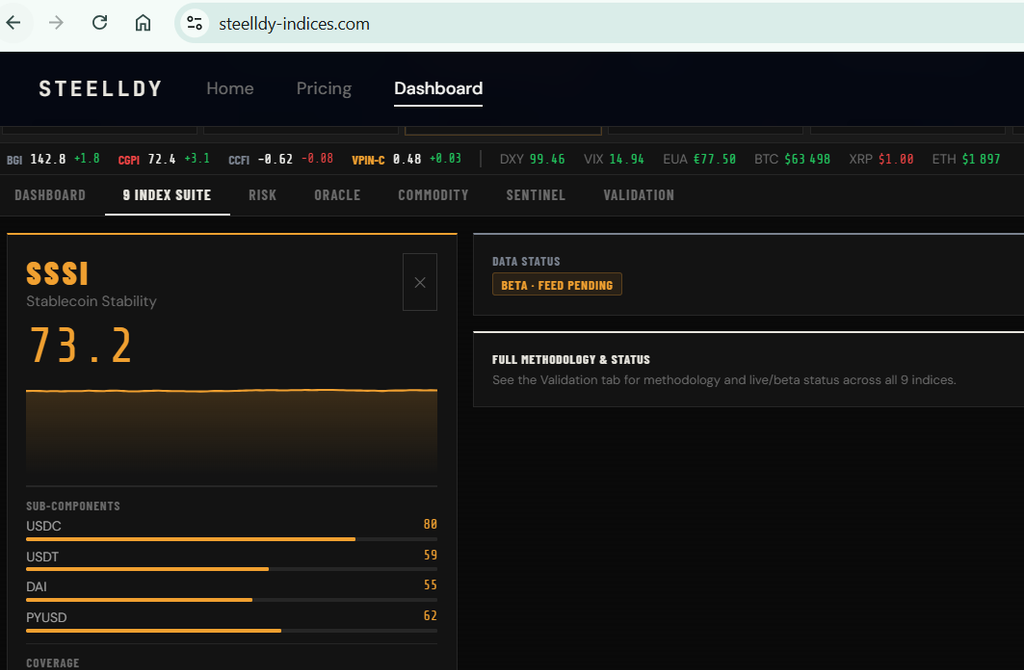
3. A regulated stablecoin with transparent reserves wins over an opaque one. Our SSSI scoring (reserve transparency, EWMA peg deviation, informed flow detection like VPIN, refreshed every 6 hours) flagged UST 12 hours before the depeg: in a world where corporate treasuries hold stablecoins as operational cash, dynamic reserve rating becomes as essential as credit rating.
Positioning. Long the euro on-chain settlement infrastructure (MiCA issuers, consortium banking rails), long stablecoin rating data (nascent monopoly), cautious on stablecoins without monthly attested reserves, wait-and-see on retail CBDCs (adoption = political variable, not technological).
Risks. Political: an EU legislative reversal post-2026; Banking: deposit disintermediation if the holding limits for digital euro (EUR 3,000 under study) are raised; Technological: quantum (IDEMIA demonstrated the first quantum-resistant offline CBDC payment in 2026, the cryptographic race begins).
Verdict. Overweight infrastructure and data, underweight unregulated issuers. Programmable money is the rail; the rent belongs to those who audit and rate the rail.
SOURCES
1. Stobox. The State of RWA Tokenization, 2026 Mid-Year Report (juillet 2026) : 33,5Md on-chain RWA ex-stablecoins, +400 % depuis début 2025, ~995 k détenteurs, 167 plateformes, standard ERC-7943.
2. rwa.xyz / DeFiLlama (données reprises dans guides sectoriels 2026) : Treasuries tokenisés ~15 Md, crédit privé 10−12Md , commodités ~1,5 Md$ ; BUIDL ~2,4-2,6 Md$ ; USYC ~2,9 Md$ ; BENJI ~2,1 Md$.
3. Altrady / Defi-Intel / eco.com (2026) : BUIDL ~4,5-5 % APY, min. 5 M, structure BlackRock/Securitize/BNYMellon; dépôt SEC du 8 mai 2026(deux nouveaux fonds tokenisés+ parton− chain 7Md ) ; USDtb adossé à >90 % à BUIDL ; collatéral marge chez FalconX.
4. J.P. Morgan Payments, ISO 20022 Migration Guidance (4 août 2026) : adresses structurées/hybrides obligatoires dès le 14 novembre 2026 (CBPR+), retrait des adresses non structurées.
5. OasisPro / pain001.com / Cambridge Currencies (2026) : fin de coexistence MT/MX le 22 novembre 2025 ; 65 % de messages non conformes, 44 % de banques en retard (été 2026) ; SEPA le 15 novembre 2026 ; E&I camt.110/111 en novembre 2027 ; retraite MT9xx en 2028 ; coût d’exception 25-75 $/transaction.
6. Blockcritics / FII Institute / 120btc (2026) : BCE, phase suivante de l’euro numérique décidée le 30 octobre 2025, vote du Parlement européen en février 2026, coût de construction ~1,3 Md€, Pontes (règlement DLT monnaie centrale) au T3 2026, pilote possible mi-2027, émission 2029 ; EURAU (AllUnity : DWS/Galaxy/Flow Traders) émis en Allemagne ; consortium Qivalis (BNP Paribas et 9-10 banques) stablecoin euro 2026 ; doctrine US anti-MNBC / GENIUS Act.
7. Informed Clearly (2026) : vague MNBC 2026, 24 pays, ~73 % du PIB mondial ; DCJPY/Japan Post Bank (~190 000 Md¥ de dépôts) ; e-CNY ~890 Md$ de transactions, 260 M d’utilisateurs ; e₹ offline et programmable ; 68 % des banques centrales citent la vie privée comme défi n°1.
8. CryptoVerse Lawyers (déc. 2025) : marché tokenisé EU projeté à 2 000 Md€ d’ici 2028 ; coût licence CASP 500 k€-1 M€.
9. Prévisions 2030 : McKinsey (2 000 Md),Citi (5000Md ), BCG/Ripple (16 000 Md$ scénario haut), Keyrock/Securitize (400 Md$ distributed).
10. steelldy-indices.com ; scoregex.streamlit.app (747 transactions, 8 communes, 92 k frontaliers, différentiel ×2,1) ; steelldy.com (archives Economic studies).
11. J.P. Morgan — ISO 20022 Migration (août 2026): https://www.jpmorgan.com/insights/payments/fx-cross-border/iso-20022-migration
12. Yahoo Finance / BeInCrypto — Reality of RWA Tokenization in 2026 (juillet 2026): https://finance.yahoo.com/markets/crypto/articles/reality-rwa-tokenization-2026-only-131856773.html
13. Reap — Stablecoin Statistics & Data 2026 (août 2026): https://reap.global/blog/stablecoin-statistics-2026
14. LuvKaizen — MiCA Licensing Guide 2026: https://www.luvkaizen.com/blogs/mica-licensing-guide-2026
15. Stobox — The State of RWA Tokenization, 2026 Mid-Year Report: https://www.stobox.io/reports/state-of-rwa-2026
16. EU MiCA Register — Circle MiCA CASP status: https://eumica.com/exchange/circle
17. Merehead — RWA Tokenization Statistics 2026
18. https://merehead.com/blog/rwa-tokenization-statistics/
19. Zitadelle AG — MiCA CASP License 2026: https://www.zitadelleag.com/services/vasp-licensing/mica-casp
20. Pintu Academy — Crypto Market Analysis (10 août 2026)
22. Precedence Research — Smart Cities Market (juillet 2026) https://www.precedenceresearch.com/smart-cities-market
23. Technology.org — Humanoid Robots in 2026: What Is Actually Deployed (juillet 2026): https://www.technology.org/2026/07/18/humanoid-robots-in-2026-what-is-actually-deployed/
24. InsightAce Analytic — AI Video Analytics for Smart Cities Market (juillet 2026): https://www.insightaceanalytic.com/report/ai-video-analytics-for-smart-cities-market/3638
25. 360iResearch — IoT in Smart Cities Market (juillet 2026) https://www.360iresearch.com/library/intelligence/iot-in-smart-cities
26. Algorithmine — Humanoid Robots in 2026: Figure, Tesla Optimus, Agility (août 2026) https://algorithmine.com/research/humanoid-robots-warehouse-deployment-2026
27. FF.io News of the 3rd week of August 2026: https://ff.io/en/blog/news/weekly-2026-08-22
28. Plainly Crypto — Weekly Crypto Brief (9 août 2026): https://plainlycrypto.com/weekly-crypto-brief-2026-08-09/
CryptoDEGX — Bitcoin & Ethereum ETF Flows, Week Ending August 7, 2026: https://cryptodegx.com/news/bitcoin-ethereum-etf-flows-august-7-2026/
Informed Clearly — CBDC Wave 2026: https://informedclearly.com/en/economy/59029/cbdc-24-nations-digital-currencies-2026
Informed Clearly — CBDC Rollout 2026: https://informedclearly.com/en/geopolitics/56545/cbdc-rollout-24-nations-digital-currencies-2026
Sergey Tereshkin — Cryptocurrency News (5 août 2026): https://sergeytereshkin.co.za/publications/cryptocurrency-news-bitcoin-bounces-to-64000-market-awaits-clarity-act
Yahoo Finance — AI’s Absurd Spending Boom? (août 2026): https://finance.yahoo.com/technology/ai/articles/ai-absurd-spending-boom-hyperscalers-162709082.html
SesameDisk — Hyperscaler Capex 2026: AI Impact: https://sesamedisk.com/hyperscaler-capex-ai-infrastructure-2026/
PrimeRates — Fed Rate Forecast 2026 (août 2026): https://primerates.com/primerate/fed-rate-forecast-2026/
MenFem KB — AI Hyperscaler Capex 2026: https://menfem.com/kb/datacenters/sources/ai-hyperscaler-capex-2026
Clarity AI — EU Taxonomy Simplification 2026: https://clarity.ai/research-and-insights/eu-taxonomy/eu-taxonomy-simplification-what-the-omnibus-really-changed/
IO Fund — AI Capex to Hit $1 Trillion (août 2026): https://io-fund.com/ai-stocks/ai-capex-1-trillion-estimates-too-low
GPUSmith — Hyperscaler AI Capex 2026 (juillet 2026): https://gpusmith.com/articles/en/hyperscaler-ai-capex-2026
The AI Index — AI Investment & Funding 2026: https://report-ai.org/library/ai-economics/ai-investment-funding-statistics-2026/
RedPakPak — Tokenized Gold (PAXG vs XAUt): https://redpakpak.com/tokenized-gold-paxg-xaut-rwa/