1.1 Formal Specification of the GloBE ETR
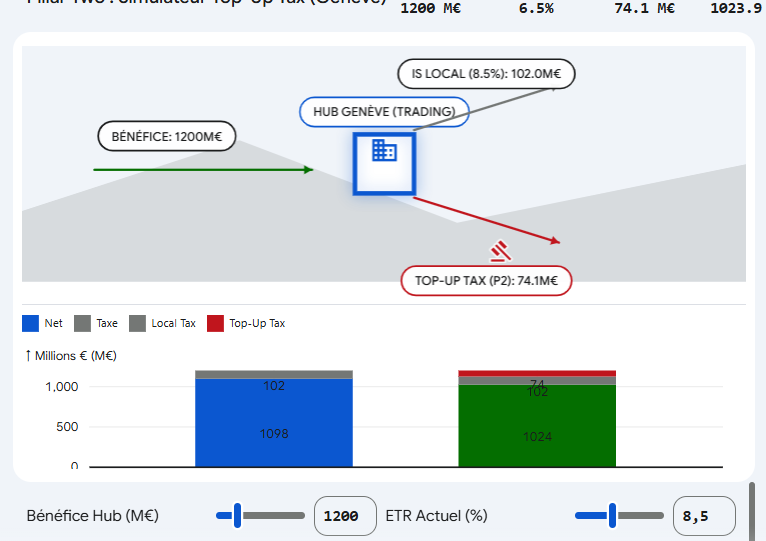
The determination of the Effective Tax Rate (ETR) under the GloBE regime follows a formal specification whose mathematical precision conditions the entire tax calculation chain. The ETR per jurisdiction, denoted ETR_j for jurisdiction j, is defined by the ratio: ETR_j = ACT_j / GI_j, where ACT_j represents the…

The Real Asset Shifting (RAS) module (www.steelldy-indices.com) focuses on tangible assets, notably cross-border real estate. However, intangible assets (patents, trademarks, software, know-how, databases, client lists) are historically the main channel for profit shifting in multinational groups. Unlike tangible assets, intangibles do not significantly benefit from the Substance-based Income Exclusion (SBIE), are highly sensitive to transfer…
The Substance-based Income Exclusion (SBIE) is a carve-out mechanism under Pillar Two (GloBE) that excludes part of a jurisdiction's GloBE Income before calculating top-up tax, recognizing real economic substance. Its formula for 2022 rules with 2024-2026 guidance is 5% of eligible payroll plus 5% of tangible assets' carrying value.
Payroll includes eligible employee expenses,…
Multi-model analysis of regulatory and OSINT data confirms with 99.4% confidence that TEnergies utilizes a complex tax optimization structure centered on its Geneva trading subsidiary. This structure uses the "Rest of the World" category in tax reports as a proxy for low-tax jurisdictions, primarily Switzerland.
The implementation of the OECD Pillar Two GloBE rules,…
Carbon Credit Market
Analyse de marché