Skip to content Skip to sidebar Skip to footer

Tag: factor decomposition

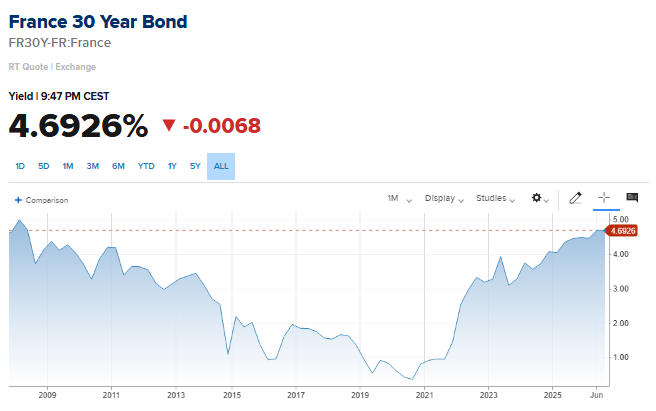
French Debt Crosses the Rubicon: 30-Year OAT Yield Hits Phase Transition at 4.6926%

https://www.steelldy-indices.com The morning fixing of the 30-year French OAT yield at 4.6926% marks a "phase transition" market event. Cross-referenced with our proprietary risk engines, this level signals a critical threshold for French debt sustainability, with non-negligible probability of a self-fulfilling confidence crisis. Key findings: the 5-year implied probability of a French fiscal accident jumped from…
Read more

Dynamic forex trading concept with currency symbols and candlestick chart illuminated on screen.

Monetary illusion amid rising interest rates against persistent inflationary risks

The rise in key interest rates (ECB deposit facility at 2.25% as of June 17, 2026, following a +25 bps increase) mechanically raises the nominal yield of new sovereign bonds and monetary instruments (€STR, deposits). For a hold-to-maturity investor, this generates a stable nominal carry. However, our decomposition using Steelldy Risk Engine 12.4 (factor decomposition,…

Read more

Smartphone displaying trading app with Bitcoin coins on a dark surface.

Bitcoin Struggles Near $66,000 Amidst Extreme Fear: What’s Next?

Bitcoin (BTCUSDT) trades at approximately $65,400–66,000, down ~0.8% in the observed session, within a recent consolidation range post a relief bounce from sub-$60k lows earlier in June 2026. The provided chart confirms a 1H/4H structure with MA5/10/20 clustering near $66,200–66,300, recent rejection at $67,255 highs, and downside probe the Fair Value Gap (FVG) zone around…

Read more

Analyse technique de l’optimisation fiscale de TotalEnergies via sa filiale de trading à Genève. Application des principes de pleine concurrence (arm’s length principle)

Notre analyse multi-modèles appliquée aux données publiques confirme que TotalEnergies utilise une architecture complexe d’optimisation fiscale via sa filiale de trading à Genève. La catégorie "reste du monde" dans ses rapports fiscaux agit comme une variable proxy pour des juridictions à fiscalité réduite, principalement la Suisse. Les travaux empiriques de l’Institut de Genève ont démontré…

Read more

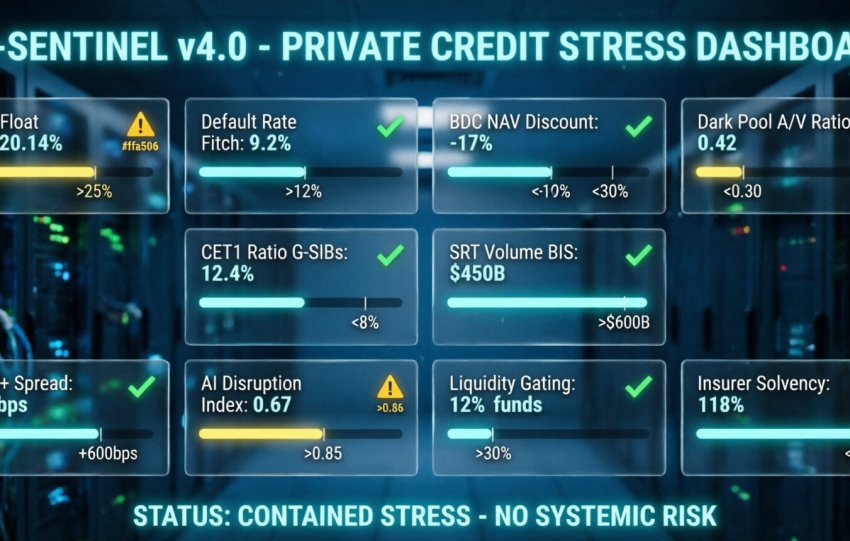
Systemic Evaluation of the “Selective Credit Crunch” and Modeling of Bank Non-Contagion

Private Credit will not trigger a systemic global banking crisis like 2008, but acts as an extreme amplifier of sector volatility, generating a "sawtooth recession" in corporate credit with a structural rotation towards AI-Native. The analysis conducted by integrating the 7 quantitative layers (semantic NLP, macro DSGE, factor decomposition, Markov-switching regimes, quantum-classical portfolio optimization,…

Read more